
Same-day & Next-day Delivery

Quality Guaranteed

Unlock Your Welcome Offers: FREE Delivery | Up to 80% OFF | Free 30-day JoyPlus trial
Download the APP
A well-organised garage, cellar, or workshop is the key to an efficient and safe workspace. But when it comes time to choose a storage solution, it can quickly become a headache. Faced with a jungle of options, it's easy to fall into the usual traps and end up with a purchase you immediately regret. As a layout and organisation specialist, my mission is to help you see things more clearly by decoding the marketing jargon to focus on what truly matters.
Before you get started, here are the three mistakes you must avoid:
To ensure you invest in a storage rack that will stand the test of time, a few technical points need to be checked. These are the details that make all the difference between a reliable product and a future source of frustration.
The true measure of sturdiness isn't the advertised total capacity, but the maximum load supported by each shelf. This is the indicator that tells you what you can actually store. For heavy tools, mechanical parts, or stacks of canned goods, aim for at least 120 kg per level.
The frame should be made of sufficiently thick steel. Also, check for reinforcement crossbars under the widest shelves to prevent them from warping. Finally, an included anti-tip kit is a non-negotiable safety feature, especially for taller models.
Garages and workshops are often damp environments. It is therefore imperative to choose a steel structure protected against corrosion. Two options are common:
The shelves are most often made of MDF (Medium-Density Fibreboard). Their thickness is an excellent indicator of strength: panels of 5 mm or more will hold up much better to heavy loads and moderate humidity.
Modular shelving offers highly valuable flexibility. Good models allow you to adjust the height of the shelves, often in increments of a few centimetres, to accommodate objects of all sizes.
Some shelving units can even be split into two identical, shorter modules. This clever feature allows you to create a workbench with storage space underneath—an ultra-practical configuration for a workshop.
Rather than an endless list, we have selected products that meet specific needs while adhering to our criteria for sturdiness and practicality.
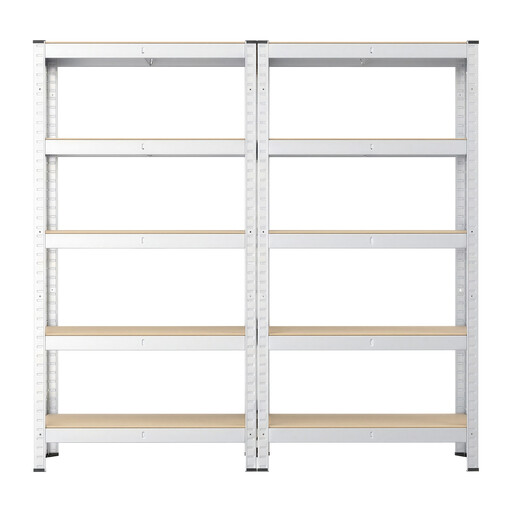
Why we chose it: This set of two is the ideal starting point for organising a standard-sized garage or cellar. It offers a generous amount of storage space at an affordable price point, without compromising on the essential sturdiness needed for initial equipment.
The load capacity is clearly stated as 130 kg per shelf, a realistic and reliable value for most household uses. Its steel structure and modularity (convertible into a workbench) set it far apart from low-end, inflexible products.
The two-pack format offers great layout flexibility and an unbeatable price-per-area ratio for outfitting an entire room at once.
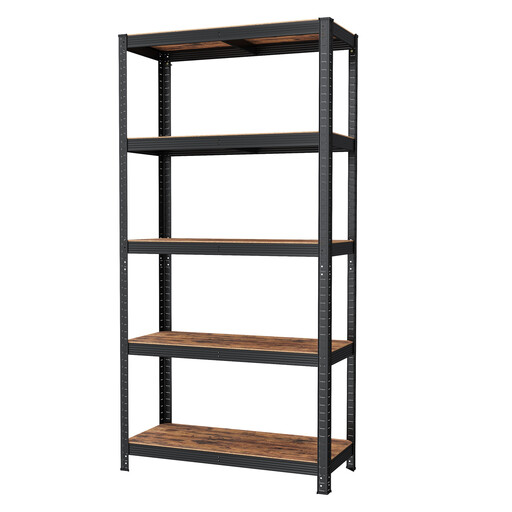
Why we chose it: For professionals, expert DIYers, or anyone storing truly heavy equipment (engines, anvils, large tool chests), load capacity is the number one criterion. This model is built to handle the most demanding loads.
It tackles the problem of inflated capacity head-on with a true rating of 175 kg per shelf. Its powder-coated steel frame is designed to last, even in the demanding environment of a workshop.
Its per-shelf load capacity is one of the highest on the market in this segment, allowing you to store your heaviest and densest items with complete peace of mind.
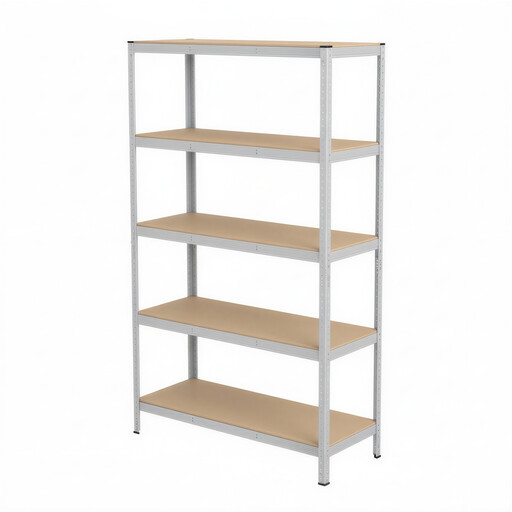
Why we chose it: When you need to store bulky items (tyres, trunks, moving boxes), width and depth matter just as much as load capacity. This XXL model is perfect for optimising large spaces.
At 120 cm wide and 60 cm deep, it provides a stable and spacious base that prevents bulky items from dangerously overhanging. Its 150 kg per-shelf capacity ensures you can use all that volume safely.
Its XXL dimensions (200 x 120 x 60 cm) make it the perfect solution for lining a large wall and storing everything that won't fit on a standard shelf.
Browse our complete selection of products, all verified for their quality and compliance with safety standards.
The lifespan of a metal shelf depends primarily on the quality of its anti-corrosion treatment and its environment. A galvanised or powder-coated steel model, used in a dry garage while respecting the maximum load, can easily last over 10 years. However, in a very damp cellar, rust will more quickly attack contact points and scratches.
Most heavy-duty models come with an anti-tip kit. This consists of one or two brackets (or straps) to be screwed to the top of the frame and into the wall. Using this kit is essential to eliminate any risk of tipping, especially if children are present or if the shelf is heavily loaded at the top. Be sure to use wall plugs and screws appropriate for your wall type (plasterboard, brick, concrete).
Absolutely, this is one of the major advantages of modular shelving models. The structure is often designed to be assembled either as a tall column (e.g., 180 cm) or as two separate low modules (each 90 cm high). This allows you to create two small storage racks or even two very sturdy workbenches, offering incredible versatility for organising a workshop.