
Same-day & Next-day Delivery

Quality Guaranteed

Unlock Your Welcome Offers: FREE Delivery | Up to 80% OFF | Free 30-day JoyPlus trial
Download the APP
Switching from plastic to glass for food storage is a smart move for a healthier, more sustainable lifestyle. But be wary of the common pitfalls: the glass food container that leaks in your bag, the dish that cracks coming out of the oven, or the lid that warps in the dishwasher. The transition to glass can quickly become a headache.
To ensure your smart investment doesn't turn into a regret, you need to see through the marketing hype and focus on what truly matters. Here are the key points to check to make the right choice.
The "Airtight" Myth: Many containers are marketed as "?airtight,?" but not all seals are created equal. A flimsy locking system or a poor-quality silicone gasket can lead to leaks, making the container useless for transporting soups or saucy dishes. It's a disaster when you were counting on your glass lunch container for your office meal.
Confusion Over Oven Safety: The "?oven-safe?" claim is often highlighted, but it hides a critical technical detail. A glass dish with a lid made from soda-lime (tempered) glass cannot withstand significant thermal shock, unlike borosilicate glass. The risk? Your dish cracking when you move it from the fridge to a preheated oven.
The Lid: The Weak Link: We choose glass for its safety and neutrality, but often forget about the lid. A low-quality plastic lid can warp with heat, stain, retain odours, and, more concerningly, contain bisphenol A (BPA). A great airtight food container must be flawless from top to bottom, and that includes the lid.
To make the right choice, focus on three technical factors that guarantee the quality and versatility of your container.
The quality of a glass container depends first and foremost on its composition.
A high-performance lid is essential. Check two elements:
Finally, for complete peace of mind, check that the lid and gasket are clearly marked as BPA-free.
The convenience of a glass container lies in its ability to adapt to your daily routine. Before buying, confirm that it is:
A container that checks all these boxes will simplify your life, from meal prep and storing leftovers to cleanup.
Here are a few options that meet specific needs, taking into account the quality and safety criteria we've just covered.

Why we chose it: With its 630 ml capacity, this container is the ideal size for a single lunch portion. Its rectangular shape and clip-locking system make it a reliable partner for daily transport to the office or on the go.
The four-clip locking system and silicone gasket ensure a rock-solid seal (pitfall #1). The borosilicate glass allows you to safely reheat your meal in the microwave (pitfall #2).
Its excellent versatility (freezer, microwave, dishwasher-safe) and compact size make it an all-in-one solution for preparing and transporting meals.

Why we chose it: Its large 2-litre capacity is perfect for storing leftovers from a family meal, preparing a casserole, or keeping a large mixed salad. It's the ideal format for optimising fridge space.
Made from borosilicate glass, it withstands temperature changes of up to 200°C. This means you can put it in the oven straight from the fridge (pitfall #2). Its BPA-free lid is a major health benefit (pitfall #3).
Its generous 2L volume allows you to cook, store, and serve all in the same dish, greatly simplifying family meal organisation.
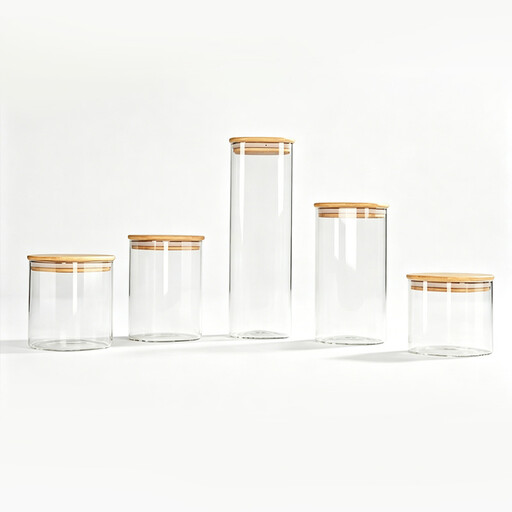
Why we chose it: This set is designed for those who want to organise their pantry with style. These jars are perfect for storing dry goods (cereal, pasta, rice, legumes) while adding a decorative touch to the kitchen.
Designed for dry foods, each jar features a silicone gasket that effectively protects against moisture, avoiding the pitfall of non-airtight lids that compromise preservation.
The set of five different sizes (from 750 ml to 2300 ml) allows you to create a cohesive and visually harmonious storage system for all your dry goods.
If you'd like to explore other formats, such as bottles for homemade drinks or oils, we've compiled a complete list of products that meet our strict selection criteria.
Even with borosilicate glass, it's best to avoid extreme thermal shock. Let your dish cool to room temperature for a few minutes before placing it in the refrigerator or freezer. This will extend the life of your container.
To prevent odours and mould, remove the gasket from the lid at least once a week. Wash it with hot, soapy water or let it soak in a mixture of water and white vinegar. Make sure it is completely dry before putting it back in place.
Glass itself is an inert material and never contains BPA. The plastic lid and its gasket are what you need to watch out for. Always check for the "?BPA-Free?" label on the packaging or product description to ensure 100% food-safe contact.