
Livraison le jour même ou le lendemain

Qualité garantie

Débloquez vos offres de bienvenue: Livraison GRATUITE | Jusqu'à -80 % | 30 jours d'essai gratuits à JoyPlus
Téléchargez l'application
Whether you're short on space, dealing with overflowing closets, or need to store seasonal clothing, a garment rack on wheels is the ultimate flexible and practical storage solution. However, the market is saturated with models that make enticing promises but often disappoint in practice. To prevent a promising purchase from becoming just another piece of clutter, it's crucial to know the most common traps.
As a Product Expert at Joybuy, my mission is to help you see clearly. Let's cut through the marketing jargon and focus on the facts. Here are the three most frequent mistakes made when buying a mobile wardrobe and, more importantly, how to avoid them.
To avoid falling into these traps, a few technical checks are necessary. These details make all the difference between a purchase you'll regret and a long-lasting investment.
Rather than trusting vague terms like "heavy-duty," look for the maximum static load capacity. This value, expressed in kilograms, indicates the total weight the rack can support when stationary.
The durability of a closet rack depends on its materials. Opt for all-steel structures, including the connecting bars. Models with plastic connectors are consistently the weakest link. The diameter of the tubes is also a good indicator: thicker tubes ensure better resistance to bending. A well-designed clothing rail on wheels must have a wide, stable base to prevent tipping.
An adjustable wardrobe rack is a major asset: it allows you to hang long dresses or coats without them dragging on the floor. An extendable-width model adapts to your volume of clothes and available space. Also, consider additional storage options: a double-rod rack optimises vertical hanging space, while a bottom shelf is perfect for shoes, boxes, or bags.
Every home and every wardrobe has its own constraints. Here are a few options that cater to distinct user profiles, taking into account durability and practicality.
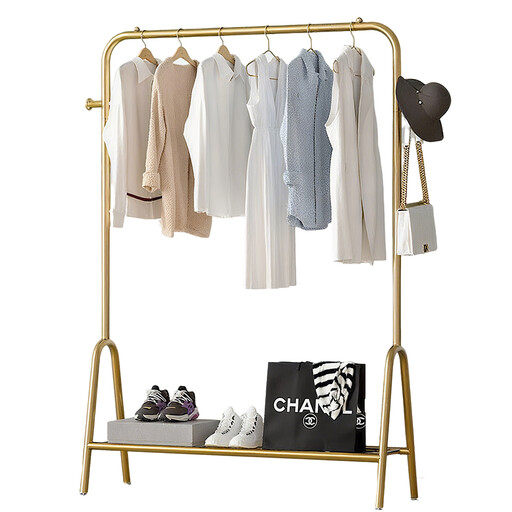
Why we chose it: Perfect for a bedroom or entryway where aesthetics matter as much as practicality. Its sleek structure and refined finish make it a true decorative piece, ideal as a secondary rack for daily outfits or for holding guests' coats.
Its fixed, freestanding coat rack design prioritises stability above all. By not trying to be modular, it guarantees excellent rigidity for its intended use.
Its clean design and small footprint make it the perfect solution for studio apartments or as a decorative open wardrobe.
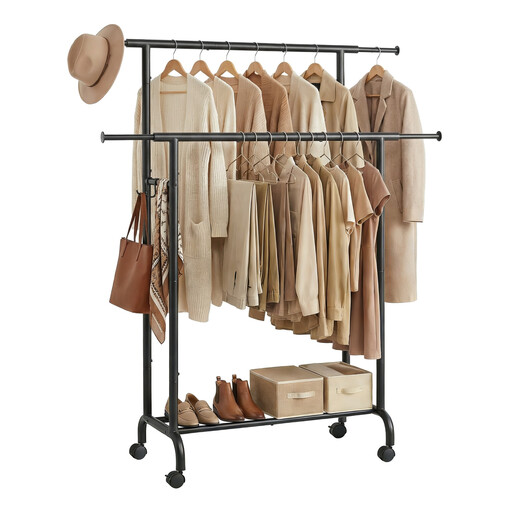
Why we chose it: The perfect solution for couples, roommates, or for separating work attire from casual wear. The double-rod format optimises vertical space and simplifies organisation, all on a sturdy, mobile frame.
It tackles the sturdiness trap head-on with a verified load capacity of 80 kg and an all-metal frame. Its swivel casters with brakes prevent accidental movement and protect your floors.
Its double rod maximises storage capacity, while the bottom bars are perfect for shoes or boxes.
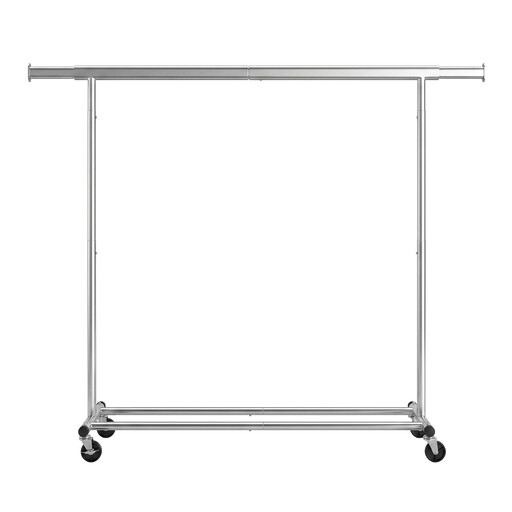
Why we chose it: For those who refuse to compromise on strength. Perfect for storing an entire seasonal wardrobe, heavy sports equipment, or for use as a secondary closet in a laundry room. Its capacity and design make it a nearly permanent storage solution that still retains the flexibility of wheels.
It shatters the capacity benchmark with a stated static load of 150 kg. Its 100% steel structure and reinforced casters are designed to handle a very heavy load without buckling, deforming, or becoming unstable.
Exceptional load capacity and an extendable top rod for even more space.
Explore our full selection of garment racks that meet our standards for quality and durability.
Its longevity depends almost exclusively on its materials. A model with plastic connectors will show signs of weakness in less than a year with regular use. Conversely, a heavy-duty garment rack with a 100% steel frame can last for years, provided you don't exceed its maximum load capacity.
Check the caster material before buying. Wheels made of rubber or soft polypropylene (PP) are much gentler on delicate floors than those made of hard ABS plastic. Also, look for models with brakes on at least two of the four casters; this is essential for immobilising the rack and preventing accidental movements that could scratch the floor.
Not necessarily. Stability doesn't depend on the number of rods, but on the base design (width, weight) and the rigidity of the uprights. A well-designed double-rod rack with a wide base and quality materials will be perfectly stable. In contrast, a poorly made single-rod model could tip over in a slight breeze. Always compare the base dimensions and the quality of the materials.