
Livraison le jour même ou le lendemain

Qualité garantie

Débloquez vos offres de bienvenue: Livraison GRATUITE | Jusqu'à -80 % | 30 jours d'essai gratuits à JoyPlus
Téléchargez l'application
A clothes airer needs to meet a simple requirement: dry a certain amount of washing without taking up space in the room permanently. Yet some models disappoint from the very first use. An unstable frame, a stated capacity with no explanation or awkward castors can quickly turn a solution that should make everyday life easier into a hassle to handle.
Here are the main things to check before choosing a folding clothes airer, a large-capacity model or a clothes airer on castors.
A large drying area doesn’t necessarily mean the airer can hold several loads of washing. Instead, look at the number and arrangement of levels, the space between the rails and whether the wings or side arms can be extended. Rails that are too close together restrict airflow and mean you have to space clothes further apart, reducing the usable capacity.
The folded dimensions are useful for storage, but the dimensions when the airer is open determine how practical it is day to day. In a flat, measure the width of doorways, the space around your sofa and the room available by a window or radiator. An XXL clothes airer could be ideal for a family, but difficult to fit into a small bathroom.
Castors make it easier to move an airer that can be used indoors or outdoors, but their quality matters just as much as their number. Check whether it has brakes, how the castors are positioned and how stable the feet are. A mobile model should be easy to move even when loaded, then stay firmly in place on tiled or slightly uneven floors.
A compact clothes airer with two or three levels may be enough for one person or a couple. A larger family would be better off choosing a large-capacity clothes airer with several tiers, extendable rails and hanger holders.
Take the maximum load with a pinch of salt: it usually refers to the total weight spread across the whole frame, not the weight a single rail can hold. Wet washing is heavy, so spread towels, jeans and sheets across several levels to reduce strain and keep the airer stable.
Steel, aluminium and stainless steel each have different benefits. Aluminium is lightweight and offers good resistance to oxidation, while steel is often more rigid. If you plan to use your airer on a balcony or patio, choose surfaces that can withstand moisture and wipe down the frame after prolonged exposure to rain.
A corrosion-resistant coating doesn’t mean you can ignore the manufacturer’s instructions. Plastic parts also deserve a careful check, as they often connect the uprights to the rails.
A clothes airer with wings gives you more drying space without needing to fix anything to the wall. An extendable model lets you adjust the length to suit the room and the amount of washing. In a rented home, a wall-mounted airer with a suction-cup system can help you avoid drilling into the walls, provided you stick to the stated weight limit and fit it to a clean, smooth, compatible surface.
Handles, swivel castors and locking systems make an airer easier to use every day. Finally, a folded thickness of less than 10 to 13 cm makes it easier to store behind a door or in a cupboard.
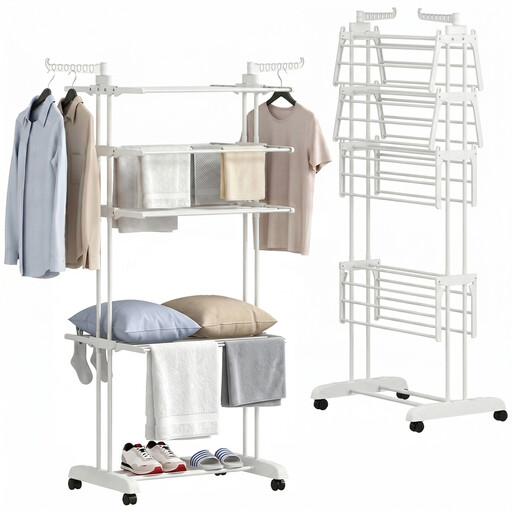
Why it suits this type of user : This folding clothes airer is ideal for everyday use and homes where easy storage matters. Its four castors make it easy to move between the bedroom, bathroom and balcony.
Its folding wings and multi-tier design stop you having to cram everything onto a single rail. When folded, the airer can be stored against a wall.
Steel and PP frame, eight folding wings, two hanger arms and a stated load capacity of up to 55 kg.
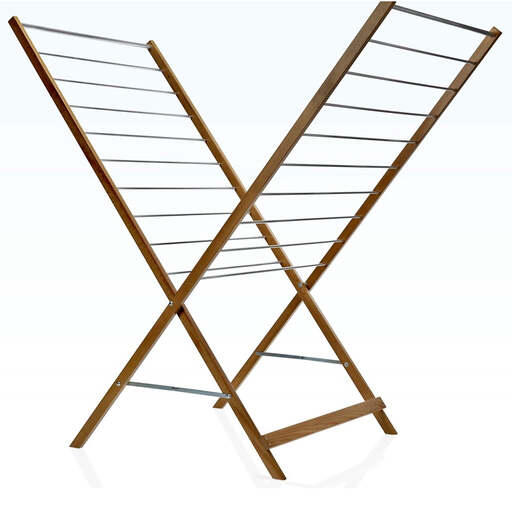
Why it suits this type of user : The combination of pine and aluminium rails blends easily into a home where the airer may sometimes be on show. Its X-shaped design is particularly well suited to flats and multi-purpose rooms.
It folds flat to save space, while the non-slip feet help prevent it from moving unintentionally across the floor.
Ten metres of drying space, a pine frame, aluminium rails and no assembly required.
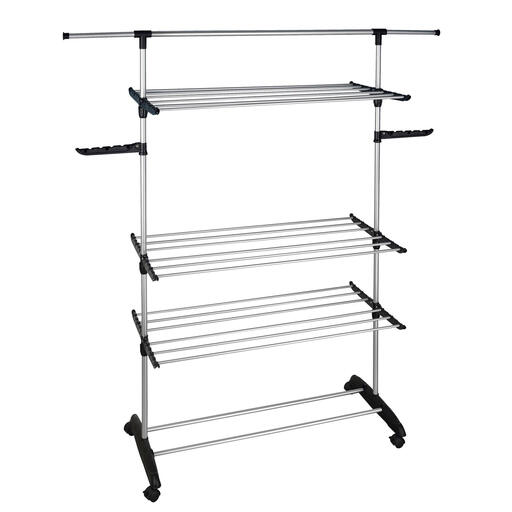
Why it suits this type of user : Families who do load after load of washing get three levels, extendable rails and space for sheets and bulky textiles.
The drying space, stated to be equivalent to three loads, is spread across several configurations, helping you avoid overloading a single area.
Four swivel castors, an anti-sway system and folds down to around 10 cm thick.
We’ve put together a comprehensive list, updated in real time, of products that meet these strict selection criteria and European safety regulations.
Fully open the legs, lock the wings in place and distribute the washing evenly. Put heavier items on the lower levels and leave enough space between clothes. On a balcony, avoid exposed spots where gusts of wind can catch the airer, and check the castors are stable regularly.
Its lifespan depends on the material, the load it carries over time and how much moisture it is exposed to. Wipe the rails after outdoor use, don’t exceed the stated weight limit and check the screws, joints and non-slip end caps regularly. Folding it without forcing the frame also helps it last longer.
A standard clothes airer doesn’t use electricity. The cost of using one mainly depends on how much space it takes up and how much maintenance it needs. To speed up drying without using a heated appliance, improve the room’s ventilation, spin the washing properly and avoid hanging clothes too close together.