
Livraison le jour même ou le lendemain

Qualité garantie

Débloquez vos offres de bienvenue: Livraison GRATUITE | Jusqu'à -80 % | 30 jours d'essai gratuits à JoyPlus
Téléchargez l'application
A clothes rail can help declutter a bedroom, bring order to a utility room or make it easier to organise a hallway. But choosing the right model is essential: some quickly become bulky, wobbly or awkward to move. Looks aren’t everything.
Before placing your order, check the load capacity, the space you actually have available and the quality of the moving parts. Here are the key criteria to review to avoid unpleasant surprises, along with a selection of models suited to different needs.
A high maximum load does not necessarily guarantee good stability in every situation. A clothes rail filled with thick coats puts far more strain on the rail and base than a model intended for a few shirts.
Pay particular attention to:
For intensive use, a sturdy clothes rail should remain stable when clothes are distributed along the full length of the rail, rather than gathered in the middle.
An extendable clothes rail, also known as a telescopic clothes rail, allows you to adjust the width. However, this flexibility can affect the overall balance. Measure the available space before and after extending it, leaving enough room to open a door, move around or pull out a drawer.
Height also deserves your attention. A rail positioned at around 160 cm suits most hanging clothes, but long coats may require more clearance beneath the rail.
Tool-free assembly is convenient, but you should still check that every part is properly fitted and that the screws, connectors and castors are securely attached. For a hallway unit with a bench, the anti-tip kit should be installed according to the instructions, especially if there are children in your household.
Never exceed the load recommended by the manufacturer. You should also place the clothes rail on a level floor, away from heat sources and prolonged exposure to moisture.
For a few everyday garments, a simple metal frame may be enough. For a coat rack, mobile wardrobe or professional use, look for a clearly stated capacity and check whether it refers to the total static load or the capacity of a single rail.
Steel generally provides a frame suitable for heavier loads. Castors made from PP or an equivalent material make moving the rail easier, provided they are wide enough and, where possible, fitted with brakes. An industrial clothes rail can work well in a utility room, dressing room or storage area, as long as you stay within the specified limits.
Measure the available space in width, depth and height. A compact model can fit into a small bedroom, while a clothes rail with shelves requires more clearance. Also consider the space needed to remove hangers without knocking them against a wall.
The dimensions given in product listings are therefore particularly useful. Some models on castors are approximately 45 cm deep and extend from 92 to 132 cm, while others reach 160 to 200 cm in width.
A simple rail is enough for hanging clothes, but shelves, lower rails or hooks help you organise accessories, boxes, shoes and bags more effectively. In a hallway, a hallway clothes rail with shoe bench combines several functions, but naturally takes up more space than a simple rail.
Set your priorities: mobility, high capacity, storage for folded laundry, seating or seamless integration into the room.
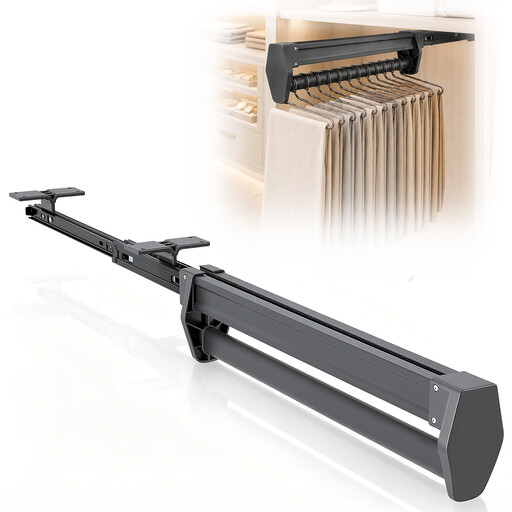
Why this choice suits this type of user : Its telescopic design is ideal if you want a simple solution for a wardrobe or cupboard without installing a large piece of furniture.
The extendable rail adapts the hanging space to the amount of clothing, rather than permanently taking up the full available width.
A steel frame and extendable design for organising clothes in a limited space.
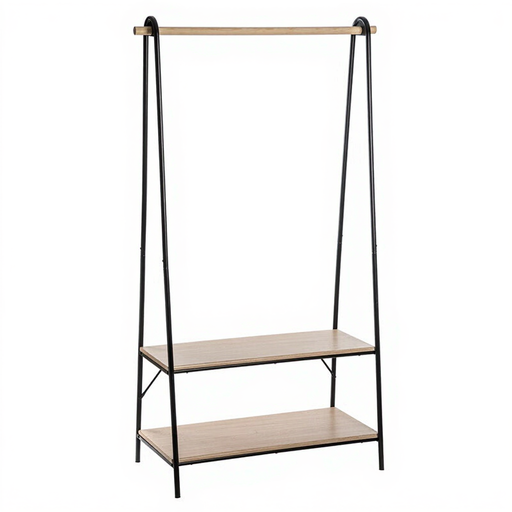
Why this choice suits this type of user : This model combines a steel frame, wooden elements and dedicated space for folded clothes, shoes and accessories.
The two shelves prevent all the weight from resting on a single rail and make it easier to distribute heavier or folded items.
A 120.5 cm rail, two MDF shelves and an advertised load capacity of 40 kg ; assembly takes approximately 30 minutes.
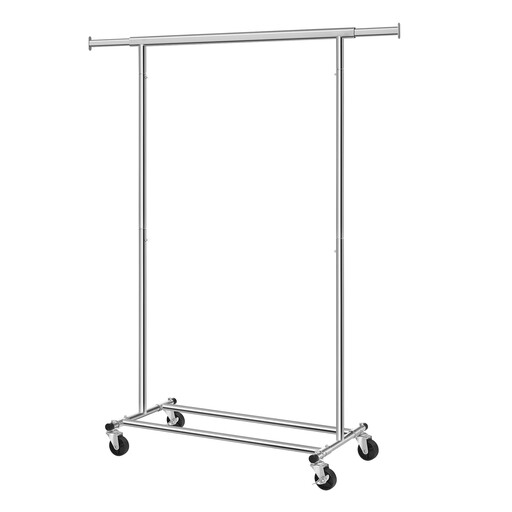
Why this choice suits this type of user : Its castors, extendable rail and lower rails make it a practical choice for a utility room, dressing room or frequent movement from one room to another.
The four swivel castors, two of which have brakes, help prevent unwanted movement when the rail is loaded.
Adjustable width from 92 to 132 cm, an advertised total static load of 100 kg and tool-free assembly.
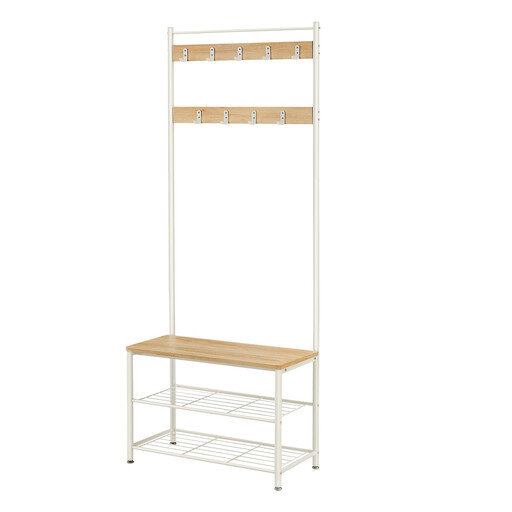
Why this choice suits this type of user : This hallway unit with shoe bench combines hooks, seating and storage in a 32 × 70 × 177 cm structure.
The adjustable feet and anti-tip kit address the stability issues that are common in a busy hallway.
Nine hooks, each supporting up to 3 kg, a bench supporting up to 136 kg and shelves designed to hold 10 kg each.
Place it on a level floor, distribute the clothes along the full length of the rail and lock the castors fitted with brakes. Avoid gathering coats at one end. If the model has an anti-tip system, secure it to the wall according to the manufacturer’s instructions.
It depends on what you intend to hang on it. A few shirts and pairs of trousers represent a moderate load, while a collection of thick coats can quickly become heavy. Compare the advertised static load with your intended use, and never exceed the limit specified for the frame, shelves, hooks or bench.
Its lifespan depends on the quality of the materials, how often it is moved, exposure to moisture and whether the maximum load is respected. Regular cleaning, keeping the castors clear and checking the assembly can help preserve the frame for longer. For a utility room or balcony, choose a model whose materials and conditions of use are clearly specified.