
Livraison le jour même ou le lendemain

Qualité garantie

Débloquez vos offres de bienvenue: Livraison GRATUITE | Jusqu'à -80 % | 30 jours d'essai gratuits à JoyPlus
Téléchargez l'application
Whether you're reaching for a jar on the top shelf, changing a lightbulb, or dusting a bookshelf, the folding step stool is an essential everyday tool. However, finding the right model isn't as simple as it seems. Caught between promises of compactness and claims of safety, it's easy to end up with a product that's wobbly, bulky, or non-durable.
To avoid buyer's remorse, let's review the 3 most common pitfalls:
To avoid these unpleasant surprises, it's crucial to focus on a few key technical criteria.
Judging a folding step stool by its appearance is a mistake. A few technical specifications are all you need to assess its safety and everyday usability.
There can be no compromise on safety. The first indicator is the maximum supported load, expressed in kilograms. A capacity of 150?kg is a reliable standard that ensures excellent sturdiness for most adults.
The locking system is just as crucial. Some models lock automatically upon opening to prevent accidental folding, while others require manual locking. Make sure the mechanism is easy to operate and visibly reliable.
Finally, a truly non-slip step stool is identified by two things:
A folding stepladder marketed as "compact" must actually be compact. Always check its dimensions when folded, especially its thickness. A model less than 5?cm thick will easily slide into the narrowest of spaces.
The choice of material directly impacts weight and durability:
It all depends on your needs: a plastic step stool for grabbing a book, or a steel 2-step ladder for more demanding tasks.
There's a step stool for every need. Here is a selection of models suited for different profiles, all evaluated based on our criteria for safety and practicality.
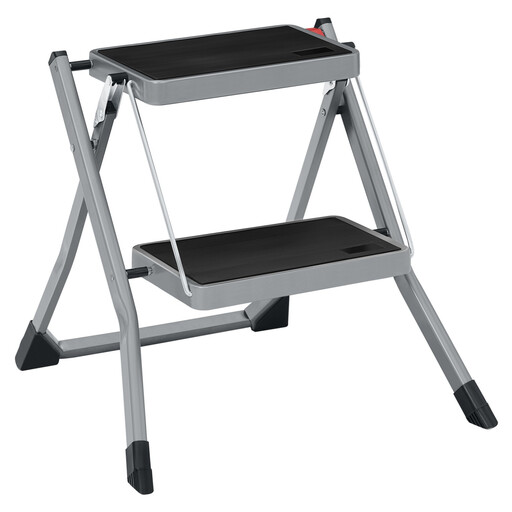
The profile: Perfect for apartments or small spaces. Its steel frame offers great stability for common household tasks (like reaching high kitchen cabinets), while being incredibly easy to store.
At only 4.5 cm thick when folded, it sidesteps the "deceptively bulky" trap. Its robust steel frame and automatic lock eliminate any risk of instability.
Stability and compactness: Supports 150 kg and folds flat. Maximum safety: Non-slip steps and feet, rounded corners.
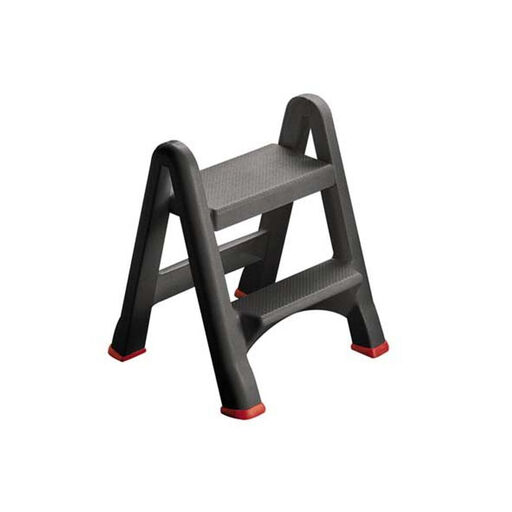
The profile: For those seeking a reliable product for regular use, from DIY projects to gardening. The Curver brand reputation and its proven design make it a durable investment.
The 5-year manufacturer's warranty is the best antidote to the disposable product trap. Its proven design guarantees flawless stability up to 150 kg.
Reliable design: A time-tested design for safe use. Easy storage: Its folding mechanism makes it very compact.
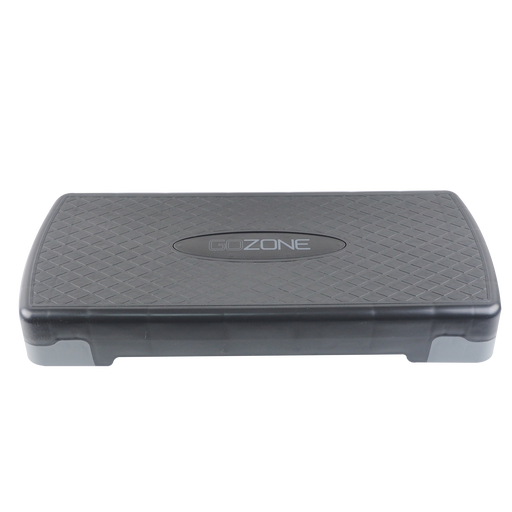
The profile: A surprising alternative for those who need a single, extremely stable, and versatile step. Perfect as a low, wide step to access a high bed, assist a person with reduced mobility, or even for fitness exercises.
Its wide, low base eliminates any risk of tipping over. Designed for fitness, its surface offers maximum grip, thus avoiding the pitfall of slippery surfaces.
Exceptional stability: Wide, non-slip platform supporting over 180 kg. Adjustable height: Adapts to your needs (10 or 15 cm).
We have put together a complete selection of products that meet our selection criteria and current safety standards.
Although often confused, a step stool refers to a small folding stool with one or two steps, designed for reaching low heights. A stepladder, on the other hand, is taller (usually 3 steps or more) and may include a platform or a handrail. For typical home use, a two-step stool is often ideal.
Before climbing, unfold it completely. If it has an automatic lock, you should hear a distinct "click." Apply light pressure on it to check that it doesn't fold back. On a model with a manual lock, verify that the safety latch is securely engaged. And of course, always place it on a flat, stable surface.
To reach the high cabinets in a standard kitchen (located about 2.20?m from the floor), a two-step stool is almost always sufficient. It raises you by 40 to 50?cm, allowing a person of average height to effortlessly access the highest shelves.