
Livraison le jour même ou le lendemain

Qualité garantie

Débloquez vos offres de bienvenue: Livraison GRATUITE | Jusqu'à -80 % | 30 jours d'essai gratuits à JoyPlus
Téléchargez l'application
Reaching a shelf, changing a light bulb or cleaning the top of a cupboard does not necessarily require a full-size ladder. A well-chosen folding step ladder makes these tasks easier and can be stored neatly in a cupboard or behind a door. The key is knowing how to distinguish genuinely useful features from vague marketing claims.
A maximum load of 150 kg is the static limit stated by the manufacturer. On its own, this does not guarantee that the step ladder will remain stable on every type of flooring. Safety also depends on the width of the base, the condition of the feet, the locking mechanism and the way you climb onto it.
Before every use, place the step ladder on a flat, dry and clear surface. Avoid thick rugs, damp floors and uneven surfaces.
A three-step ladder will generally let you reach higher than a two-step model, but it may also take up more space when unfolded. For changing a light bulb or reaching low cupboards, a two-step folding step stool may be more than sufficient. For reaching walls, curtains or high storage areas, three steps provide greater reach.
Never stand on the handle, on a platform that is not designed for standing on or on the top step if the instructions prohibit it.
A model advertised as “space-saving” should primarily be assessed when folded away. Check its depth, width and thickness to see whether it can fit under a bed, in a cupboard or behind a door. A compact step ladder that is awkward to handle every day may end up abandoned at the back of a garage.
Steel generally provides a rigid structure, although it can make the step ladder heavier. Aluminium, on the other hand, makes it possible to choose a lightweight model that is easy to move from room to room. Models combining aluminium, steel and PP plastic can offer several benefits, but check the product details to find out exactly how they are constructed.
For regular household use, look in particular for:
Never exceed the maximum load. This generally refers to the combined weight of the user and their equipment.
A non-slip step ladder should combine a step surface that provides good grip for your feet with pads that remain firmly in contact with the floor. Ribs, textures or PP coatings can improve grip, but they do not remove the need to use the step ladder on a clean, dry surface.
Inspect the rubber pads regularly. If they are worn, cracked or missing, stop using the step ladder until they have been replaced or a repair has been carried out in accordance with the manufacturer’s instructions.
The folding system should be intuitive. An automatic locking mechanism can be convenient, provided you check visually or manually that it is properly engaged before climbing. When folding it away, keep your fingers away from the hinges to avoid trapping them.
Information about compliance, permitted uses and any applicable European standards should appear in the instructions, on the labelling or on the manufacturer’s product information. Do not assume that a product is compliant simply because it is described as “robust” or “secure”.
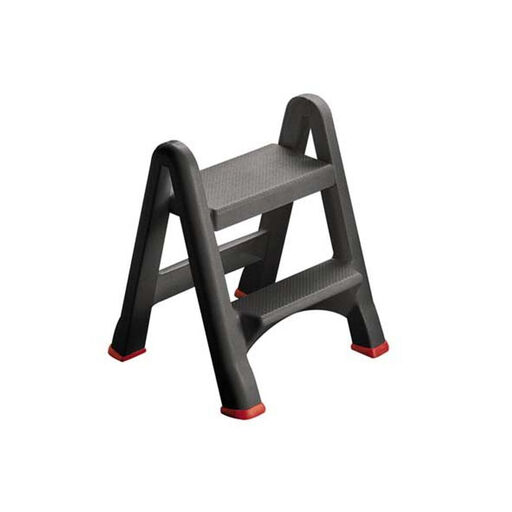
Why this choice suits this profile : This two-step folding step stool is suitable for everyday tasks and folds away neatly in a cupboard or behind a door. Its stated maximum load is 150 kg.
The product details specify the folding system, the locking mechanism to check and the presence of non-slip feet, rather than relying on a general promise of stability.
Two steps, folding structure, stated maximum load of 150 kg and a five-year manufacturer’s warranty, according to the description provided.
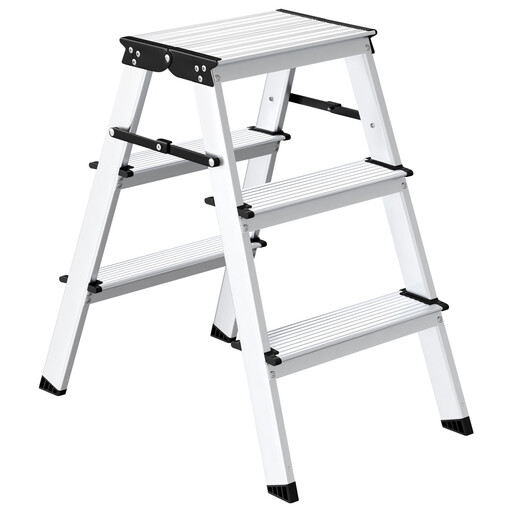
Why this choice suits this profile : With three steps and a stated net weight of 2.3 kg, this model is designed for households that need to reach higher storage areas without having to move a heavy step ladder around.
The product details set out the materials, dimensions and maximum static load. This gives you concrete data to compare, rather than a simple unverified claim.
Aluminium alloy, steel and PP, three textured steps, non-slip pads and a folded format measuring 36.6 x 59.7 x 57 cm, according to the dimensions stated in the product details.
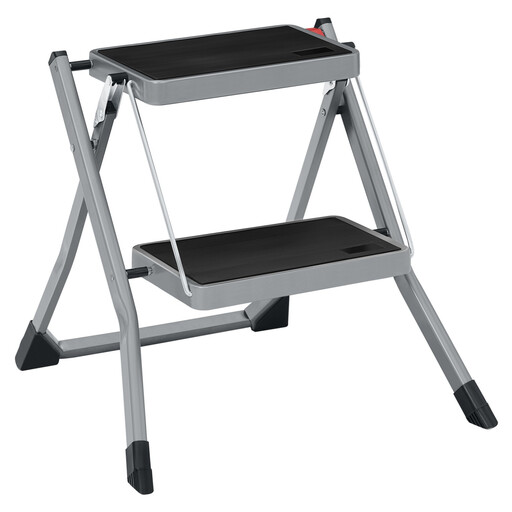
Why this choice suits this profile : Its steel frame and stated maximum load of 150 kg make it suitable for frequent household tasks, including reaching shelves, hanging curtains, decorating and cleaning.
The automatic locking mechanism should click into place when the step ladder is opened. The ribbed steps and rubber feet address two features that are often overlooked when choosing a model.
Steel frame, two non-slip steps, weight of 3.5 kg and folded dimensions of 55 x 50 x 4.5 cm for discreet storage.
Before climbing, check that all four feet are resting correctly on the floor and that the locking mechanism is properly engaged. Keep your body centred between the rails and avoid leaning to one side. To move the step ladder, climb down completely, then fold it away only once you are back on the floor.
Regular maintenance and a few precautions can help extend its service life:
These products are intended for household tasks. They are not a substitute for equipment designed for professional or industrial work.
We have compiled a complete, real-time updated list of products that fully meet these strict selection criteria and European safety regulations.
It is suitable for tasks at moderate height, such as reaching a shelf, cupboard or curtain rail. For higher ceilings or decorating work, a three-step ladder can provide extra reach. The height you can actually reach also depends on your own height and the position of the highest permitted step.
Open it fully, check that the locking mechanism is properly engaged and place it on a flat, dry, non-slip surface. The feet should be intact and in contact with the floor. Do not use the step stool if a hinge is loose or a step moves.
Its service life depends on how often it is used, the weight it supports, storage conditions and the condition of its wear parts. There is no universal lifespan that applies to every model. Inspect the pads, steps and joints regularly; any damaged part should be a reason to stop using it.