
Livraison le jour même ou le lendemain

Qualité garantie

Débloquez vos offres de bienvenue: Livraison GRATUITE | Jusqu'à -80 % | 30 jours d'essai gratuits à JoyPlus
Téléchargez l'application
Buying a folding 2-step stool? It seems simple enough. But who hasn't cursed at a wobbly model that's too bulky to store or starts creaking after just three uses? Reaching the top shelf or changing a lightbulb shouldn't turn into a high-risk mission.
As a product expert for our editorial team, my mission is to sift through the market to help you find reliable and suitable equipment. Before you make your choice, here are the common pitfalls to avoid so a practical purchase doesn't turn into a nightmare.
To avoid these disappointments, a few objective technical points make all the difference. These are the true guarantors of the quality and safety of your future folding step stool.
This is the non-negotiable criterion. A good step stool must include a solid and reliable locking system. When you unfold it, a crisp "click" should confirm that the structure is perfectly locked. Without this, the stool could fold back on you mid-use.
Also, consider the surface of the steps. A non-slip step stool is identifiable by its grooved or rubber-coated steps. Its feet must be equipped with non-slip pads for a perfect grip on all floors, from tile to hardwood.
You might think a high load capacity isn't necessary if you're lightweight. That's a mistake. The 150 kg step stool standard is above all a guarantee of structural integrity. It means the stool was designed with materials and an assembly capable of handling significant stress. Don't forget that you never climb empty-handed: a box, a can of paint, or a toolbox, and the weight adds up quickly. This 150 kg standard provides an essential safety margin for peace of mind during daily use.
The key advantage of a folding step stool is, of course, its small footprint. Before buying, check the dimensions when folded. A truly compact and lightweight model won't be more than a few centimetres thick, making it ideal for storage. This is a crucial point if you're looking for a kitchen step stool or live in an apartment. The weight is also a factor: a model that's too heavy quickly becomes a chore to move. The right balance is typically between 3 and 5 kg for a steel or aluminium model.
Keeping these criteria in mind, here are two models that meet specific needs to help you make the right choice.
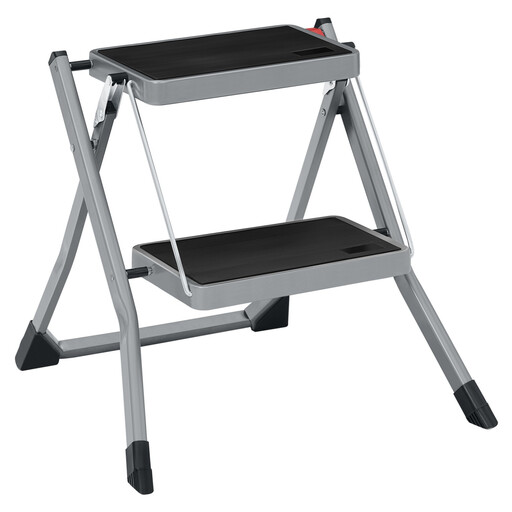
The Editor's Verdict: Perfect for those who prioritise safety above all else. Its steel frame and automatic locking system make it a trusted partner for everyday tasks and small projects where stability is non-negotiable.
Its automatic locking system eliminates any risk of accidental folding (goodbye, deceptive stability!). Its robust steel frame is built to last and stand the test of time, a far cry from materials that degrade quickly.
Supports up to 150 kg. Only 4.5 cm thick when folded—a record for compactness in a steel model. Non-slip steps and feet.
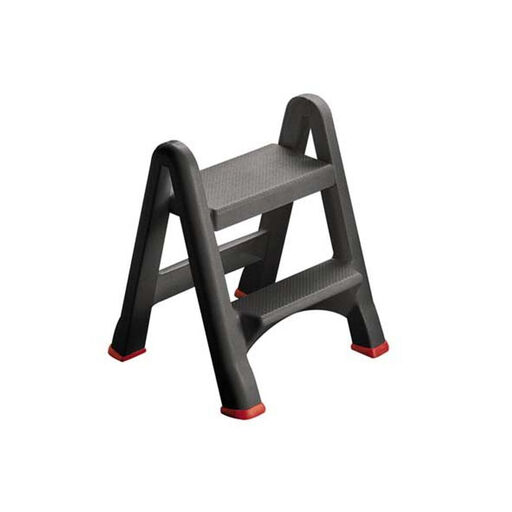
The Editor's Verdict: The perfect partner for small daily tasks in the kitchen, closet, or laundry room. Its design is all about easy handling and storage. A discreet and effective tool that knows how to stay out of the way.
Its ultra-compact design avoids the trap of the "folding" stool that's still bulky. The 5-year manufacturer's warranty is also an excellent vote of confidence in its durability.
Also supports up to 150 kg. Its mixed-material design (plastic and metal) is an excellent compromise between lightness and strength. The manufacturer's warranty is a real bonus.
Discover our complete selection of ladders, platforms, and step stools, all rigorously chosen for their safety and reliability.
Although the terms are often used interchangeably, a step stool generally refers to a small model with one or two steps and no handrail. A stepladder, on the other hand, is technically larger, with more steps, and may include a platform and a safety rail. In everyday language, for home use, a folding 2-step stool perfectly matches what we call a "step stool."
Before climbing, place the step stool on a flat surface and unfold it completely. Apply a little pressure to ensure it's stable. On good models, an audible "click" confirms the safety lock has engaged. It's a few-second habit that makes all the difference.
Yes, and it's highly recommended. This load capacity isn't just about the user's weight; it's an indicator of the overall design's robustness. A 150 kg-rated step stool means more durable materials and stronger joints. The result: greater stability and longevity, even for light tasks. It's a safety standard that gives you peace of mind.