
Livraison le jour même ou le lendemain

Qualité garantie

Débloquez vos offres de bienvenue: Livraison GRATUITE | Jusqu'à -80 % | 30 jours d'essai gratuits à JoyPlus
Téléchargez l'application
A step stool? A trivial purchase, you might think. Yet, whether you're reaching for that high shelf or changing a lightbulb, this everyday tool is what keeps you steady. The market is flooded with models, but be warned: not all are created equal. An attractive design can hide flaws that turn a simple task into an unnecessary risk. Our mission: to help you spot the most common pitfalls and make a truly informed decision.
Before you even start comparing spec sheets, let's learn to recognise the false promises and design flaws that can make a step stool not just disappointing, but dangerous.
To ensure your small step stool will be a reliable ally for years to come, here are the non-negotiable checkpoints.
Safety is the number one criterion. A reliable step stool must have several key attributes:
A folding step stool should be easy to use and store.
After scrutinizing the market based on these criteria, here are the models that caught our attention, each catering to a specific need.
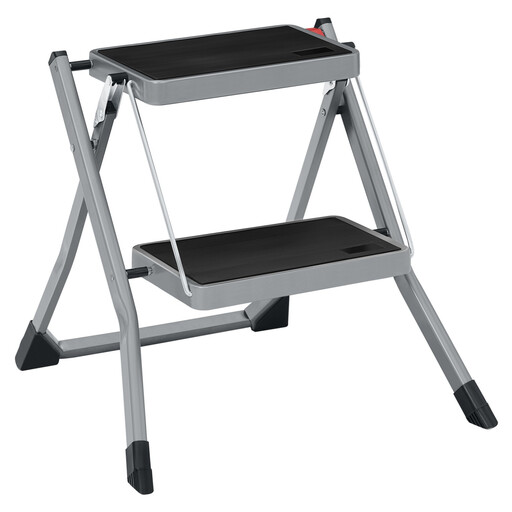
Why we chose it: Ideal for studios and apartments where every square centimetre is precious. Its ultra-slim design when folded (4.5 cm) allows it to slide in absolutely anywhere, without ever cluttering your space.
It overcomes the illusion of the flimsy, ultra-slim design. Despite its record-breaking thinness, its sturdy steel frame provides unmatched rigidity and stability compared to overly light aluminium models.
Extreme compactness (4.5 cm thick) and a manageable weight (3.5 kg) for effortless storage and handling.
Why we chose it: This is the perfect model for family use where safety is non-negotiable. Whether it's for parents or for helping kids reach the sink (with supervision), its robust design inspires complete confidence.
It doesn't fall into the trap of sacrificing stability for design. Its automatic locking system, wide ribbed steps, and thick rubber feet guarantee a perfectly stable and secure platform.
A 150 kg load capacity and a full suite of safety features (locking mechanism, non-slip feet and steps) for absolute peace of mind.
Discover our complete selection of step stools that meet our strictest safety and quality criteria.
Although the terms are often used interchangeably, a step stool generally refers to a small model with one to three steps, without a top platform or guardrail. A 2-step stool is a more specific description of this type of product. A step ladder, in the broader sense, can be taller and may be equipped with a platform and a guardrail to make working at height safer.
Without being able to test it physically, rely on the technical specifications. Check the frame material (steel is a sign of sturdiness), the explicit mention of a safety locking system, and the presence of non-slip rubber feet. The dimensions of the base (the wider, the better) and the maximum load capacity (150?kg is a good indicator) are also valuable clues.
It's a matter of trade-offs. A steel model will always be slightly heavier than an aluminium one. However, for a 2-step stool, the difference is often minimal, and the gain in stability and durability is considerable. A product like the JOYFURNOS model, at 3.5?kg, remains perfectly manageable for most adults and represents an excellent balance between robustness and ease of use.