
Same-day & Next-day Delivery

Quality Guaranteed

Unlock Your Welcome Offers: FREE Delivery | Up to 80% OFF | Free 30-day JoyPlus trial
Download the APP
Grabbing a spice jar from the top shelf, changing a lightbulb, retrieving a book from the highest part of the bookcase… for these small daily tasks, a 2-step folding stepladder is an invaluable ally. But be warned: choosing the right model is far from simple. The market is flooded with options that, beneath a practical exterior, hide flaws capable of turning a simple job into a real chore, or even a hazardous situation.
Before you decide, here are the three pitfalls to avoid at all costs:
To avoid falling into these traps, let's review the criteria that truly separate a reliable small stepladder from a gadget you'll regret after the first use.
To make the right choice, a few technical points need close inspection. They are the guarantee of your safety and ease of use.
This is the non-negotiable criterion. For domestic use, demand a model certified for a 150 kg load capacity. This standard isn't just about the user's weight; it's primarily an indicator of the structure's overall robustness. A stepladder designed to support 150 kg will better withstand repeated use and offer rock-solid stability, even when you're leaning to grab an object.
The choice of materials is just as crucial:
A good non-slip stepladder is judged on two points:
The locking mechanism is another critical point to watch. A good folding stepladder must include a safety system that locks the structure in the open position without the slightest wobble. Whether it's a manual latch or an automatic lock, it must be simple to operate and confirm it's engaged with a clear signal, most often a distinct "click".
The main advantage of a 2-step stool is its ability to disappear once its job is done. Before buying, be sure to check its thickness when folded. The slimmest models are less than 5 cm thick, allowing them to slide in anywhere: between a piece of furniture and a wall, in the back of a closet, or even under a bed. Weight is also a comfort factor: a folding step stool weighing between 3 and 5 kg can be carried from one room to another without breaking a sweat.
To help you make your choice, here are a few models that caught our eye. Each meets a specific need while adhering to the safety and practicality criteria we've just discussed.
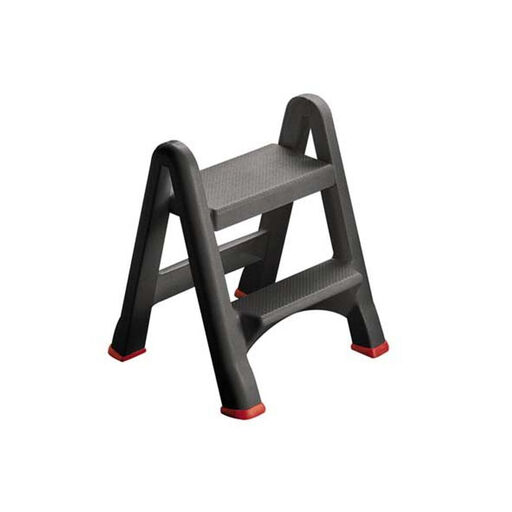
The verdict: Ideal for those in apartments or who need a handy, easy-to-store solution. Its mixed-material design (plastic and metal) makes it lightweight and manageable for occasional use, like reaching high kitchen cabinets.
It avoids the "pseudo-bargain" pitfall by relying on a reputable brand's name and a 5-year manufacturer's warranty, a true sign of long-term confidence.
Ultra-compact and lightweight, it is stored and handled effortlessly. Supports up to 150 kg.
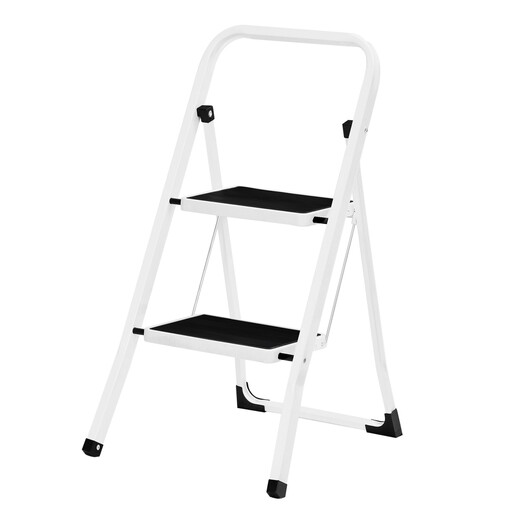
The verdict: Perfect for seniors or anyone seeking maximum confidence. Its support handle provides a reassuring point of contact for ascending and descending, drastically reducing the risk of losing balance.
It tackles the instability pitfall head-on. Its sturdy steel frame, safety lock, and, above all, its high handle create an optimal sense of security.
Its support handle is a game-changer for balance and safety. Ultra-slim when folded (4.5 cm), it's easy to store.
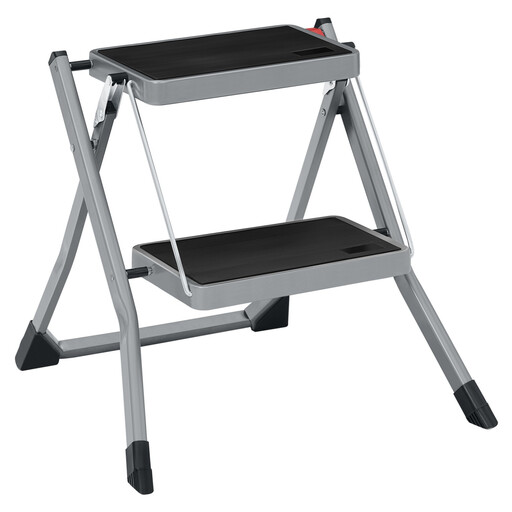
The verdict: This is the model designed for those who use their stepladder daily. A robust steel frame, automatic lock, and wide non-slip steps: it's built for repetitive tasks and demanding use.
It thwarts the pitfall of premature wear and tear. Its "Heavy Duty" design and automatic lock are forgiving of user error and ensure foolproof longevity.
All-steel construction and an automatic lock for maximum safety and durability. Bonus: its rounded edges prevent snags.
Explore our full selection of models that meet all our criteria for safety and practicality, as well as current standards.
In common parlance, the two terms are often used interchangeably, especially for smaller models. To be precise, a step stool is traditionally a small stool with one or two steps and no platform. A stepladder is taller and may include a platform and a handrail. But for a two-step model, both names are perfectly valid.
This is a reflex you should have before every use. Once the stepladder is unfolded, listen closely: you should hear a distinct "click" confirming it's locked. Then, take a look to verify that the safety latch is fully engaged. Finally, grip the stepladder and give it a light shake to ensure there's no wobble before you step on it.
Not necessarily; it all depends on your use case. Steel is the champion of robustness and stability, ideal for heavy-duty use or if stability is your number one criterion. Its downside is its weight. A good model made of aluminum, or a plastic/metal alloy, will be much lighter and therefore easier to handle and store. It's perfectly suitable for standard domestic use, provided it meets the crucial 150 kg load capacity standard.