
Livraison le jour même ou le lendemain

Qualité garantie

Débloquez vos offres de bienvenue: Livraison GRATUITE | Jusqu'à -80 % | 30 jours d'essai gratuits à JoyPlus
Téléchargez l'application
Preparing fresh juice at home may seem simple. However, choosing an electric juicer requires a few checks. Between citrus juicers, centrifugal juicers and cold-press juicers, each appliance is suited to different uses. A model designed for oranges will not necessarily be suitable for carrots, celery or apples.
Some common pitfalls arise when buying:
The first criterion to consider is the type of ingredients you plan to use.
An electric citrus juicer works with a rotating cone that you simply press down with half an orange, lemon, grapefruit or lime. Quick to set up, it is ideal for breakfast and for preparing citrus juices regularly.
An electric orange juicer is generally more compact and easier to maintain than a versatile appliance. However, it is not suitable for processing hard vegetables or whole fruits effectively.
A centrifugal juicer grates fruit and vegetables, then separates the juice from the pulp using the rotation of a filter basket. Its wide feed chute sometimes means you do not need to cut the food beforehand. This format is aimed at people who want to vary their recipes with apples, carrots, cucumbers or firm-fleshed vegetables.
However, remember to check the maximum continuous operating time, noise level, filter size and cleaning procedure.
A cold-press juicer uses an auger or a slow-pressing system. It is suitable for users who regularly prepare fruit and vegetable blends and are happy to spend a little more time dismantling the appliance. The chamber capacity, size of the feed opening and access to the filter deserve particular attention.
Marketing claims about vitamins, oxidation or nutritional benefits should not be treated as general guarantees. It is better to compare the appliance’s design, the accessories supplied, the usage instructions and the removable parts.
Measured in watts, power provides an indication of the motor’s performance, but it is not enough to predict output. A 30 to 60 W citrus juicer can be perfectly suitable for occasional family use. A 600 W centrifugal juicer will be better suited to preparing a variety of fruit and vegetable juices.
For intensive use, check in particular:
A 400 ml to 700 ml bowl is generally suitable for one or two servings. A family appliance with a larger reservoir reduces interruptions, but also takes up more room on the worktop.
Check the capacity of the chamber, juice collector and pulp container separately. These volumes are not always equivalent.
An easy-to-clean juicer should have accessible removable parts, a filter that can be rinsed properly and a motor base that can only be cleaned with a damp cloth. Dishwasher compatibility should be confirmed in the instructions, part by part.
For safety, prioritise:
The following models are suited to different requirements. The specifications given are based on the information available in the product listings.
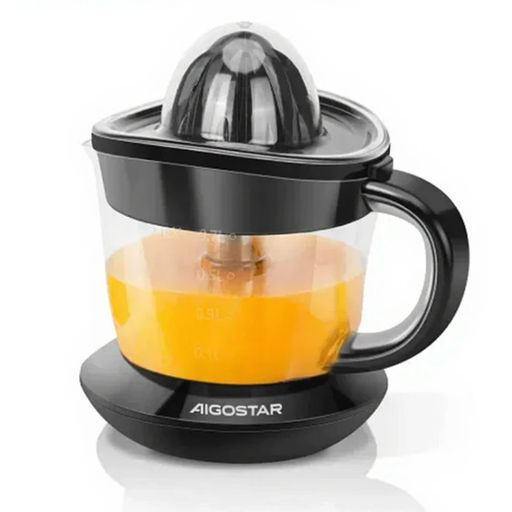
Why this choice suits this profile : Its compact 0.7 L format and 40 W motor make it a great first appliance for oranges, lemons and limes.
The two cones avoid the problem of a single attachment that is poorly suited to citrus fruits of different sizes. The removable parts are advertised as dishwasher-safe.
Two-way rotation, 0.7 L reservoir, anti-drip spout and space-saving design.
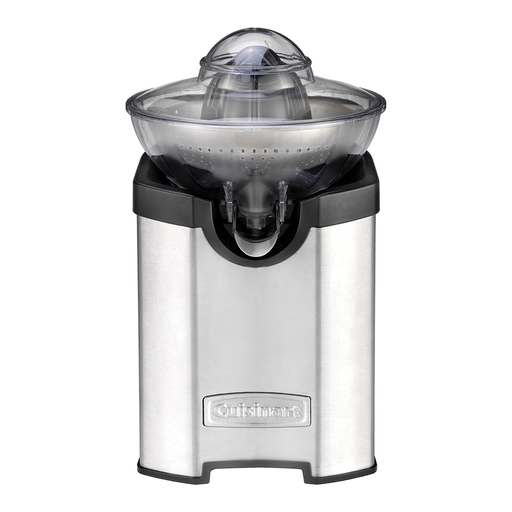
Why this choice suits this profile : Its brushed stainless-steel base, Quick Press lid and long spout are designed for users who want a polished presentation and effortless serving.
The anti-drip system and removable parts address two common challenges of daily use: splashes and time-consuming cleaning.
Automatic cone, Fast-Spin function, stainless-steel filter and spout compatible with several glass sizes.

Why this choice suits this profile : Its 1.8 L chamber, 130 mm opening and 726 ml cup are suitable for regular fruit and vegetable preparations.
Overheating protection and precise break instructions help manage repeated sessions. The manufacturer specifies a 10 minute limit, followed by a 20 minute rest period.
150 W power, 836 ml pulp container, reverse function and removable accessories advertised as dishwasher-safe.
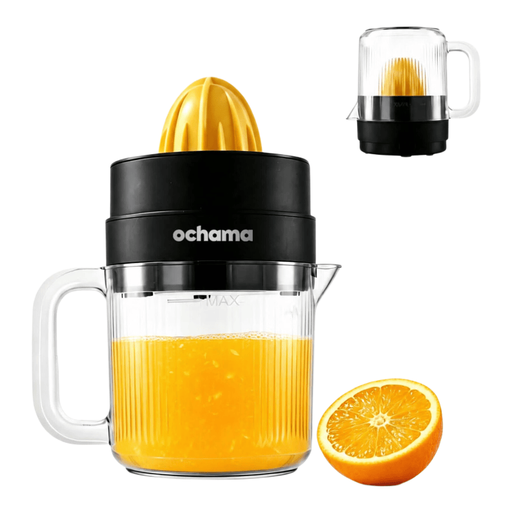
Why this choice suits this profile : Its 1.4 L reservoir and press-operated design allow you to serve several glasses of citrus juice without having to refill it frequently.
The blade-free design reduces the number of sharp components to handle. The advertised easy dismantling makes rinsing easier after preparing several portions.
30 W power, large 1.4 L capacity, pulp separation and use with several types of citrus fruit.
We have put together a complete, real-time updated list of products that meet these strict selection criteria, as well as European regulatory safety requirements.
Rinse the removable parts immediately after preparation to prevent pulp from drying on the filter or inside the ducts. Use only a soft brush when recommended in the instructions, and never immerse the motor unit in water.
With a centrifugal juicer, alternate fibrous ingredients with more watery pieces and use only the supplied pusher. With a cold-press juicer, cut fibrous foods into suitable pieces and remove stones, hard seeds, ice cubes and ingredients not approved by the manufacturer.
An electric citrus juicer will generally be sufficient. A 30 to 60 W model with interchangeable cones, an anti-drip spout and a reservoir suited to your household size will be easier to use than a centrifugal juicer.
Consumption depends on the power and length of use. As a guide, a 60 W appliance used for five minutes consumes around 5 Wh. The actual cost depends on the tariff specified in your electricity contract. You should also factor in cleaning and the possible replacement of wearing parts.
Follow the maximum operating time, do not overload the feed chute or chamber, remove stones and cut up excessively fibrous foods. Always unplug the appliance before dismantling or cleaning it, or removing a stuck piece.