
Livraison le jour même ou le lendemain

Qualité garantie

Débloquez vos offres de bienvenue: Livraison GRATUITE | Jusqu'à -80 % | 30 jours d'essai gratuits à JoyPlus
Téléchargez l'application
A duck feather duvet offers a cosy, enveloping feel and good temperature regulation, but product descriptions are not always easy to compare. Reversed composition details, vague warmth ratings or dimensions that do not suit the bed can turn a comfortable purchase into a disappointing expense.
Before choosing a duck down duvet, it is therefore worth looking beyond claims such as “all seasons” or “extra warm”. The filling composition, quilting, cover and care requirements provide much more useful information about everyday comfort.
Down is made up of light, soft clusters, while feathers have a central shaft and generally provide more structure. A duvet made from 90% feathers and 10% down will often feel firmer and weigh more than a model filled mainly with down.
Some product descriptions nevertheless mix the terms “feathers” and “down” across different sections. Always check the line describing the exact filling composition, rather than relying solely on the product title.
A duvet described as warm may be ideal in a lightly heated bedroom, but feel too enveloping in a well-insulated home. If you feel the cold, a warm duck feather duvet will be better suited to winter. For more versatile use, a lightweight all-seasons duvet or a model weighing around 200 g/m² will be more suitable for milder nights.
The feeling of warmth also depends on the filling weight, loft, cover weave and how evenly the filling is distributed.
A poorly compartmentalised duvet can develop cold spots if the filling shifts. Square or box quilting helps keep the filling evenly distributed. It cannot compensate for an unsuitable composition, but it remains an important feature to check.
Care requirements deserve just as much attention. A duvet that is machine washable at 40 °C maximum must be allowed to dry for long enough at a low temperature. Otherwise, residual moisture could affect comfort and compromise the freshness of the filling.
If you are looking for a 90% feather and 10% down winter duvet, check the stated warmth, total weight and dimensions before placing your order.
A cotton cover can contribute to a more breathable feel. Some available models feature a cover made from organic cotton sateen, with a stated density of 129 threads/cm². This textile specification can be checked, but it is not enough on its own to predict comfort.
MORPHEA products specifically mention OEKO-TEX Standard 100, CertiPUR, Sanitized and ISO 9001 certifications. Check this information on the product page and packaging. These certifications are not a medical guarantee: the claim “hypoallergenic” should be understood as a characteristic claimed by the manufacturer. Anyone sensitive to feathers should therefore check that the product meets their needs.
Choose the size according to your mattress and the desired overhang:
Also measure the mattress depth and the height of the bed base. A duvet that is too short may leave the sides uncovered during the night, while a larger size can be more difficult to wash and dry.

Why this choice suits this profile : Its 200 x 200 cm size is suitable for a standard double bed. Its stated composition of 90 % duck down and 10 % feathers is designed for cold nights.
The product description specifies the size, stated composition and washing instructions of up to 40 °C : three details to check before buying.
Double-bed size, high stated warmth rating, and care options including machine washing or professional cleaning.
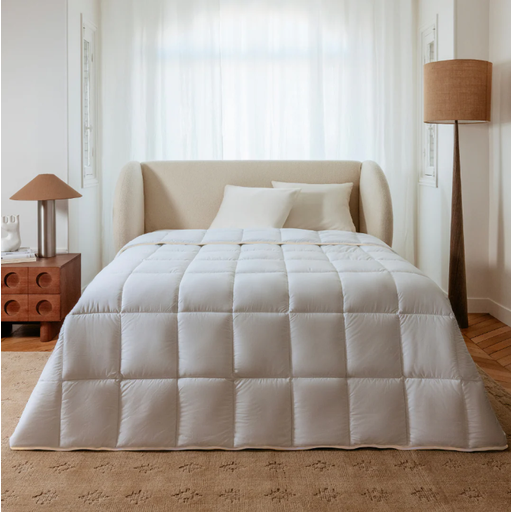
Why this choice suits this profile : Its generous size is suitable for couples and larger beds, while the organic cotton sateen cover is designed to provide a soft, breathable feel.
The square quilting is designed to limit filling movement and reduce the risk of areas with less coverage.
240 x 260 cm size, stated filling of 90 % feathers and 10 % down, certifications listed on the product page, and washing at up to 40 °C.

Why this choice suits this profile : This duck feather mattress topper is intended for people who want to change the feel of a firm mattress, with attachments designed to limit movement.
The four corner elastic straps and central strap address the common problem of a mattress topper slipping on a double bed.
180 x 200 cm size, cotton cover, integrated attachments and washing at up to 40 °C.
We have put together a complete, real-time updated list of products that meet these demanding selection criteria and European safety standards.
Air your duvet regularly, without exposing it to high humidity for too long. Gently shake it to redistribute the filling, then use a breathable protective cover. Washing it too frequently can reduce its lifespan: follow the care label instructions and generally aim for one or two washes a year, when the product allows.
For drying, select a low temperature and make sure the inside is completely dry before putting the duvet back on the bed. Professional cleaning may be preferable if your washing machine or tumble dryer does not have sufficient capacity.
A duck feather pillow requires similar care: airing, reshaping and washing according to the care label. The Soft duck feather pillow 50 x 70 cm model, for example, mentions a cotton cover and machine washing at up to 40 °C.
Yes, it can be suitable for chilly nights, but its warmth depends on the proportion of feathers and down, the filling weight, the quilting and the overall construction. For a lightly heated bedroom, look for a model explicitly intended for winter. For versatile use, compare lightweight all-seasons duvets instead.
The 200 x 200 cm size is often suitable for a standard double bed. The 220 x 240 cm and 240 x 260 cm sizes provide a greater overhang, which can be useful for couples or deep mattresses. Always measure the bed’s width as well as the height of the sleeping surface.
Check the care label and your machine’s capacity. The models featured indicate washing at up to 40 °C, followed by gentle drying or professional cleaning. Afterwards, make sure there is no moisture left at all before storing the duvet, to preserve the freshness and even distribution of the filling.