
Livraison le jour même ou le lendemain

Qualité garantie

Débloquez vos offres de bienvenue: Livraison GRATUITE | Jusqu'à -80 % | 30 jours d'essai gratuits à JoyPlus
Téléchargez l'application
The return of cold weather brings up a crucial question for anyone who feels the cold?: how do you find the perfect duvet, one that will keep you warm without turning your bed into a sauna?? The market for warm duck down duvets is a minefield, where it's easy to get lost between marketing promises and technical reality. Too many purchases end in disappointment?: a duvet that goes flat after a few months or simply fails to deliver on its promise of warmth.
As a product expert at Joybuy, my mission is to help you read between the lines and identify the criteria that truly make a difference. Here are the pitfalls to avoid and the key points to check for a successful purchase.
Before you even start comparing models, learn to recognise the red flags that lead to a bad investment.
To ensure you make the right choice, scrutinise these three technical criteria.
This is the number one criterion for a duck down duvet. Down is made of light, airy clusters that trap air to create a natural insulating barrier. Feathers, which are heavier and flatter, are mainly used as a filler material.
Fill weight indicates the weight of the filling. For a winter duvet, a fill weight between 350 g/m? and 500 g/m? is generally recommended for a natural fill. However, this figure alone means nothing. It must be analysed alongside the fill power (measured in CUIN), which assesses the down's ability to trap air. In short?: premium duck down with a high fill power will offer the same warmth with a lower fill weight.
The duvet's outer shell, known as the casing, plays a key role in comfort and durability. A 100% cotton casing with a very high thread count (over 250 threads per square inch) will prevent small feathers from escaping while remaining soft to the touch.
Always check for the Oeko-Tex Standard 100 label. It guarantees a textile free from chemicals harmful to your health and skin. Other certifications, like Sanitized, indicate a specific anti-dust mite and antibacterial treatment.
To put theory into practice, here are a few models that perfectly illustrate our advice.

Why we recommend it: Designed for the coldest nights and poorly heated homes, this duvet features a high-performance fill for absolute comfort.
The composition is clearly stated: 90% duck down and 10% small feathers. This high ratio guarantees optimal thermal insulation and enveloping warmth, without the excessive weight of low-end duvets.
Excellent warmth-to-weight ratio thanks to the high percentage of down. The organic cotton sateen casing offers unparalleled softness and breathability.
Why we recommend it: Ideal for allergy sufferers or those mindful of their bedding's composition, this model ticks all the boxes for a perfectly healthy sleep environment.
No empty promises here. The product is backed by verifiable certifications: Oeko-Tex Standard 100, Certipur, and Sanitized, which guarantee the absence of harmful substances and an effective anti-dust mite and antibacterial treatment.
The peace of mind of a certified hypoallergenic, anti-dust mite, and antibacterial product, combined with the thermal comfort of natural down.
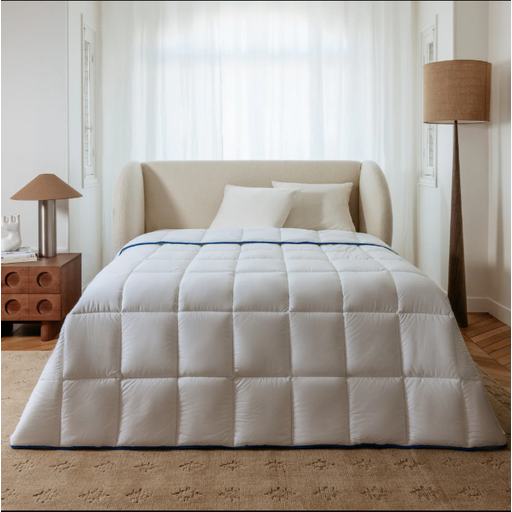
Why we recommend it: For those who prioritise simple maintenance and a hypoallergenic product, this synthetic alternative combines comfortable warmth with ultra-simple care.
This model is fully transparent about its composition: a fill of siliconised hollowfibre. It doesn't try to imitate down but offers a different technology, known for its excellent insulating power and lightness.
Machine washable at 40°C without any issues, hypoallergenic, and certified Oeko-Tex Standard 100. The ultimate practical and healthy solution.
We have selected a complete range of products for you that meet these quality criteria and current standards.
A quality duck down duvet, if well-maintained, can easily last 10 years or more. Regular care (frequent airing, careful washing) is the key to preserving the down's fill power and maximising its lifespan.
Washing it once or twice a year is sufficient. Use a large-capacity washing machine (12 kg or more) so the duvet is not compressed. Choose a delicate cycle at 40°C maximum with a gentle spin. For drying, a tumble dryer on low heat is the best solution, ideally with dryer balls to help the filling spread out and regain its loft. If you don't have a tumble dryer, a professional dry cleaner is the safest option.
Absolutely not. As we've seen, the quality of the fill is more important than the quantity. A 400 g/m? duvet filled with 90% high-quality down will often be warmer and significantly more breathable than a 500 g/m? duvet filled mostly with small feathers. Therefore, rely on the down-to-feather ratio and customer reviews rather than just the fill weight figure.