
Same-day & Next-day Delivery

Quality Guaranteed

Unlock Your Welcome Offers: FREE Delivery | Up to 80% OFF | Free 30-day JoyPlus trial
Download the APP
The cleaning products aisle can be overwhelming. Between tempting marketing claims and a maze of formats, it's hard to navigate and easy to walk away with an unsuitable product. Be warned: a product that cleans isn't necessarily one that disinfects, and a "gentle" formula can prove completely ineffective in certain situations.
To help you make sense of it all, we've decoded the labels, identified the pitfalls to avoid, and listed the essential criteria for choosing the right disinfectant. Our goal: a truly effective home cleaning routine that's safe for your surfaces and fits your daily life.
To be sure of a product's effectiveness, a few key pieces of information on the label should be scrutinised.
These terms indicate which type of microorganisms the product is active against.
For complete protection, especially against enveloped viruses like the flu or SARS-CoV-2, the presence of the EN 14476 standard is a must. This certification guarantees that the product's virucidal efficacy has been tested and validated according to a rigorous European protocol.
The choice depends on the surface to be treated and the level of disinfection required.
Each format meets a specific need.
To guide you, here is our selection of products that meet specific needs, all evaluated according to the criteria we've just detailed.
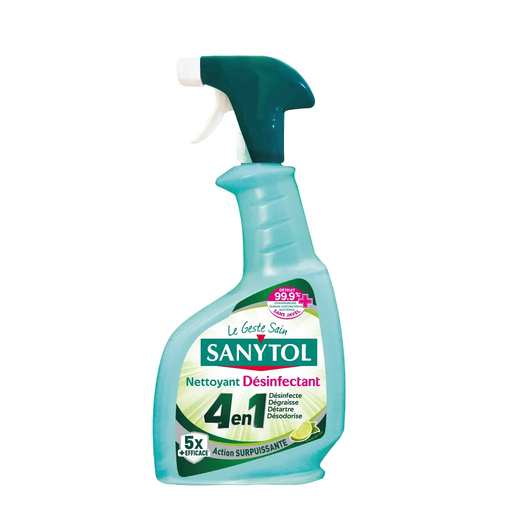
Editor's Verdict: Its bleach-free formula is a real plus for surfaces that come into contact with food (high chairs, worktops, etc.), a reassuring feature for parents. The fact that it doesn't require rinsing (except for prolonged food contact) is a welcome time-saver in daily life.
This isn't just a scented cleaner, but a true multi-action disinfectant (it degreases, descales, and deodorises). A genuinely practical all-in-one solution.
Its 4-in-1 formula radically simplifies cleaning. Being safe for food-contact surfaces provides peace of mind for families.
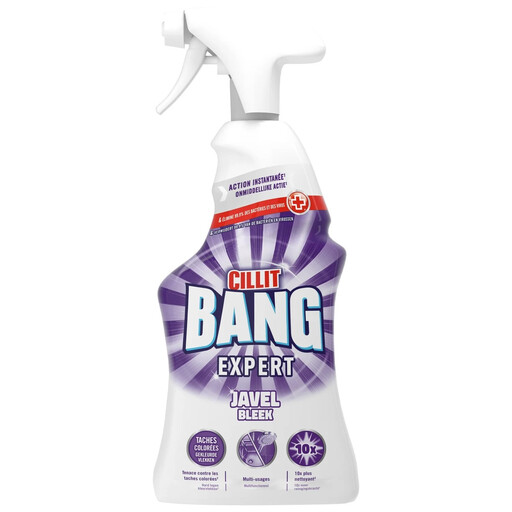
Editor's Verdict: For critical areas like tile grout, shower walls, or the bottom of the bathtub, its bleach-based formula is formidable against mould and ingrained stains, while also ensuring a deep disinfection.
There's no compromise on effectiveness here. The product embraces the use of bleach for a targeted shock treatment where it's truly essential.
It combines a virucidal disinfectant action (EN 14476 standard) with powerful agents for results you can see on the toughest bathroom grime.
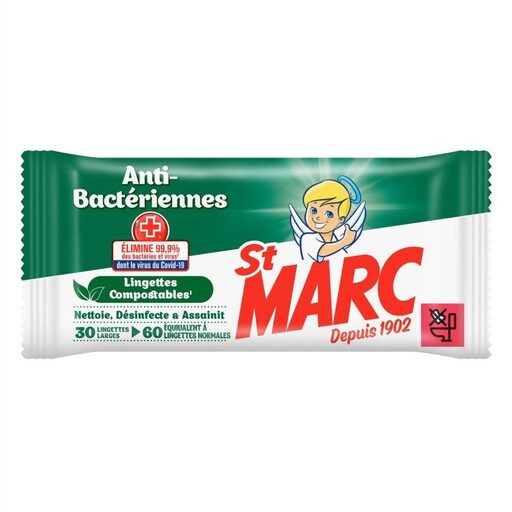
Editor's Verdict: The perfect solution for a quick clean and disinfection of light switches, remote controls, or your car's steering wheel. Convenience is the top priority here for effortless, impeccable daily hygiene.
Unlike simple "freshness" wipes, these offer a true disinfecting action (bactericidal and virucidal, EN 14476 standard). The format is perfectly suited for on-the-go or express use.
Their on-the-go format is ultra-practical. The pack's anti-drying lid ensures the wipes stay effective down to the very last one.
Discover our complete, up-to-date selection of products that meet our selection criteria and applicable regulations.
A cleaner is used to remove visible dirt (dust, grease). A disinfectant, on the other hand, contains biocidal agents designed to kill invisible microorganisms: bacteria, viruses, and fungi. A product can perform both functions. To check, look for the words "bactericidal," "virucidal," or "fungicidal" on the label.
Yes, provided you choose the right one. Effective bleach-free products rely on other active ingredients like ethanol, hydrogen peroxide, or quaternary ammonium compounds. Their effectiveness is always validated by European standards (EN standards). The EN 14476 standard, for example, certifies virucidal action. The key takeaway: always read the label to check for these standards.
The required contact time varies greatly from one product to another (generally from 1 to 15 minutes). This crucial information is always indicated on the label. Adhering to this dwell time is essential to ensure the antibacterial or virucidal action is complete.