
Livraison le jour même ou le lendemain

Qualité garantie

Débloquez vos offres de bienvenue: Livraison GRATUITE | Jusqu'à -80 % | 30 jours d'essai gratuits à JoyPlus
Téléchargez l'application
Keeping your home clean and healthy is a priority, but the cleaning products aisle can often feel like a jungle. Between bold promises and marketing jargon, it's hard to sort through it all. Our mission? To help you see things more clearly. Let's break down the most common traps together so you can choose the disinfectant cleaner that truly meets your needs.
The labels on cleaning products are often filled with claims designed to impress. Here are two essential points to watch out for before you check out.
1. The "Kills 99.9% of Germs" Myth This claim, seen everywhere, is not a guarantee of superiority. It simply means the product complies with current European standards. In other words, it has successfully passed bactericidal or virucidal efficacy tests under very specific laboratory conditions. The real question isn't if the product achieves the famous 99.9%, but rather which germs it targets (bacteria, viruses, fungi) and on which surfaces.
2. The "Gentle Formula" Argument That Hides the Essentials Many bleach-free formulas are promoted for their gentleness. While they are indeed less harsh on materials and more reassuring in a home with children or pets, the word "gentle" should not overshadow the need for proper usage precautions. A biocidal product, even without bleach, is still a concentrate of active substances. It is therefore imperative to read the label and follow the instructions, especially regarding contact time and the need to rinse.
To avoid being fooled by slogans, focus on objective characteristics. Here are the three points you absolutely must check.
Not all disinfectants act on the same microorganisms. It is crucial to choose a product whose spectrum of activity matches your needs.
A good multi-surface disinfectant will often cover all three spectrums, but only the label can give you certainty.
The choice between a formula with or without bleach depends on the intended use and the surfaces to be treated.
The format has a direct impact on ease of use and cost-effectiveness.
To illustrate these criteria in practice, here are a few products that stand out, tailored to specific needs.
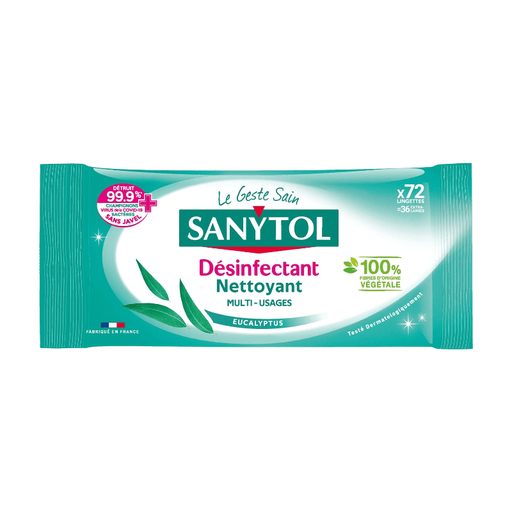
Why this product stands out: The wipe format is ultra-practical for managing everyday little messes, from high chairs to plastic toys. Its bleach-free formula is more reassuring for surfaces that children are likely to touch.
Instead of a vague promise, the label details its action on bacteria, fungi, and enveloped viruses (H1N1). The information about its effectiveness is therefore transparent.
Its triple action (cleans, disinfects, deodorises) in a single step is a precious time-saver for busy parents.
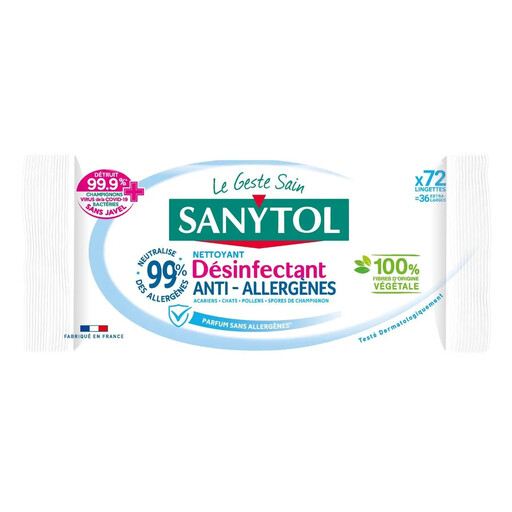
Why this product stands out: For people with allergies or pet owners, the challenge is twofold: to disinfect, but also to reduce the presence of allergens in the home. This product is specifically formulated to meet this need.
It goes beyond simple disinfection by tackling a specific problem: neutralising the most common allergens (cat hair, dust mites, pollen) on surfaces. A concrete and verifiable promise.
It combines a complete disinfecting action (bactericidal, fungicidal, and virucidal according to the EN14476 standard) with an anti-allergen action, offering a 2-in-1 solution for a healthier home.

Why this product stands out: For those who want a single solution for the whole house, this concentrated format is the winning combination of versatility and economy. It can be used on floors as well as other washable surfaces.
It doesn't just rely on the "bleach-free" argument. It provides objective guarantees: compliance with EN standards (bactericidal, fungicidal, virucidal) and suitability for food contact surfaces (according to the HACCP method), which legitimises its great versatility.
The large 5-litre format, which requires dilution, ensures an excellent cost-per-use ratio, making it a smart choice for frequent use and on large surfaces.
Discover our full selection of products that meet our demanding selection criteria and safety standards.
1. What is the difference between cleaning and disinfecting? Cleaning is removing visible dirt, dust, and debris from a surface, often with water and a detergent. Disinfecting, on the other hand, is killing invisible microorganisms (bacteria, viruses, fungi) with a biocidal product. For perfect hygiene, the golden rule is to always clean a surface before disinfecting it.
2. Can a disinfectant cleaner be used on surfaces that come into contact with food? Yes, some products are specifically designed for this purpose, such as a kitchen disinfectant on a worktop. It is imperative to look for the "Suitable for food contact surfaces" mention on the label. In almost all cases, it is essential to rinse the surface with clean water after letting the product sit for the indicated time.
3. How long should a disinfectant be left to work? Contact time is the key to effectiveness. It varies depending on the product and the germs being targeted (e.g., 5 minutes for bactericidal action, 15 minutes for virucidal action). This information is always on the label and must be strictly followed. A quick wipe is never enough to disinfect.