
Same-day & Next-day Delivery

Quality Guaranteed

Unlock Your Welcome Offers: FREE Delivery | Up to 80% OFF | Free 30-day JoyPlus trial
Download the APP
Choosing a new dishwasher can quickly become a daunting task. Between confusing energy labels, capacity promises, and marketing jargon, it's easy to get lost. As the Head of Product Recommendations at Joybuy, my mission is to help you see clearly and avoid the common pitfalls that lead to disappointment.
The goal isn't to sell you a "perfect" appliance, but to give you the keys to finding the one that will truly fit into your daily life. Let's break down the mistakes to avoid and the criteria that really matter.
Marketing is full of claims that fall flat in practice. Here are three things to watch out for so you don't get caught out.
To ensure your future appliance won't disappoint, focus on these three fundamental parameters.
Rather than focusing on the number of place settings, examine the interior layout. A well-designed dishwasher, whether it's a standard 60 cm model or a more compact one, must above all be flexible. Look for the following features:
In an open-plan kitchen or a small apartment, noise is a top priority. A silent dishwasher is generally considered to be a model that does not exceed 44 dB. Appliances equipped with an induction motor (sometimes called Inverter or iQdrive) are known for their quiet operation, durability, and energy efficiency.
The new energy label (from A to G) has the advantage of being clearer. However, don't just stop at the letter. Check the consumption in kWh per 100 cycles and in litres of water per cycle for the "Eco" programme. If possible, try to find information on the consumption of the programmes you'll actually use (quick, intensive). The ultimate goal? An appliance that offers the right balance between efficiency and speed, for example, with a high-performance "daily" programme that runs in under 90 minutes.
To move from theory to practice, here are a few models that perfectly meet specific needs.
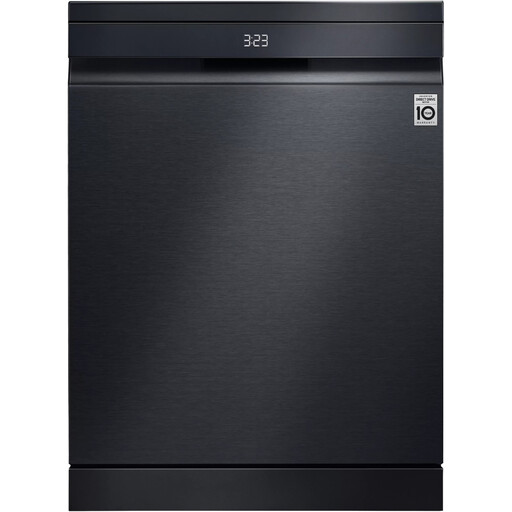
Why it's a great choice: Ideal for families looking for capacity, hygiene, and performance. The TrueSteam technology uses steam for a deep clean, while the QuadWash system ensures impeccable spray coverage. It's a connected dishwasher and very efficient.
Its EasyRack Plus modular basket system offers flexibility that goes far beyond the simple "14 place settings" figure. Its Class A rating is one of the best on the market, even outside the Eco cycle, thanks to its optimised washing technologies.
TrueSteam and QuadWash technologies for an impeccable clean and hygiene. 10-year guaranteed Inverter Direct Drive motor, ensuring quiet operation (43 dB).
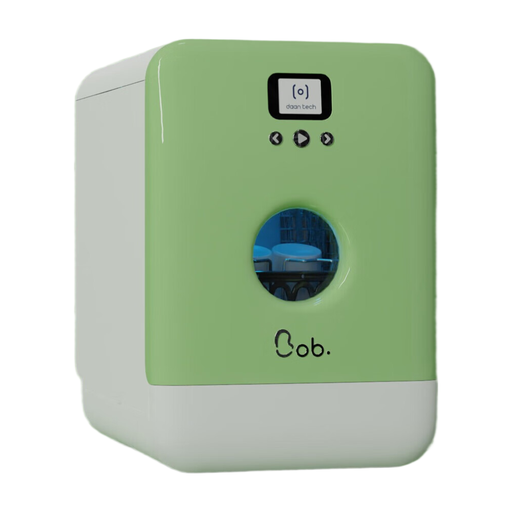
Why it's a great choice: The Bob dishwasher is THE solution for very small spaces, single people, or couples. It doesn't require a water connection and its consumption is minimal, making it a top choice for users concerned about their ecological footprint.
It fully embraces its "installation-free" concept by offering an easy-to-fill integrated tank. Its 43 dB noise level places it among the silent models, an essential feature for an appliance intended for a studio.
Made in France, ultra-compact (34 cm wide), and uses only 2.9 litres of water per cycle. Its colourful and modern design almost makes it a decorative object.
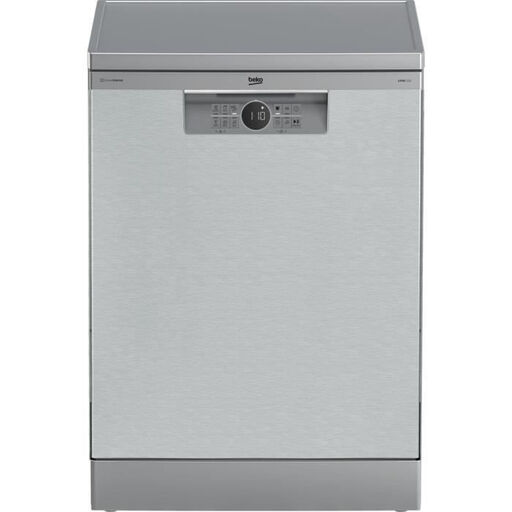
Why it's a great choice: For families or flatshares looking for maximum space without breaking the bank. With 16 place settings, it surpasses many competitors while remaining in a very affordable price range. It offers useful programmes like the 58-minute Quick&Shine.
It doesn't sacrifice practicality for capacity. The cutlery tray and functional interior layout allow you to take full advantage of its 16 place settings. Its induction motor ensures reliability and a controlled noise level (44 dB).
Record capacity of 16 place settings and a high repairability score of 9.1/10, a guarantee of durability. Controlled water consumption at 9.5 L per Eco cycle.
Discover our complete and up-to-date selection of products that meet our demanding selection criteria and French safety standards.
No, this is an old habit you can break. Modern dishwashers and current detergents, like Fairy dishwasher pods, are perfectly capable of dissolving grease and food residue. Simply scrape off the largest pieces with a fork or spatula. Pre-rinsing is not only a waste of water, but it can even hinder washing efficiency: the appliance's sensors can be tricked into running a less powerful cycle.
The average lifespan of a dishwasher is typically around 10 years. This duration, of course, depends on the manufacturing quality, frequency of use, and the quality of maintenance. The water hardness in your region also plays a role. Opting for a model with an induction motor and a high repairability score is a good bet to maximise its longevity.
The installation of a dishwasher primarily depends on the model. A freestanding dishwasher is not particularly difficult: you just need to connect it to a water inlet, a drain, and a power outlet. For a built-in dishwasher, things get a bit more complicated, as it needs to be fitted into a kitchen cabinet and have a custom front panel attached. If DIY isn't your cup of tea, it's recommended to use a professional installation service for freestanding dishwashers or built-in models to ensure a professional-standard installation.