
Livraison le jour même ou le lendemain

Qualité garantie

Débloquez vos offres de bienvenue: Livraison GRATUITE | Jusqu'à -80 % | 30 jours d'essai gratuits à JoyPlus
Téléchargez l'application
Choosing a cooker hood can quickly become a headache. Between marketing promises, complex spec sheets, and a multitude of designs, it's easy to make a purchase you'll regret. An inefficient, noisy, or hard-to-maintain hood can ruin the joy of cooking.
As a product expert at Joybuy, my mission is to help you see clearly. Let's cut through the jargon and focus on what's essential. Here are the common pitfalls to avoid and the objective criteria for selecting the perfect hood for your needs and your kitchen.
Before comparing models, it's crucial to know the most frequent mistakes, which are often a source of disappointment.
To avoid these traps, focus on three fundamental technical characteristics.
The airflow rate, expressed in cubic metres per hour (m?/h), determines the hood's capacity to renew the air in your kitchen. A simple calculation can help you estimate your needs:
Kitchen Area (m?) × Ceiling Height (m) × 10 = Recommended Minimum Airflow Rate (m?/h)
For example, for a 12 m? kitchen with a 2.5 m ceiling, the required rate is around 300 m?/h. If your kitchen is open to the living room, allow for extra capacity. A model with multiple speeds lets you adjust the power whether you're simmering a dish or grilling meat.
This is the most critical factor, as it depends on your home's layout.
Installation types also vary: a wall-mounted hood is fixed to the wall, an integrated hood is concealed within a wall unit, and an angled hood offers a modern design while freeing up space above the hob.
Two final points to check for optimal comfort:
To put theory into practice, here are a few models suited to different user profiles.
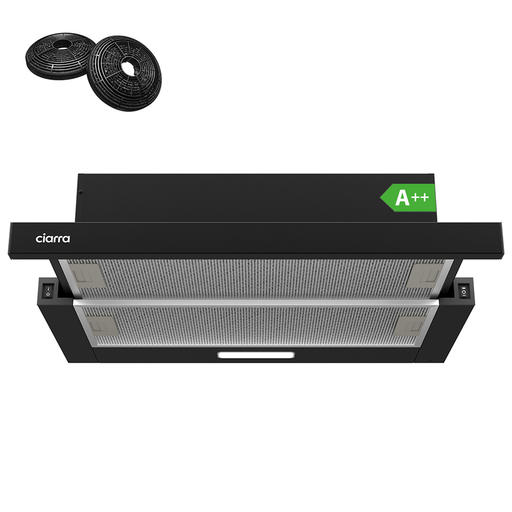
Why it's a match: Ideal for studios or small kitchens, its telescopic design allows it to be concealed in a wall unit, freeing up valuable visual space. Its 60 cm hood width is standard for most hobs.
With an airflow rate of 370 m?/h, it avoids the trap of being overpowered for a compact space. It is compatible with both extraction and recirculation modes, offering maximum installation flexibility.
Its telescopic design is a real space-saver. Its A++ energy class ensures low consumption, a bonus for tight budgets.
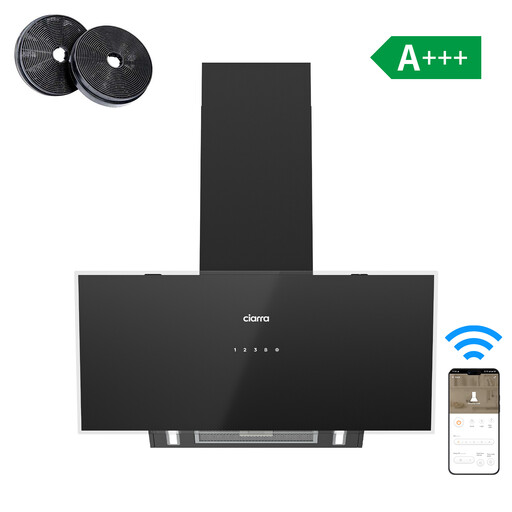
Why it's a match: For those who love technology and sleek design. The angled glass panel is both elegant and practical, while the WiFi app control offers a modern user experience. It's a perfect smart hood for a contemporary kitchen.
The angled design isn't just for looks; it improves comfort by providing more headroom. The glass surface is easy to clean, avoiding the tedious maintenance trap. Its A+++ rating compensates for its high power.
Control via a smartphone app is a real bonus. The dual-intake system and 650 m?/h airflow rate ensure excellent efficiency, even during intensive cooking.
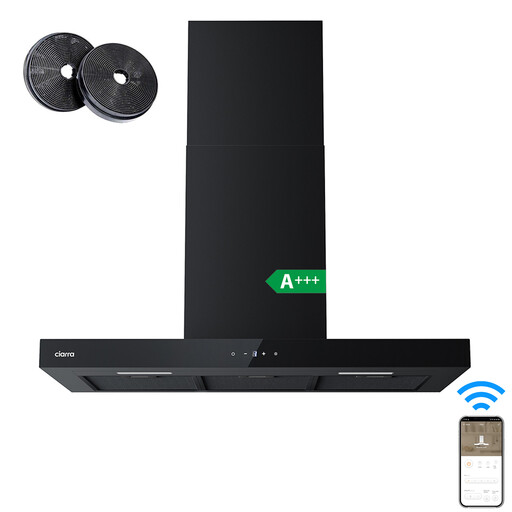
Why it's a match: With its wide 90 cm hood and powerful 650 m?/h airflow, it's designed for large hobs and open-plan kitchens. The booster function is perfect for handling sudden bursts of smoke from frying or grilling.
Despite its power, its noise level remains contained at 59 dB, and its A+++ class (annual consumption of 12 kWh/year) keeps the impact on your electricity bill in check. It comes with charcoal filters, avoiding unwelcome surprises for a recirculation setup.
The booster function provides a very high, temporary extraction power. The combination of width, power, and energy efficiency makes it a well-rounded choice for demanding cooks.
We have selected a full range of products for you that meet these demanding criteria and current safety standards.
The lifespan of an active charcoal filter depends on how often you use the hood. On average, it is recommended to replace it every 3 to 6 months. A saturated filter loses its ability to absorb odours, making the recirculation mode ineffective. Most filters are not washable and must be replaced.
Yes, and this is actually a recommended setup. A hood that is wider than the hob can capture vapours and smoke more effectively, especially those that escape from the sides. The opposite—a hood narrower than the hob—is strongly discouraged as its effectiveness would be greatly reduced.
Absolutely. An A+++ rated hood like the Ciarra models shown above consumes about 12-13 kWh per year (kWh/annum). In comparison, an older or B-rated model can consume 27 kWh/annum or more. Over the appliance's lifespan (about 10 years), the difference on the electricity bill is significant, especially if you cook daily. It's an initial investment that quickly pays for itself through energy savings.