
Livraison le jour même ou le lendemain

Qualité garantie

Débloquez vos offres de bienvenue: Livraison GRATUITE | Jusqu'à -80 % | 30 jours d'essai gratuits à JoyPlus
Téléchargez l'application
Choosing a cooker hood can quickly become a headache. Between airflow rates, installation types, and a jungle of designs, it's easy to get lost in technical specs. A hasty decision often leads to regret?: a device that's too noisy, impossible to install in your home, or maintenance costs you never saw coming.
As a product expert at Joybuy, my mission is to guide you through this maze. This guide gets straight to the point?: it breaks down the essential criteria for making an informed choice and avoiding the pitfalls that turn a good purchase into a bad surprise.
Before you even start comparing models, let's review the most common mistakes. Knowing them is the first step to avoiding them.
To get it right, focus on this powerful trio.
The airflow rate, measured in cubic metres per hour (m?/h), indicates the extraction power. To be effective, a hood should be able to renew the air volume of your kitchen 10 to 12 times per hour.
But this raw power is worthless without silence. The noise level, expressed in decibels (dB), is the deciding factor. A hood is considered silent if it stays below 60 dB at normal speed. Above that, it becomes a real daily noise nuisance.
This is THE criterion that will determine everything.
A cooker hood is no longer just a functional appliance; it must integrate perfectly with your kitchen and your style.
To move from theory to practice, here's how these criteria translate into real-world models, designed for different needs.
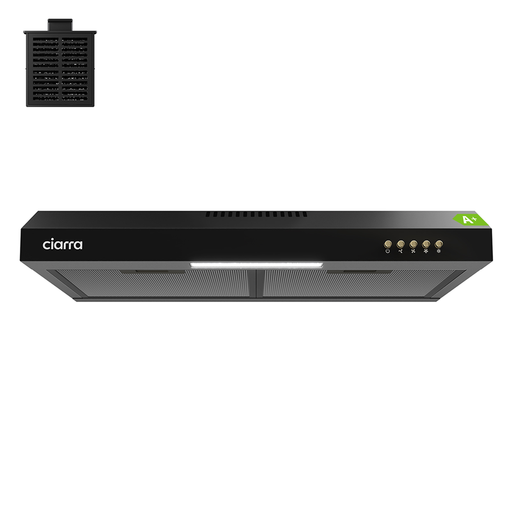
Why this model ? Designed for kitchens where every inch counts, this hood slides under an overhead cabinet for maximum discretion. Compatible with recirculation mode, it's the perfect solution for apartments without an extraction duct.
It bypasses the installation headache with its effective recirculation mode. No complex work or unpleasant surprises during setup.
Its ultra-compact form factor and feather-light weight (3.2 kg) make its installation a breeze, even in a fully fitted kitchen.
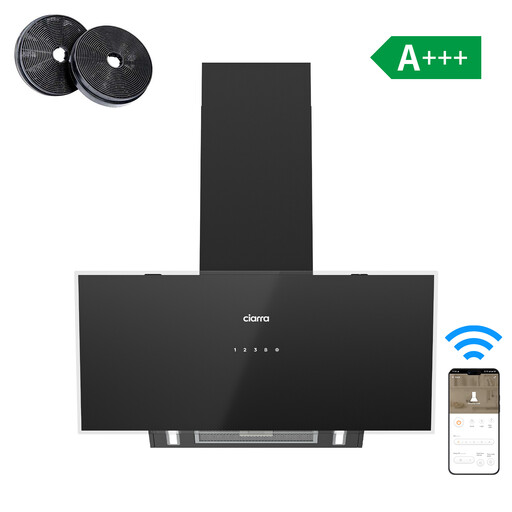
Why this model ? For those whose kitchen is a true living space, this 90 cmdesigner hood is the perfect marriage of aesthetics and technology. Its angled black glass panel and smart controls make it a piece that's as high-performing as it is sculptural.
It proves that a high airflow rate (650 m?/h) can go hand-in-hand with silence, thanks to a controlled noise level (60 dB) and an exemplary A+++ energy rating.
Its innovative dual-extraction system and control via the WiFi app offer a resolutely modern user experience and optimal air purification.
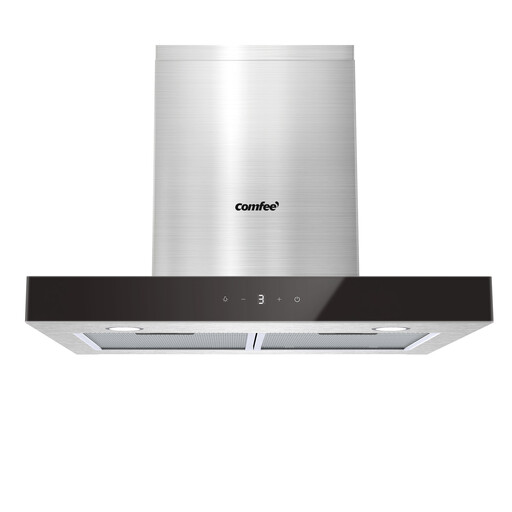
Why this model ? The ultimate smart choice that sacrifices nothing on performance. With its powerful 650 m?/h airflow and A+++ rating, it's built for dedicated cooks who demand power, energy savings, and convenience.
It avoids the trap of running costs thanks to its ultra-efficient BLDC motor, all while delivering extraction power worthy of a professional kitchen.
Gesture control allows you to operate the hood with a simple wave of the hand : a feature that's as practical as it is hygienic when your hands are covered in flour.
Explore our complete selection of cooker hoods that meet our performance criteria and UK safety standards.
1. When should you change the charcoal filter on a recirculation hood?? It all depends on how often you use it. On average, it's recommended to replace it every 4 to 6 months. Once saturated, a charcoal filter can no longer absorb odours, making your hood almost ineffective.
2. At what height should a cooker hood be installed?? It's a matter of safety and efficiency. The minimum distance between the hob and the hood should be 65 cm for an electric hob (ceramic, induction) and 75 cm for a gas hob. In all cases, you must consult your appliance's instruction manual.
3. Is a recirculation hood really effective?? Absolutely. A modern recirculation hood is very effective at capturing grease and neutralising odours, on one condition?: its filters must be high-quality and changed regularly. While it doesn't remove humidity like an extraction model, it remains an excellent alternative when creating a duct is simply not an option.