For Christmas baking, choose a bar labelled as baking or dessert chocolate, then compare its cocoa percentage with your recipe and the flavour you’re after. Dark chocolate bars with 52–53% cocoa are an option if you want a less intense flavour, while those labelled 64–70% are suited to recipes where you want a more pronounced cocoa taste. In either case, check the ingredients, sugars and allergens on the bar you buy.
Who are these bars for?
For a recipe where cocoa takes centre stage
If you’re making a yule log, a gooey chocolate cake or a ganache where chocolate is the main flavour, compare the cocoa percentages shown on baking chocolate bars. Lindt France, for example, lists a Dessert Noir Intense bar with 70% cocoa. Also check how much sugar your recipe calls for.
For a range of Christmas desserts
A dark dessert chocolate bar can be a good starting point if you’re choosing between a mousse, cake and topping. Carrefour Original lists at least 52% cocoa for its dark dessert chocolate bar, while Auchan gives 53% for its 205 g Nestlé Dessert Noir bar. Compare the ingredients before choosing.
For cooking around allergies
If someone you’re serving has an allergy, read the label on the bar you actually buy, including any may-contain statements. Declarations vary between products: Lindt France lists soya and possible traces of milk and nuts for its Dessert Noir Intense bar.
What should you check before buying?
When buying a single bar, start with your recipe. The flavour you want, the quantity required and any dietary needs among your guests will determine what to look for on the packaging.
| What to consider |
What to check |
Who is it for? |
| Cocoa intensity |
Cocoa percentage and whether the bar is intended for baking or desserts. |
For a ganache or gooey chocolate cake where I want the cocoa flavour to come through clearly, intensity comes before the other criteria; around 45% of the consumers concerned would put it first. |
| Milder flavour and versatility |
Cocoa percentage and sugars per 100 g, compared with the recipe. |
If I’m planning several desserts or a cake for guests with different tastes, I first look for a milder flavour; this would be the priority for around 33% of the consumers concerned. |
| Ingredients and allergens |
Ingredients list, declared allergens and may-contain statements; nutritional information per 100 g. |
When I’m cooking for someone with an allergy, reading the label determines my choice before flavour; around 22% of the consumers concerned would make this their priority. |
What common pitfalls should you avoid?
-
Confusing a snacking bar with a baking chocolate bar
“Just one bar” can mean different sizes. The baking chocolate bars mentioned here weigh 200 g or 205 g; that doesn’t mean a mini bar or filled chocolate can be used as an equivalent in a recipe.
Look for the words “baking chocolate” or “dessert chocolate”, then check the net weight and weigh out the amount required.
-
Using the fizzy drinks tax as a guide to sugar content
The rules cited by Légifrance apply to drinks and liquid preparations for drinks, not solid chocolate bars. So this levy tells you nothing about the sugar content of a chocolate bar.
To compare two bars, check the sugars per 100 g and the ingredients list on the packaging.
-
Relying on the Nutri-Score alone
Santé publique France explains that displaying the Nutri-Score is voluntary. Whether it appears on the packaging or not, it doesn’t replace checking the information specific to the bar.
Check the ingredients list, allergens and nutrition table, whether or not the logo appears on the packaging.
-
Forgetting about heat during delivery
Transport conditions matter if a chocolate bar is being delivered before you use it for baking. Lindt France recommends choosing a suitable delivery method during periods of high temperatures.
Before you order, check the delivery method available for your address and the product’s storage instructions.
Brands and ranges to know
These examples give you an idea of the types of baking chocolate bars available and what to compare. A range may include products with different recipes.
Lindt
Lindt France lists its 200 g Dessert Noir Intense bar, with 70% cocoa, for both desserts and eating.
- The cocoa percentage, ingredients and allergens are listed for this product.
- “Intense” is the brand’s positioning, so check that it matches the flavour you’re after. The product information lists soya and possible traces of milk and nuts.
Nestlé Dessert
Auchan lists, among other products, a 205 g dark baking chocolate bar with 53% cocoa and a 200 g strong dark chocolate bar.
- These products let you compare different cocoa percentages for a mousse, gooey chocolate cake or ganache.
- For the strong dark chocolate bar, Auchan shows 64% in the product title and at least 65% in the ingredients. Check the information for the product you choose, along with its allergen details.
Carrefour Original
Carrefour France lists a 200 g dark dessert chocolate bar with at least 52% cocoa.
- The product information includes ingredients and nutritional details that are useful when comparing recipes.
- It mentions possible traces of nuts, cereals containing gluten and milk. Check the packaging you buy if these statements matter for your guests.
Tablette d’Or / Marque Repère E.Leclerc
E.Leclerc lists, among other products, a 200 g Tablette d’Or dark baking chocolate bar.
- The ingredients published for this product include cocoa mass, sugar and cocoa butter.
- Check the details of the bar you choose and its availability at the relevant E.Leclerc store.
Auchan / Cultivons le Bon
Auchan lists, among other products, a 200 g Cultivons le Bon strong dark baking chocolate bar, with 64% cocoa.
- The type of chocolate and the stated cocoa percentage give you two useful points of reference when deciding whether it suits your recipe.
- Compare the ingredients and allergens for the specific product rather than assuming the whole range has the same ingredients.
A dessert chocolate bar available on Joybuy
For Christmas baking that calls for dessert chocolate to melt or stir into a mixture, this selection features a 205 g bar. If your recipe requires a specific cocoa percentage, be sure to check it.
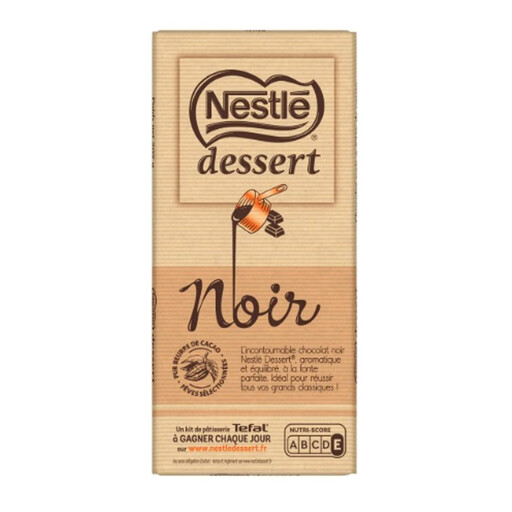 Image unavailable
Nestle Dark Dessert 205 g
This dessert chocolate bar is presented as suitable for baking and melting, making it a useful choice for preparing a dessert. It weighs 205 g. If your recipe calls for a specific cocoa percentage, check the packaging. Also look for any warnings about possible traces of milk and nuts if you’re serving guests who need to avoid these allergens.
View on Joybuy
Frequently asked questions
Does the fizzy drinks tax apply to a chocolate bar?
No, not to a solid chocolate bar. The rules cited by Légifrance apply to drinks and liquid preparations for drinks intended for human consumption. To find out how much sugar a chocolate bar contains, check its nutritional information per 100 g.
Is Nutri-Score compulsory on chocolate sold in France?
No. Santé publique France says producers can choose whether to display the Nutri-Score. When comparing chocolate bars, check their ingredients lists and nutritional information too.
What should you check if someone you’re serving has an allergy?
Check the allergens listed in the ingredients and any may-contain statements on the bar you buy. The product information from Lindt France and Carrefour France shows that possible warnings for soya, milk or nuts vary by product.
How should you store the bar before making your dessert?
Follow the instructions on the packaging. For the Nestlé Dessert Noir Corsé bar, Auchan recommends storing it in a dry place, away from light, at between 15 and 18 °C. This advice applies to that product and may not be suitable for other chocolate bars.


