Who is this choice for?

Anyone looking for a clearly labelled fair trade gift

If fair trade is important to you, check the label or standard shown on the chocolate bar and find out which ingredients it covers. Fairtrade International’s standard applies in particular to certified cocoa; check the product itself to see exactly what any claim covers.

Anyone putting together a Christmas chocolate tasting

For a gift hamper or something to share, compare the types of chocolate, cocoa percentages and added ingredients. Check the allergen information for each recipe before putting your selection together, too.

Anyone keeping an eye on nutritional information

When comparing two prepacked chocolate bars, use the same basis for each, especially the sugar and saturated fat content per 100 g. EU regulations require prepacked foods to display a nutrition declaration, subject to applicable exemptions; Nutri-Score is voluntary.

What should you look for?

Whether you’re choosing a gift or putting together a tasting, check what the fair trade claim covers for the recipe you’ve chosen, then compare the taste you’re after with the information on the label.

What to consider What to check Who is it for?
Proof of fair trade credentials The logo or standard shown on the chocolate bar, and which ingredients it applies to. If I’m giving chocolate because of its fair trade credentials, I want to know exactly what they cover rather than rely on a general claim; around 36% of consumers rank this as their top priority.
Taste and sharing The type of chocolate, cocoa percentage and any added ingredients. For a hamper for several people, I look for flavours that suit their tastes, without assuming that everyone will enjoy a very high-cocoa chocolate bar; around 29% of consumers prioritise taste and sharing.
Nutritional information Sugars and saturated fat per 100 g, as well as the ingredients list. When I compare recipes, I want to check their values on the same basis rather than judge their composition by the cocoa percentage alone; around 21% of consumers put nutritional information first.
Allergens and dietary restrictions The ingredients list and any ‘may contain’ warnings on the specific chocolate bar. Before choosing something for someone with a dietary restriction, I need to be able to check the information for that particular recipe; around 14% of consumers make this their top priority.

What pitfalls should you avoid?

  • Assuming every ‘fair trade’ claim means the same thing

    A standard may cover cocoa or a range of ingredients; a general claim doesn’t necessarily tell you exactly what it applies to.

    Look for the logo or standard on the chocolate bar, then read the wording to see which ingredients are covered.

  • Rejecting a chocolate bar because it has no Nutri-Score

    Nutri-Score is voluntary. Its absence does not, by itself, mean that required nutritional information is missing.

    To compare recipes, check the nutritional values per 100 g, especially sugars and saturated fat.

  • Choosing based on cocoa percentage alone

    The percentage can help you find the type of recipe you’re looking for, but it doesn’t tell you how much sugar it contains or whether it includes added ingredients or allergens.

    If you’re sharing, compare different chocolate profiles and check the label for each product separately.

  • Forgetting to check ‘may contain’ warnings

    Even if there are no visible inclusions, you still need to read the allergen warnings. For example, the product information for Kaoka’s 70% dark chocolate bar warns that it may contain traces of milk, nuts and cereals containing gluten.

    Check the ingredients and ‘may contain’ warnings on every chocolate bar intended for someone with an allergy or dietary restriction.

Brands to know

Alter Eco

Alter Eco offers a range of dark and milk chocolate bars, including varieties with added ingredients, making it easy to put together a selection of different flavours.

  • The brand describes its products as organic and associated with fair trade.
  • Check the claims and ingredients on the specific chocolate bar: an overview of the range won’t give you the details for every recipe.

Ethiquable

Ethiquable offers fair trade and organic chocolate bars, including dark chocolate with different cocoa percentages.

  • The brand says it offers dark chocolate bars with 65%, 70% and 80% cocoa, among others.
  • For a specific gift, check the recipe and fair trade claims on the packaging, along with the ingredients and allergen information.

Kaoka

Kaoka offers organic and fair trade chocolate bars, including a 70% cocoa dark chocolate bar.

  • Kaoka says that all the agricultural ingredients in this 70% dark chocolate bar are covered by fair trade, monitored in line with the FiABLE standard.
  • This claim applies to the product mentioned, not necessarily to every Kaoka chocolate bar; its product information also warns of possible allergen traces.

Chocolate bar available on Joybuy

This milk chocolate bar with puffed rice could be a good addition to a selection to share. If fair trade is important to you, check the standard and what it covers on the packaging for this product.
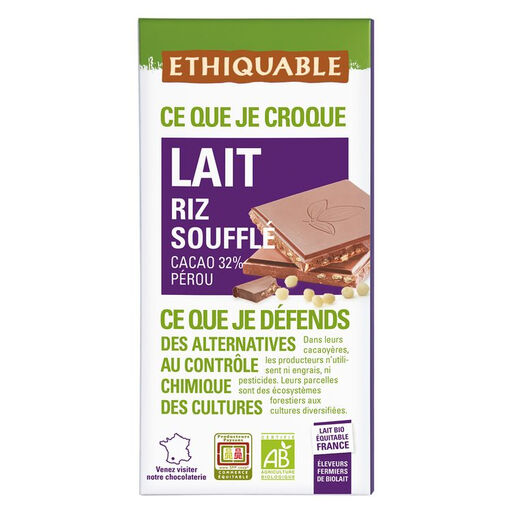
Ethiquable organic milk chocolate bar with puffed rice, 100 g

Ethiquable organic milk chocolate with puffed rice, 100 g

A milk chocolate option with puffed rice to consider for sharing at Christmas. The bar weighs 100 g. Before giving it as a gift, check the label for the applicable fair trade claim, nutritional information and warnings about milk and possible allergen traces.

View on Joybuy

Frequently asked questions

How can I tell what a fair trade claim on a chocolate bar covers?

Look for the logo or standard on the packaging, then check which ingredients it applies to. Fairtrade International’s standard for cocoa covers the production, purchase and sale of certified cocoa; on its own, it doesn’t describe every ingredient in a chocolate bar.

Is Nutri-Score compulsory on chocolate bars?

No, displaying it is voluntary. However, EU regulations require prepacked foods to carry a nutrition declaration, subject to applicable exemptions. To compare two chocolate bars, look in particular at the sugars and saturated fat per 100 g.

Does the ‘sugar tax’ apply to chocolate bars in France?

No. The French Ministry of the Economy says this levy applies to sugary drinks, not chocolate bars. To compare chocolate bars, check their sugar content in the nutritional information.

How should I store chocolate bars for a Christmas market?

Follow the storage instructions on the packaging for each chocolate bar, rather than assuming they’re the same for every recipe. Check them before planning how to store and display the products.