Anyone making a cake or ganache
A bar labelled for baking, with its net weight clearly stated, makes it easier to work out how much chocolate your recipe needs.


For baking a cake, choose a bar of dark chocolate specifically made for baking rather than a gift box, unless you can check the ingredients and usable quantity of each chocolate in the box. Bars with around 51–53% cocoa are a good starting point for a milder flavour; 70% cocoa options are suitable if you want a stronger cocoa taste. In either case, check the sugars and allergens for the product you choose before adjusting your recipe.
A bar labelled for baking, with its net weight clearly stated, makes it easier to work out how much chocolate your recipe needs.
The cocoa percentage helps you identify bars to compare. Then check whether their ingredients suit your recipe and the intensity of flavour you want.
Before baking for a group, check the ingredients and allergen information for the exact product, including any warnings about possible traces.
If you’re adding chocolate to cake batter or ganache, first check that it’s suitable for baking and that you have the right amount. Then narrow down your choice based on the flavour you want and the ingredients.
| What to consider | What to check | Who is this for? |
|---|---|---|
| Use and quantity | Look for a label indicating that the chocolate is suitable for baking or desserts, then compare the net weight with the amount required by your recipe. | If I’m adding chocolate to cake batter or ganache, I want to know how much to use. Around 36% of consumers put quantity and suitability for baking first. |
| Flavour and sugars | Compare the cocoa percentage and the ‘of which sugars’ figure per 100 g for the bar you’re considering. | If I want a less sweet cake or, conversely, a milder flavour, my choice of chocolate can change the balance of the recipe. Around 29% of consumers prioritise flavour and sugar content. |
| Ingredients and allergens | Read the ingredients list and check the ‘contains’ or ‘may contain’ warnings on the exact product packaging. | If I’m making a cake for someone with an allergy, I need to check the declared ingredients before baking. Around 21% of consumers put this first. |
| Gift or baking | For a gift box, check the ingredients and usable quantity of each chocolate. Otherwise, treat a gift separately from the ingredient you need for your cake. | If I’m buying something that also needs to work as a gift, I want to know whether the box can actually provide the chocolate required for the cake. Around 14% of consumers prioritise this choice between gifting and baking. |
An assortment may contain chocolates with different ingredients and weights. The name on the box alone won’t tell you how much to add to your cake.
For baking, choose a bar labelled for this purpose, or check each chocolate in the box before using it in your recipe.
The cocoa percentage and sugar content answer two different questions. The figures vary depending on the product you choose.
Compare the ‘of which sugars’ figure per 100 g on the packaging, then adjust the sugar in your recipe if needed.
According to Santé publique France, displaying the Nutri-Score is voluntary. If it appears on a product, it won’t give you details of its ingredients or allergens.
Check the ingredients list, allergen warnings and nutritional information for the chocolate you plan to use.
Depending on the product, the ingredients may include soya or milk, and there may be warnings about possible traces of nuts or cereals containing gluten.
If someone has an allergy, check the packaging of the exact bar before making or serving the cake.
The Lindt DESSERT range includes 51% and 70% dark baking chocolate bars, in 200 g packs.
The range includes 53% and 70% dark baking chocolate bars, as well as chocolate chips for desserts.
Carrefour offers an organic dark dessert chocolate bar with a minimum cocoa content of 52%, in a 200 g pack.
The range includes an organic 52% cocoa dark baking chocolate bar, in a 200 g pack.
The L’Original dark chocolate bar is designed for eating and should be considered separately from bars labelled for baking.
E.Leclerc is a retailer, and its shopping guide distinguishes cooking chocolate from other chocolate bars.
These two dark chocolate bars are worth considering for a cake. Compare their pack sizes and packaging information with your recipe; they aren’t a selection of gift boxes.
 Image unavailable
If your recipe calls for dark chocolate to be added to the mixture, check whether the 200 g pack is the right size. Before baking for someone with an allergy, check the packaging for the ingredients, which include milk and soya, and for any possible trace warnings.
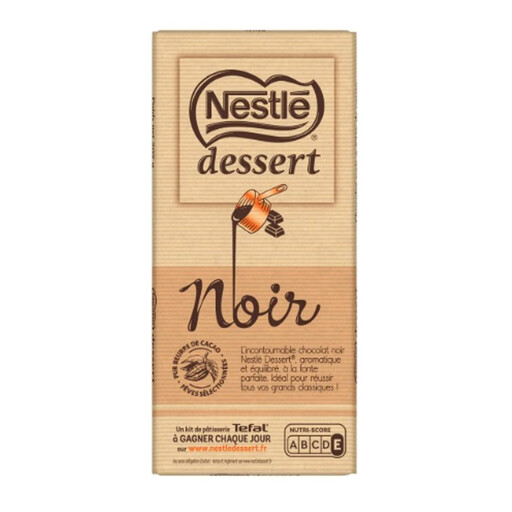 Image unavailable
This 205 g Dessert bar is worth considering if your recipe calls for melted or incorporated chocolate. To choose a specific flavour intensity, check the cocoa percentage on the packaging. Also look out for warnings about possible traces of milk and nuts.
A baking chocolate bar with around 51–53% cocoa is a good starting point. The Auchan product page describes the Lindt DESSERT 51% bar as milder than its 70% version, but the flavour of your cake also depends on the other ingredients in your recipe.
No. Santé publique France says that displaying the Nutri-Score is voluntary. Whether it’s shown or not, check the ingredients, allergens and nutritional information when comparing the chocolates you’re considering.
Check its product name, net weight, ingredients, allergens and nutritional information, then compare the pack size with the amount required by your recipe. Check the packaging again when your order arrives, especially if you have an allergy.
Follow the instructions on the bar you’ve bought. The Auchan product pages for Nestlé DESSERT products recommend storing them in a cool, dry place away from light. Always check the packaging for the storage instructions for your specific product.