Stick with milk baking chocolate if you’re after a smooth, creamy dessert. For a more pronounced cocoa flavour, choose dark chocolate with around 51% or 70% cocoa, depending on how intense you want it. Before swapping the chocolate specified in a recipe, check the product description, sugars per 100 g and allergens too: the cocoa percentage alone doesn’t tell you everything about the bar.
Who are these options for?
Those looking for a pronounced cocoa flavour
If you want the chocolate to take centre stage in your dessert, a 70% dark baking chocolate bar fits the intense profile described by Lindt France for its DESSERT range. Bear this intensity in mind before swapping it for milk chocolate.
Households that prefer a sweeter taste
For a cake aimed at people who aren’t keen on cocoa’s bitterness, milk baking chocolate keeps things creamy. A dark chocolate with around 51% cocoa offers a more pronounced chocolate flavour without going straight for a 70% bar.
Those who pay close attention to the label
If you need to check ingredients, allergens or sugar content, compare the exact products rather than relying on the broad categories of “milk” or “dark”. Check the packaging again if you switch to a different bar or pack size.
What should you check before choosing?
Start with the flavour you want from your recipe, then check whether the chocolate is suitable for baking, read the label and work out how much you need.
| What to consider |
What to check |
Who is it for? |
| Cocoa intensity |
Whether it is described as “milk” or “dark”, and the cocoa percentage shown. |
If I want the chocolate to stand out in my fondant, I’m looking for a pronounced cocoa flavour rather than a creamy result. Around 31% of consumers put this intensity at the top of their list. |
| Suitability for the recipe |
Whether it is labelled “baking” or “dessert”, and the quantity required by the recipe; don’t assume how it will melt based on the cocoa percentage alone. |
When my recipe calls for melted chocolate, I want to choose a bar intended for baking and make sure I have the right amount. Around 31% of consumers say suitability for the recipe is their top priority. |
| Label and allergens |
The ingredients and allergen information, followed by the sugars and saturated fat per 100 g. |
If I’m making a dessert for someone who needs to avoid an ingredient, I check the packaging of the product I’ve bought before I start cooking. Around 23% of consumers prioritise these label checks. |
| Pack size |
The weight of the bar or multipack compared with the amount needed for the recipe. |
For a recipe with a precise weight requirement, I look for a pack that gives me enough chocolate to measure out the amount I need. Pack size is the top consideration for around 15% of consumers. |
Common mix-ups to avoid
-
Assuming “dark milk chocolate” is a single product category
Here, “dark” refers to dark chocolate, while “milk chocolate” is a different category. For milk chocolate, the French decree published by Légifrance sets requirements including at least 30% total dry cocoa solids and 18% dry milk solids.
Choose the description shown on the bar: “milk baking chocolate” for a sweeter recipe, or “dark baking chocolate” with its cocoa percentage for a more pronounced flavour.
-
Treating the cocoa percentage as a nutritional profile
The percentage doesn’t replace the ingredients list or nutritional information. On its own, it won’t tell you how much sugar or fat a particular product contains.
To compare two bars intended for the same use, check their nutritional values per 100 g. If there’s a Nutri-Score on the packaging, treat it as additional information, not a verdict on the recipe.
-
Ignoring “may contain” statements
The words “dark chocolate” aren’t enough to establish whether a bar is suitable for someone avoiding milk, soya or nuts.
If you’re baking for someone with an allergy, check the ingredients list and the statements on the exact product packaging before using it.
Brands and ranges to consider
Lindt
According to Lindt France, the DESSERT range includes milk baking chocolate as well as dark chocolate bars with 51% and 70% cocoa.
- These descriptions make it easier to choose between a sweeter recipe and a more pronounced cocoa flavour.
- For the exact bar, check the ingredients and any statements about soya, milk and nuts in particular.
Nestlé Dessert
The Carrefour France product listing for Nestlé Dessert 70% dark chocolate states that this product contains at least 70% cocoa.
- This makes it easy to identify a dark chocolate bar when your recipe calls for a pronounced cocoa flavour.
- Check the product’s label and weight before using it in a recipe designed for a different type of chocolate.
Carrefour
The Carrefour France catalogue lists Carrefour dark dessert chocolate in a pack of 3 × 200 g.
- The multipack size can be compared with the quantity needed for several recipes.
- Check the ingredients and allergens on the listing or packaging for the exact pack.
Tablette d’Or (E.Leclerc)
E.Leclerc lists a 200 g Tablette d’Or Dark Baking Chocolate bar.
- Its ingredients list includes cocoa mass, sugar and cocoa butter.
- The word “dark” doesn’t replace checking the nutritional information and allergens on the bar you buy.
A dark baking chocolate option on Joybuy
This dark dessert chocolate is suitable for home-baking recipes that call for chocolate to be melted. If you’re looking for a specific intensity, check its cocoa percentage before choosing it.
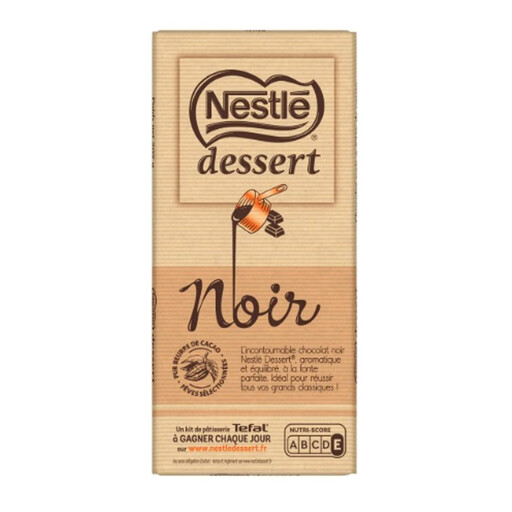 Image unavailable
Nestle Dark Dessert 205 g
This dark dessert chocolate is made for baking and melting. The bar weighs 205 g. If your recipe calls for milk chocolate or a specific cocoa percentage, check the label before swapping it in. If you have an allergy, also check the packaging for statements about milk and nuts.
View on Joybuy
Frequently asked questions
Can you swap milk chocolate directly for 70% dark chocolate?
Not if you want to keep the same level of sweetness: 70% dark chocolate will give the recipe a more pronounced cocoa flavour. For a subtler change, consider a dark chocolate bar with around 51% cocoa. In either case, taste the mixture and adjust the recipe rather than assuming the result will be the same.
Is Nutri-Score mandatory on a chocolate bar in France?
No. The Directorate General for Competition Policy, Consumer Affairs and Fraud Control describes Nutri-Score as a voluntary label. In general, prepacked foods must carry a nutrition declaration, so compare the sugars and fat per 100 g on the bars you’re considering.
Does the French tax on sugary drinks apply to a chocolate bar?
No. Article 1613 ter of the General Tax Code, published by Légifrance, applies to drinks and liquid preparations for making drinks, not solid chocolate bars. To compare the composition of two chocolates, check their sugar content per 100 g instead.
Is dark baking chocolate suitable if a guest needs to avoid milk?
Don’t rely on the word “dark” alone. Read the ingredients list and any “may contain” statements for the exact product, including if you switch to a different pack size, to check whether it’s suitable for the required avoidance.


