For making a cheesecake base
You want to crush the biscuits into crumbs, mix them with butter and press the mixture into a tin. Marmiton lists dry Digestive-style biscuits as one option for this base.


For a cheesecake base that you’ll crush and press into the tin, start with a dry Digestive-style biscuit: Marmiton uses them in a cheesecake recipe and also suggests speculoos and petit-beurre biscuits as alternatives. Choose a chocolate-coated biscuit if you want visible pieces of chocolate, or a filled biscuit if you want the filling to be part of the dessert. In either case, check the ingredients and nutritional information for the specific product you choose.
You want to crush the biscuits into crumbs, mix them with butter and press the mixture into a tin. Marmiton lists dry Digestive-style biscuits as one option for this base.
A chocolate biscuit, a petit-beurre topped with chocolate and a filled biscuit each bring chocolate to the table in a different way. Choose according to the effect you’re after: a chocolate-flavoured base, visible pieces or a filling.
If your recipe uses more than one type of biscuit, compare the sugars and fat per 100 g, then check the ingredients and allergens for each variety. In France, the DGCCRF says that prepacked foods must carry a nutrition declaration; Santé publique France notes that displaying the Nutri-Score is voluntary.
First decide whether the biscuit needs to form a compacted base, provide a particular kind of chocolate or simply supply the amount your recipe calls for. Then compare the labels of products suited to that purpose.
| What to consider | What to check | Who is it for? |
|---|---|---|
| How well the base holds together | Look for a dry biscuit and check that its texture suits your recipe. If it has a thick chocolate coating, try crushing one first. | For a cheesecake, you need to be able to make crumbs and then press the mixture into the tin. Around 36% of consumers put making this base first. |
| Ingredients | Compare the sugars and fat per 100 g, and check the allergens on the exact pack. | When a dessert includes several types of biscuit, I want to know what’s in them before choosing. Reading the label is the priority for around 29% of consumers. |
| How the chocolate is presented | Check whether the chocolate is in the biscuit, in a bar or coating, or in a filling; read the product description. | For decoration, I’m looking for visible pieces of chocolate; for another dessert, I might prefer a filling. The type of chocolate comes first for around 21% of consumers. |
| Pack size | Check that the pack weight matches the quantity required by your recipe. | If my recipe calls for a specific quantity of biscuits, I want to know how many packs to buy. This is the main concern for around 14% of consumers. |
The name of a biscuit doesn’t tell you what’s in it. Carrefour’s listing for McVitie’s dark chocolate biscuits gives 496 kcal per 100 g; this figure applies to that specific product.
Start by choosing a texture that suits your recipe, then compare the nutritional values per 100 g of the products you’re considering.
Santé publique France says that displaying it is voluntary. If it’s not shown, check the nutrition declaration instead; the DGCCRF says this is compulsory for prepacked foods.
If the Nutri-Score is displayed, use it as additional information and check the sugars, fat, salt and ingredients too.
E.Leclerc’s P’tit Déli petit-beurre is topped with a bar of milk chocolate, while Auchan describes Milka Choco Pause as a filled biscuit. These are different styles, so they won’t create the same look in a dessert.
For a pressed base, start with the biscuit’s texture; for visible pieces or a filling, choose the style that gives you the result you want.
Depending on the product, the biscuits listed by Carrefour and Auchan contain wheat, milk, soya, eggs or nuts. Mixing a biscuit with other ingredients doesn’t remove these allergens.
Check the label on the pack you’re using, especially if the dessert is for someone with an allergy.
Carrefour lists a 266 g dark chocolate biscuit that could be a good choice if you’re looking for a chocolate Digestive.
The products listed by Auchan let you choose between a biscuit coated in milk chocolate and a filled biscuit.
Carrefour lists 285 g packs of BN chocolate biscuits, as well as a separate variety with chocolate-flavoured chips and a milk chocolate-flavoured coating.
Carrefour’s listed product is a chocolate-filled biscuit, worth considering if you’re looking for a filling.
E.Leclerc lists a petit-beurre topped with a bar of milk chocolate, an option to consider if you want visible pieces of chocolate.
This selection features a petit-beurre topped with milk chocolate, for desserts where this style of biscuit is what you’re after. For a cheesecake base, Marmiton lists petit-beurre biscuits among the possible dry biscuits; remember to take the chocolate coating into account in your recipe.
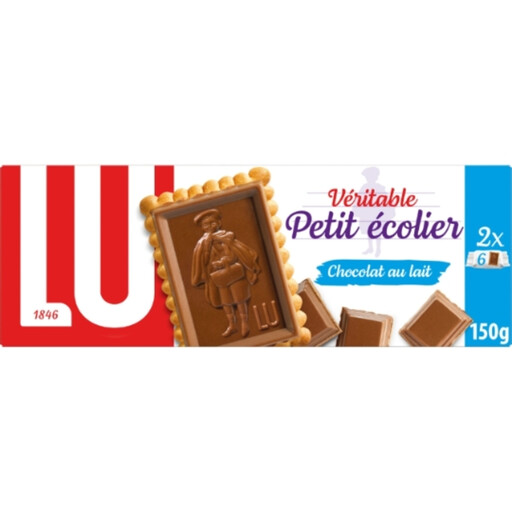 Image unavailable
Worth considering if you want to use pieces of milk chocolate biscuit in your dessert. The pack contains 150 g of butter biscuits coated in milk chocolate; check the ingredients and allergens on the packaging before use.
No, this levy doesn’t apply to biscuits. The French Directorate General of Public Finance describes it as applying to non-alcoholic drinks containing added sugars. If you want to compare the sugars in biscuits, check their nutrition declarations instead.
No: Santé publique France says that displaying it is voluntary. In France, the DGCCRF says prepacked foods must carry a nutrition declaration. If you’re choosing between two products, compare their values per 100 g in particular.
Crush the dry biscuits, mix them with melted butter, then press the mixture into the base of your tin. A Marmiton recipe calls for 200 g of Digestive-style biscuits and also suggests speculoos or petit-beurre biscuits; follow the quantities in the recipe you’re making.
Read the label on the product you buy: depending on the variety, the examples listed by Carrefour and Auchan contain wheat, milk, soya or eggs. Carrefour also lists hazelnut and notes that its Classic’ filled biscuit may contain other nuts.
Follow the instructions on the pack. For Milka Choco Pause, Auchan recommends storing the biscuits away from heat and moisture; instructions may differ for other products.