What should you check?
Start with the sugar claim, then check the ingredients and nutritional values. Before placing your order, make sure the product page matches the biscuit and pack size you’ve chosen.
| Criterion |
What to check |
Who is it for? |
| Sugar claim |
Compare the exact claim with the ‘of which sugars’ figure per 100 g. Anses reminds consumers that ‘with no added sugars’ does not mean sugar-free. |
I want to start by choosing according to sugar content, without confusing a reduction with the absence of sugars. Around 31% of consumers would prioritise this need. |
| Ingredients and allergens |
Read the ingredients list and declared allergens, including any relevant ‘may contain’ statements. |
If I need to avoid a particular ingredient, the sugar claim doesn’t answer my main question. Around 31% of consumers would put this compatibility first. |
| Nutritional values |
Compare the nutritional information per 100 g, including sugars, fat, fibre and salt where listed. |
I’m comparing several recipes and don’t want to decide based solely on the ‘reduced in sugars’ claim. Around 23% of consumers would put this overall comparison first. |
| Product page and ordering |
Check the product information before confirming your basket, then verify the pack size and ordering options shown for your selection. |
I’m ordering online and need enough detail on the product page to identify the right packet. For around 15% of consumers, this would be the main criterion. |
An option on Joybuy
This selection features spring onion biscuits to consider if you’re looking for a recipe described as reduced in sugars. Compare the product information with your ingredient criteria before ordering.
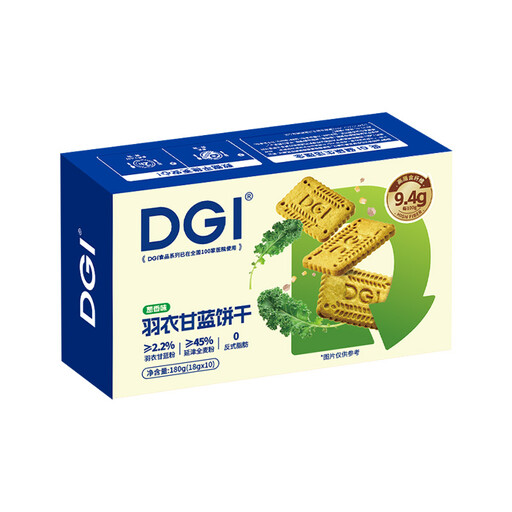 Image unavailable
DGI Kale Cookies Green Onion Flavour, 180 g
Worth considering if you’re looking for biscuits whose sugar content per 100 g you can compare before ordering. The product information lists maltitol and wheat, and warns that excessive maltitol consumption may have a laxative effect. Read the ingredients, allergen information and nutritional details for the product.
View on Joybuy
Frequently asked questions
Is Nutri-Score compulsory on biscuits sold in France?
No, it is not generally required under the INCO Regulation. The European Commission distinguishes between the nutrition declaration, which is mandatory for most prepacked foods, and voluntary supplementary front-of-pack labelling. Compare the available nutritional information even if there’s no Nutri-Score.
What information should I be able to check before ordering biscuits online?
According to the European Commission, the applicable mandatory food information must be available before a distance purchase is completed. The best-before or use-by date may be provided at delivery. Check the product name, ingredients, allergens and nutrition declaration where these apply to the product.
Does ‘with no added sugars’ mean sugar-free?
No. Anses explains that ingredients may contain naturally occurring sugars despite this claim. To find out the stated sugar content of the biscuits, check the ‘of which sugars’ figure per 100 g.
Are ‘sugar-free’ biscuits necessarily free from sweeteners?
No. Carrefour lists maltitols in the ingredients of its Gerblé Nature Sugar-Free Biscuits. Check the ingredients list for the specific product you choose rather than relying on the claim alone to tell you what it contains.
Is a Nutri-Score letter shown on a product always calculated using the current method?
No. E.Leclerc states that the Nutri-Score C shown for the relevant Grainea biscuits is based on the previous calculation, from before April 2025. Bear this in mind before using the letter to compare products.


