
当日/次日达

品质保障

开启新人专享福利: 全场免邮 | 低至 2 折 | 免费试用 30 天 JoyPlus 会员
下载 Joybuy
A flat battery never seems to go flat at a convenient moment: an early morning departure, returning from holiday, a loaded van, or a motorbike that's been sitting idle for weeks. Yet choosing a car battery charger isn't simply a matter of comparing the number of amps on the box. The wrong device can needlessly prolong charging times, fail to recognise your battery's technology, or prove frustrating to use day in, day out.
A 12 V battery charger gradually recharges the battery from a mains socket. It's designed to restore a battery to good condition, maintain it, or keep its voltage topped up during long periods of inactivity.
A battery booster, also known as a portable jump starter, works differently: it delivers a powerful surge to help the engine start. It doesn't necessarily provide a full recharge. For a motorhome, a boat, a vehicle parked outside, or journeys through remote areas, these two devices can complement each other.
A high current isn't automatically suitable for every battery. A 20 A charger might be fine for some vehicles, but it's far too powerful for a small motorbike or scooter battery. Conversely, a 2 A model will take much longer to recharge a large van battery.
So check the voltage, the battery capacity, the type of vehicle and how you intend to use it: occasional recharging, winter maintenance, or the odd emergency top-up.
A conventional lead-acid battery doesn't charge in the same way as an AGM, GEL, Lithium or LiFePO4 battery. Some automatic chargers offer multiple programmes, while others are limited to a single battery family.
Before you order, check the label on your battery and the compatibility listed on the product page. This simple step will stop you from buying a charger designed for a motorbike when you need one for a car, or using a device that's incompatible with a lithium battery.
For a standard car, a current between 4 and 6 A is usually fine for maintenance and gradual recharging. Larger vehicles, vans or heavily discharged batteries may need a more powerful unit, provided the battery is compatible.
Power, measured in watts, gives you an extra point of reference. The XLPT 6A, for example, delivers a maximum power of 100 W, compared to 35 W for the XLPT 2A model.
An automatic battery charger normally adjusts the current through the different charging phases. This takes the hassle out of manual adjustments and is ideal for a vehicle that's parked up for days or weeks at a time.
The programmes on offer are also worth your attention. Some models distinguish between standard, AGM/GEL, motorbike and LiFePO4 batteries. Maintenance, diagnostic or power supply modes can also come in handy in specific situations – for example, when you need to replace a battery without losing certain electronic settings in the vehicle.
Choose a device with built-in protection against reverse polarity, overcharging, overheating, short circuits and power surges. Cable length also affects ease of installation: a 2 to 3 metre cable can make connecting much simpler when the battery is tucked away in a hard-to-reach compartment.
A rating such as IP65 indicates protection against dust and water splashes, within the limits set by the manufacturer. It doesn't mean the charger can be submerged. If you plan to use it in a garage, on a patio or near a motorhome, read the operating instructions carefully.
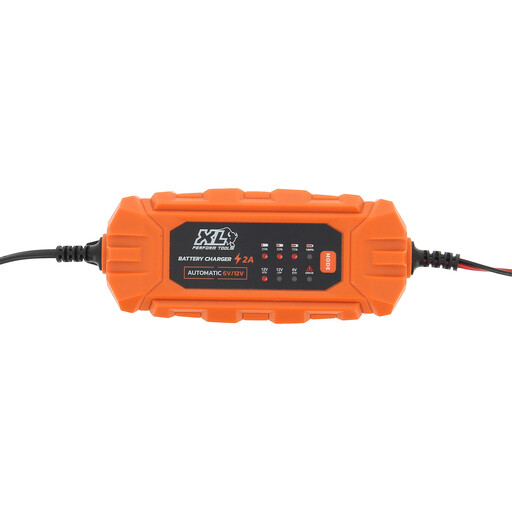
Why this is a smart choice: its compact size makes it ideal for maintaining a motorbike, scooter, lawnmower or small vehicle, without a host of complicated settings.
It doesn't rely solely on a high current and features automatic current management, with compatibility for lead-acid, AGM, GEL, Lithium and LiFePO4 batteries.
Maximum current of 2 A, maximum power of 35 W, 3 m cable and IP65 protection rating as stated by the manufacturer.
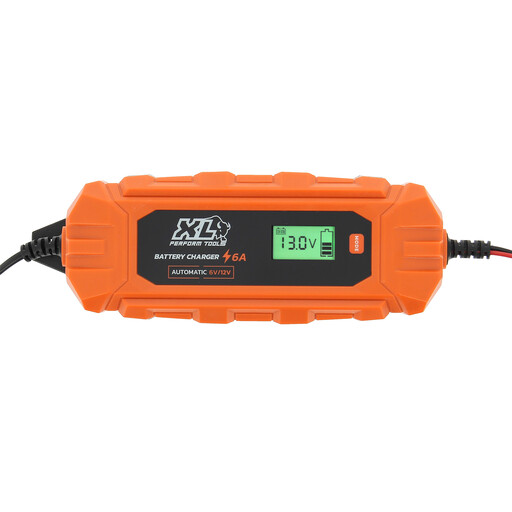
Why this is a smart choice: it's aimed at owners of cars, SUVs or light vans who want to keep a closer eye on the charging process.
Its digital display lets you monitor the charging status, while the SUPPLY mode is designed to preserve certain vehicle data when replacing the battery.
Maximum current of 6 A, maximum power of 100 W, digital display, 3 m cable and stated compatibility with lead-acid, AGM, GEL, Lithium and LiFePO4 batteries.
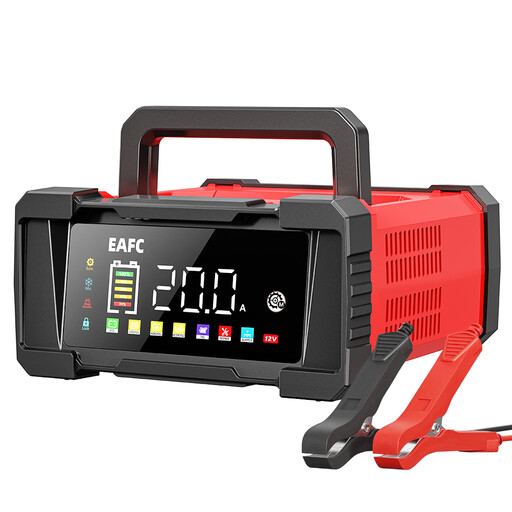
Why this is a smart choice: its various modes make it suitable for a family garage, a boat owner, a ride-on mower or a van.
It distinguishes between 12 V and 24 V use and features protection against reverse polarity, power surges, overcurrent and short circuits.
Stated current up to 20 A in 12 V, seven modes, colour display, 2 m cable and stated compatibility with lead-acid, AGM, GEL and LiFePO4 batteries.

Why this is a smart choice: this portable jump starter fits in the boot and provides a backup solution for cars, motorbikes, SUVs, vans and boats running on 12 V.
It doesn't need a mains socket at the time of breakdown and features smart cables along with several protections as stated by the manufacturer.
We've put together a comprehensive, real-time updated list of products that meet these exacting standards, all while complying with European safety regulations.
A fast battery charger can cut down on waiting time, but speed should never come before compatibility and safety features. For an electric vehicle, look instead for an electric vehicle charger with a Type 2 connector, a power rating suited to your installation, and a residual current device that matches your setup.
It all depends on the battery's capacity, how discharged it is, and the charger's current. A lower-powered model is fine for maintenance, but recharging will take longer. Check the information on the battery and the instructions supplied with the charger.
Some automatic chargers have a maintenance mode and multi-stage charging management. That doesn't mean you can ignore the instructions – make sure the area is ventilated and the device is placed in a dry, stable location.
No. A booster provides a one-off helping hand to start the engine, whereas a charger gradually restores energy to the battery. If breakdowns keep happening, have the battery and the vehicle's charging system checked.