
Livraison le jour même ou le lendemain

Qualité garantie

Débloquez vos offres de bienvenue: Livraison GRATUITE | Jusqu'à -80 % | 30 jours d'essai gratuits à JoyPlus
Téléchargez l'application
A dead battery: every driver's nightmare, especially when you're short on time. On a frosty winter morning, or just after returning from holiday… finding your vehicle won't start can quickly turn into a major hassle. Much more than a simple jump-starting tool, a smart car battery charger is an essential ally for preventive maintenance. It extends your battery's lifespan and provides genuine peace of mind.
This guide is here to help you make sense of it all. As the Head of Product Recommendations at Joybuy, my role is to guide you to the model that truly meets your needs, with full transparency and without the confusing marketing jargon.
Before jumping on the first model you see, it's crucial to understand a few key criteria that make all the difference. Here are the essential points to check to ensure you make the right choice.
The first and most obvious criterion: compatibility with your vehicle.
A good smart charger does much more than just "fill up" the battery. It offers several essential modes.
The power, expressed in amps (A), directly affects the charging speed. A 6A charger is sufficient for most car batteries, but a 10A, 12A, or higher model will significantly reduce the waiting time.
It is imperative to verify that the charger includes essential protections: reverse polarity, short circuit, overheating, and overvoltage. These safeguards are indispensable to avoid damaging your battery or your vehicle's onboard electronics.
Here is our selection of models that stand out for their versatility and performance, designed to meet every need.
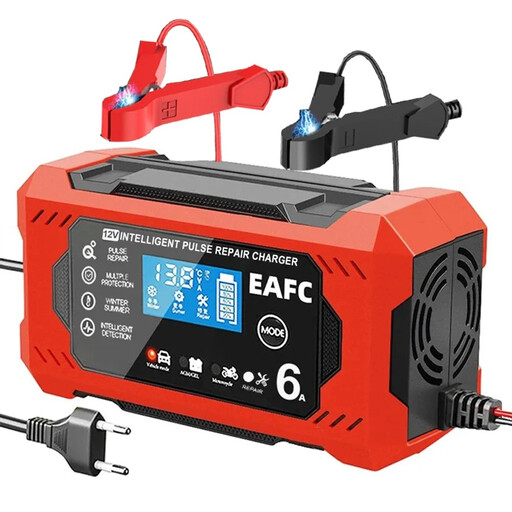
Key Features This model is the perfect solution—both affordable and effective—for the routine maintenance of car and motorcycle batteries. It's incredibly simple to use: just plug it in, select the mode (car, AGM, motorcycle), and let it do its job. Its LCD screen displays the voltage, current, and charging progress in real time.
Advantages:
Who is it for? Perfect for the car or motorcycle owner looking for a reliable, hassle-free tool for charging and maintaining their 12V battery (capacity from 4Ah to 100Ah).
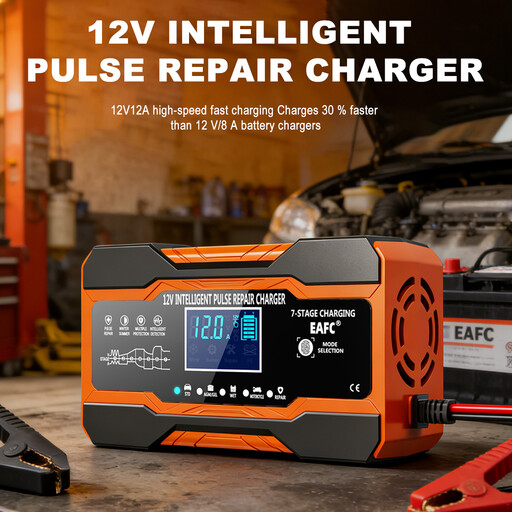
Key Features Stepping up in the range, this charger stands out with its 12V and 24V compatibility and higher charging power (10A for 12V, 5A for 24V). It is particularly versatile, offering not only several modes (car, motorcycle, AGM...) but also smart adaptation to the ambient temperature (summer/winter modes) to adjust the voltage and ensure an optimal charge in any season.
Advantages:
Who is it for? The ideal tool for those who work with multiple types of vehicles (car, motorcycle battery charger, small truck) or for demanding DIYers who want a powerful and versatile all-rounder.
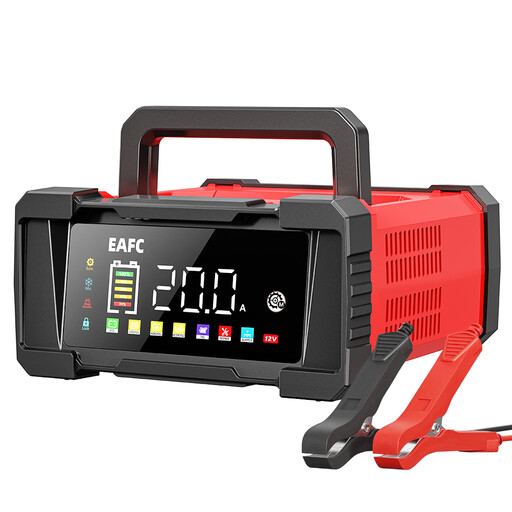
Key Features This model is for those who make no compromises on performance and compatibility. With its fast charging current of 20A (in 12V), it literally cuts the waiting time. Its key advantage is universal compatibility, covering not only lead-acid, AGM, and GEL batteries, but also modern Lithium LiFePO4 batteries.
Advantages:
Who is it for? Aimed at automotive enthusiasts, and owners of boats, commercial vans, or recreational vehicles equipped with lithium batteries. This is the expert's choice, for whom speed, advanced features, and total compatibility are non-negotiable criteria.
Our selection covers the most common needs, but every user is unique. Need a different power level, a specific feature, or simply want to compare other models? Feel free to explore our complete catalogue.
Discover our full range of equipment for Vehicle & Charging and find the tool that belongs in your garage.
1. Can you leave a smart battery charger permanently connected? Absolutely. This is one of the major benefits of a smart battery maintainer. Once charging is complete, it automatically switches to "maintenance" (or floating) mode. It then delivers a very low-intensity current, just enough to compensate for the battery's natural self-discharge. This keeps your battery at 100% capacity with no risk of overcharging. It's the perfect solution for winterizing a motorcycle or maintaining a classic car.
2. Can a charger really repair a battery? The battery repair function can indeed be effective, but it's not a miracle cure. Its purpose is to reverse the sulphation process: when lead sulphate crystals build up on the plates of a lead-acid battery that has been left discharged for too long, its capacity decreases. The electrical pulses sent by the charger can help dissolve these crystals and thus restore some of the lost capacity. However, this function is powerless against a physically damaged battery (short circuit, broken plates) or one that is simply at the end of its life.
3. What is the difference between a car charger and a motorcycle charger? The essential difference lies in the charging current (amperage). Motorcycle batteries have a much lower capacity (in Ah) and therefore require a much gentler charging current to avoid damage. This is why most smart chargers offer a dedicated motorcycle battery charger mode, which limits the output current to 1 or 2A. Using a standard, overly powerful car charger on a small two-wheeler battery would risk causing it to overheat and drastically reduce its lifespan.