
当日/次日达

品质保障

开启新人专享福利: 全场免邮 | 低至 2 折 | 免费试用 30 天 JoyPlus 会员
下载 Joybuy
A dead battery. It's every driver's nightmare, especially in the dead of winter. To ensure you never face this hassle again, getting a car battery charger is the simplest solution. The problem is, the market is flooded with models making tempting promises, and it's easy to make a mistake and a poor investment. As our editorial team's product expert, my mission is to help you navigate the pitfalls and make the right choice, without breaking the bank.
Finding your way through the jungle of battery chargers can quickly become a headache. Too many buyers end up with a device that's ineffective or, worse, dangerous for their vehicle. Here are the 3 mistakes you must not make:
You don't need to be an expert to make the right choice. You just need to focus on a few essential technical criteria. These are what guarantee the efficiency, safety, and versatility of your future charger.
This is the starting point: check the charger's compatibility with your battery.
Forget the old manual chargers that required constant supervision. A modern automatic car charger, controlled by a microprocessor, optimises the charge in several intelligent stages (diagnosis, desulfation, main charge, absorption, maintenance).
This fine-tuned management protects the battery from any overcharging. Once the battery is full, it automatically switches to charge maintainer mode, compensating for its natural self-discharge. This means you can leave it connected for several weeks or months, an ideal solution for the winter storage of a motorcycle or a classic car.
The amperage (A) defines the charging speed. Simply put: the higher it is, the faster the charge.
Here again, a good smart battery charger stands out: it adjusts the amperage itself according to the battery's condition, for a charge that is as fast as it is safe.
To put theory into practice, here is our selection of models that tick all the boxes for safety and performance, catering to different user profiles.
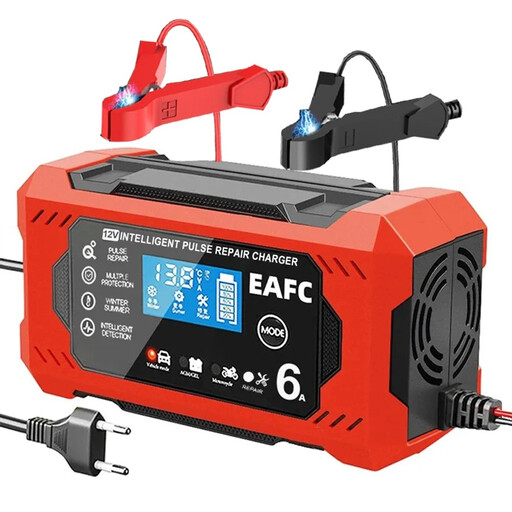
Why you need this model: Perfect for anyone looking for a 'plug-and-forget' solution for maintaining a car or motorcycle battery. Its compact design and simplicity make it the ideal tool for occasional fixes and winter maintenance charging.
It includes essential safety protections (reverse polarity, short circuit) and its broad compatibility with lead-acid batteries (AGM, GEL, WET) protects you from unpleasant surprises.
Its fully automatic mode and crystal-clear LCD screen make it accessible to everyone, even without any technical knowledge. The pulse repair function is a real bonus for long-term maintenance.
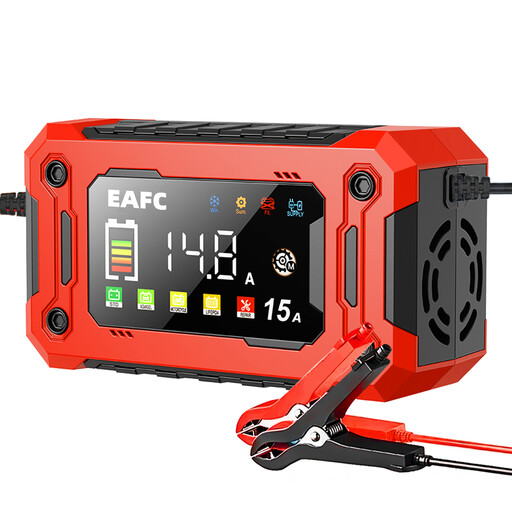
Why you need this model: The perfect tool for enthusiasts and owners of multiple vehicles (car, SUV, motorcycle). Its 15A power offers an excellent balance between speed and safety, while its large screen allows for precise monitoring of all operations.
Its broad compatibility with lead-acid batteries, including Start-Stop models (EFB/AGM), eliminates the risk of error. The automatic shut-off at 100% charge is a non-negotiable safety feature.
Its seasonal charging modes (winter/summer) adapt the voltage to the ambient temperature. This is a detail that makes all the difference in optimising performance and extending battery life.
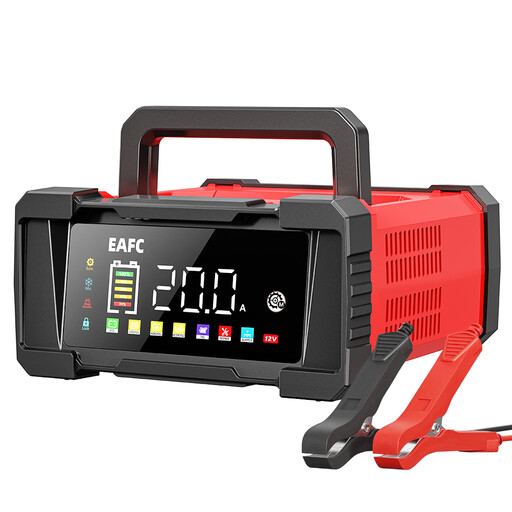
Why you need this model: This is the Swiss Army knife of chargers, designed for heavy-duty use. Its high charging power (20A) and dual 12V/24V compatibility make it the perfect ally for owners of large SUVs, commercial vehicles, boats, or even for workshop use.
It eliminates any compatibility issues by handling not only lead-acid batteries (AGM, GEL) but also Lithium (LiFePO4) models. Its 10 levels of protection make it one of the most secure devices on the market.
Its 9-step intelligent charging process, with a full diagnosis and pulse repair, provides true battery care to maximise its performance and longevity.
To find the model that perfectly matches your needs, discover our complete selection of chargers that meet all our criteria for performance and safety.
1. Can you leave a charger connected permanently? Yes, but only if it is a smart battery charger (also known as a charge maintainer). These devices detect when the battery is full and switch to a 'maintenance' (or floating) mode, which delivers a very low current to compensate for natural self-discharge. This keeps your battery at 100% without any risk of overcharging. It's the perfect solution for winter storage or any long-term vehicle inactivity.
2. Can the "repair" function really save a dead battery? No, and this is a critical point. The pulse repair function is designed to dissolve the sulfate crystals that form on a battery's lead plates (a common phenomenon in a little-used vehicle or after a deep discharge). This process can indeed restore some lost capacity, but it is powerless against a battery with a short-circuited cell, physical damage, or one that is simply at the end of its life.
3. What's the difference between a 6A, 15A, and 20A charger? The amperage (A) corresponds to the charger's "flow rate." It's what determines the charging speed.