
Livraison le jour même ou le lendemain

Qualité garantie

Débloquez vos offres de bienvenue: Livraison GRATUITE | Jusqu'à -80 % | 30 jours d'essai gratuits à JoyPlus
Téléchargez l'application
A flat battery can leave a city car, SUV, van or motorhome stranded without warning. A car jump starter will usually get you back on the road without waiting for help from another driver, as long as you choose a model that’s compatible with your vehicle and look after it properly.
There are a few pitfalls to watch out for, though. A very high peak current doesn’t automatically mean a jump starter is suitable for your engine. Similarly, a high capacity in mAh can give the impression of greater power without delivering better starting performance. Here’s what to look for before buying a portable car jump starter.
Measured in amps, peak current is the maximum value stated by the manufacturer under certain conditions. On its own, it won’t tell you whether the device can start your vehicle. Check the specifications for your engine in particular:
A model designed for a small petrol car won’t necessarily meet the needs of a diesel, van or boat.
Capacity in mAh gives you an idea of how much energy is stored, but measurement methods can vary between manufacturers. When comparing car jump starters, also consider the voltage, energy in Wh where stated, starting current and built-in features.
A high capacity can be useful for charging a phone or tablet. But you’ll still need to check how much power is actually available for starting your vehicle.
A jump starter kept in the boot needs to withstand cold, heat and changing temperatures. A lithium battery left in storage for several months without being recharged may not work when you need it. The instructions generally recommend recharging it regularly, often every two or three months.
Also check for sufficiently long cables, a storage case, a charge indicator and protection against reverse polarity, short circuits and overcharging.
For a small petrol car, a 12 V battery booster rated at 1 000 to 1 500 A may be suitable in some cases, subject to the product specifications. For a diesel, SUV, van or motorhome, it’s better to allow a more generous margin.
Specifications sometimes include limits such as ‘up to 6.0 l petrol and 4.0 l diesel’. This is a compatibility indication from the manufacturer, not a guarantee that the device will work regardless of the battery or weather conditions.
Choose a model that gives an audible or visual warning if the clamps are connected incorrectly. Useful safety features include:
Read the instructions before using the device for the first time. In general, the red clamp connects to the positive terminal and the black clamp to the negative terminal or a suitable earth point, as directed by the vehicle manufacturer.
A portable car battery charger can also double as a power bank thanks to its USB ports. An emergency LED car light with steady, flashing or SOS settings can be invaluable if you need to work at night. Some devices also include a portable car air compressor, with a pressure display and automatic shut-off.
These features make a device more versatile, but they also add to its weight, price and the number of components to maintain. Choose features to suit your needs, whether that’s city driving, long journeys, camping, boating or professional use.
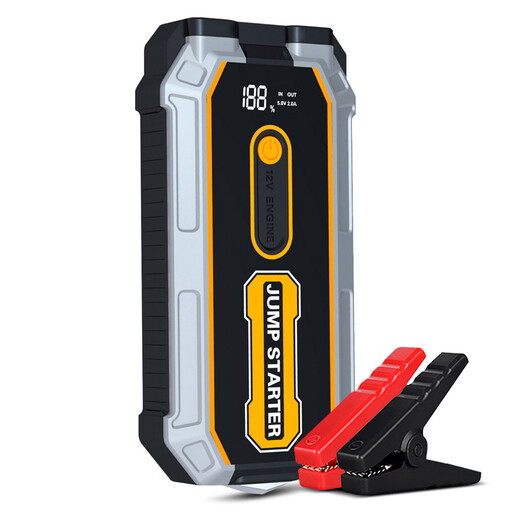
Why it’s a good fit for this type of user : At 165 × 84 × 30 mm and an advertised weight of around 330 g, it’s easy to store in a glove compartment or emergency kit. Its product information states that it’s compatible with 12 V petrol and diesel vehicles.
The LCD screen lets you check the charge level before setting off. The product information lists a capacity of 12 800 mAh and a peak current of 1 200 A, and recommends regular recharging.
12 V battery, 10 W USB output, three-mode light and compact design.
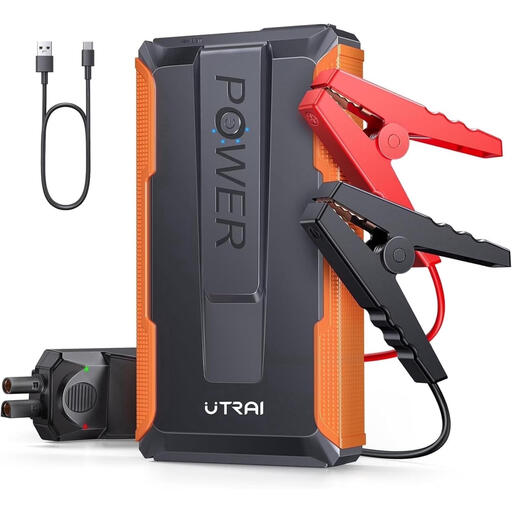
Why it’s a good fit for this type of user : This model combines an advertised peak current of 2 000 A, a 13 200 mAh battery according to its description, and USB-C charging. It’s aimed at drivers looking for a versatile device for a car, SUV, van or small 12 V boat.
The smart clamps warn you about issues such as reverse polarity, overheating and sparks. The product information gives an operating range of -20 °C to +60 °C; still, check the instructions before use.
USB Quick Charge 3.0, steady, flashing and SOS lighting, and a unit weighing 0.9 kg.
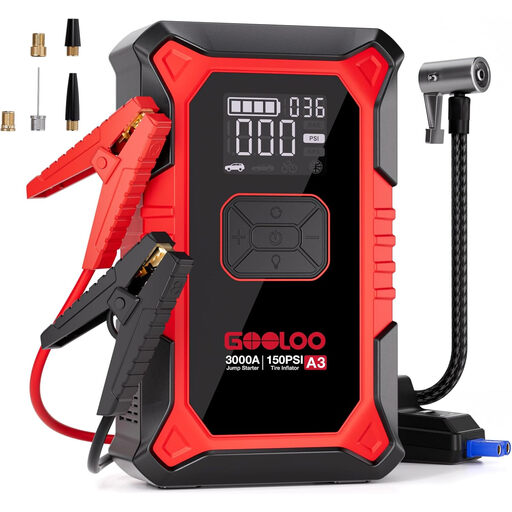
Why it’s a good fit for this type of user : Its built-in compressor complements its jump-starting function for diesel and petrol engines. It’s a good choice for long journeys, leisure vehicles and drivers who want to inflate a tyre without carrying an extra device.
The digital screen displays the pressure, and the automatic shut-off helps prevent it from exceeding your chosen setting. Follow the pressure recommended by your vehicle manufacturer rather than the maximum pressure listed.
Advertised peak current of 3 000 A, compressor up to 150 PSI and five modes for different attachments.
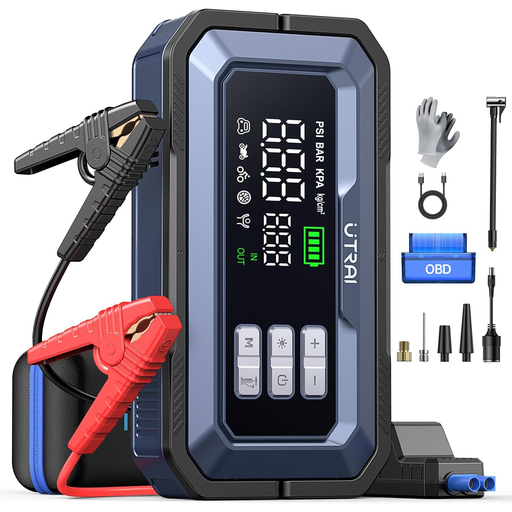
Why it’s a good fit for this type of user : The product information states that it’s compatible with diesel engines up to 14 l, and includes a built-in compressor, a 160 W 12 V output and an OBD2 code reader. It’s designed for vans, SUVs, motorhomes and professional use.
Charge, pressure and mode information is shown on the screen. However, the ten advertised safety features should be used in accordance with the manual and don’t replace a vehicle diagnosis.
Advertised peak current of 7 000 A, 150 PSI compressor, 2 000-lumen light and 18 W USB-C PD charging.
We’ve put together a comprehensive, regularly updated selection of products that meet these strict criteria as well as European safety requirements.
Never use the device on a battery that’s visibly damaged, swollen, leaking or frozen. A jump starter is designed for occasional emergencies: it doesn’t replace a check-up for an ageing battery or maintenance of the charging system.
It depends on the engine and fuel type. A small petrol car generally needs less current than a diesel or van. Compare the maximum engine size supported and 12 V compatibility rather than focusing on the amp rating alone.
Yes, but protect it from extreme temperatures, damp and direct sunlight. Check its charge level regularly and recharge it according to the instructions, usually every two or three months.
No. A jump starter provides a temporary boost to get the engine running. A mains charger or a charger designed for your vehicle recharges the battery gradually. If the battery keeps going flat, have the battery, alternator and any equipment that draws power while the vehicle is parked checked.