
Livraison le jour même ou le lendemain

Qualité garantie

Débloquez vos offres de bienvenue: Livraison GRATUITE | Jusqu'à -80 % | 30 jours d'essai gratuits à JoyPlus
Téléchargez l'application
A flat battery or under-inflated tyre can turn a simple journey into an interminable wait by the roadside. A battery booster with compressor generally combines a portable jump starter, tyre inflator, emergency LED light and USB charging function.
However, the figures printed on the packaging are not always enough to help you make the right choice. A spectacular peak current, a stated pressure of 150 PSI or a high capacity in mAh can conceal certain limitations. Here are the criteria to consider before buying, followed by a selection of models suited to different needs.
Expressed in amps, peak current is the output delivered for a very short period. On its own, it therefore does not tell you whether the booster will be able to start your vehicle. Also check the following :
A booster designed for a small petrol or diesel engine will not necessarily be suitable for a motorhome or a large-capacity diesel commercial vehicle.
A maximum pressure of 150 PSI only indicates the theoretical pressure the compressor can reach. It says nothing about the airflow or how long it will take to inflate a tyre. To assess its performance, also look at :
Automatic shut-off is very convenient : it means you do not have to stay bent over the pressure gauge throughout the entire process. However, you should still check the pressure recommended by the vehicle manufacturer.
A battery booster is not ready to work indefinitely after purchase. Like all lithium batteries, the one inside the unit gradually loses its charge when stored. Depending on the model, manufacturers generally recommend recharging it every 2 to 3 months or every 3 to 6 months.
Store the device in a dry place, away from high temperatures, and check its charge level before a long journey. A carry case also helps protect the cables, hose and various attachments.
For a small petrol city car, a compact model rated at 800 to 1 200 A may match the specifications of some vehicles. For an SUV, commercial vehicle, boat or diesel engine, it is better to allow a more comfortable margin. Always refer to the stated maximum engine capacity rather than relying solely on the amp rating.
Smart jump-lead cables also deserve your attention. Protection against reverse polarity, short circuits, overcharging, overheating and overvoltage helps reduce the risks of incorrect use. However, these features do not replace the correct procedure : red clamp to « + », black clamp to « – » or to a suitable metal earthing point, according to the instructions.
A 150 PSI tyre compressor can be suitable for several uses : car, motorbike and bicycle tyres, as well as inflatables. However, the operating pressure of a car tyre is much lower than 150 PSI. This maximum figure mainly indicates the motor’s capacity : it is not the pressure that should be applied routinely.
Choose a display showing pressure in PSI, bar or kPa, together with an adjustable target pressure. Also observe the breaks recommended by the manufacturer, as the compressor can become hot during prolonged inflation.
The capacity in mAh gives you an indication of the available energy reserve, but actual battery life also depends on the temperature, the age of the battery and the vehicle being started. A good car power bank can also recharge a phone, tablet or GPS device via its USB or USB-C ports.
An emergency LED light offering continuous illumination, a flashing mode or an SOS signal can prove invaluable when inspecting the engine compartment or changing a wheel at night. Finally, remember to check the contents of the box : the hose, attachments, cables, adaptor, USB cable and storage bag are not always included.
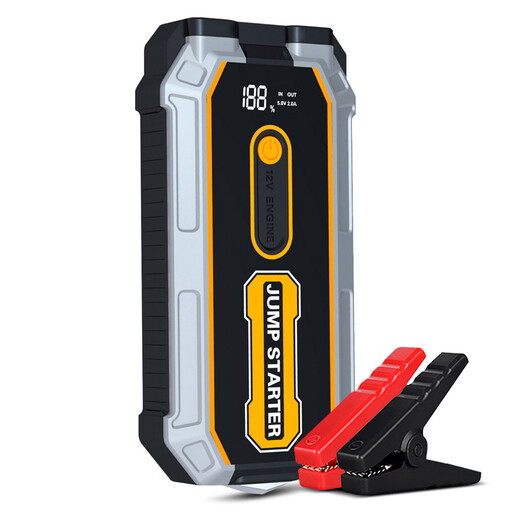
Why this choice suits this user profile : Weighing 330 g, this compact model fits easily in a glovebox or boot, making it ideal for motorists who simply want a backup solution close at hand.
The specifications state 1 200 A peak current, a 12 800 mAh battery and an LCD screen : all the essentials are readily accessible, without an unnecessary collection of features.
USB power-bank function, three-mode lamp and stated compatibility with 12 V petrol and diesel vehicles.
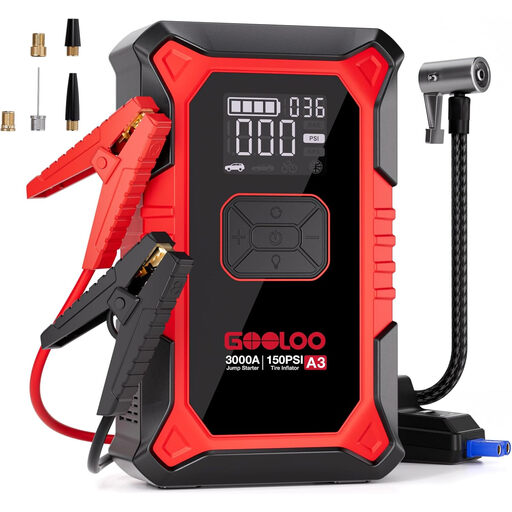
Why this choice suits this user profile : It combines jump starting, inflation and charging in a format suited to everyday journeys, holidays and outdoor trips.
The screen displays the pressure and automatic shut-off helps reduce the risk of over-inflation, provided the target pressure has been set correctly.
Stated output of 3 000 A, compressor up to 150 PSI, five inflation modes, USB ports and ten integrated protections according to the specifications.
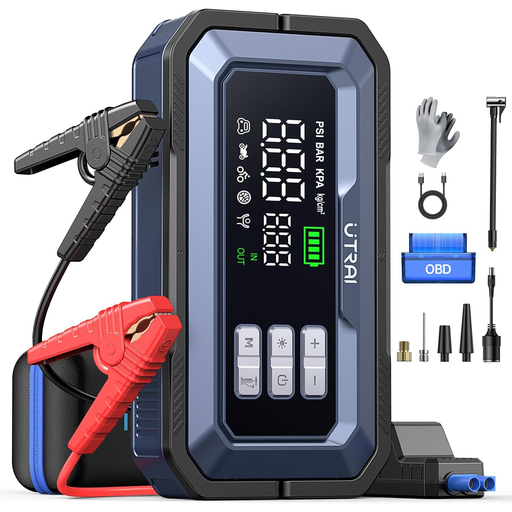
Why this choice suits this user profile : Its technical specifications are aimed at high-capacity 12 V vehicles, prolonged use and drivers who need several power outputs.
The stated compatibility extends to diesel engines of up to 14 L. The display, connection detection and various protection features help minimise errors.
150 PSI compressor, 160 W 12 V output, 18 W USB-C charging, stated 2 000-lumen LED light and OBD2 adaptor included.
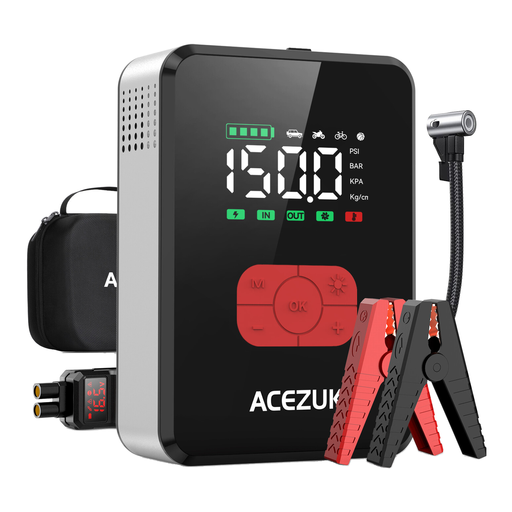
Why this choice suits this user profile : It is aimed at SUV, van, motorhome and diesel vehicle drivers looking for a high stated power reserve.
The specifications state the engine capacity supported, the compressor’s automatic shut-off and protection against reverse polarity and sparks.
Stated peak current of 7 000 A, 26 800 mAh capacity, 3.3-inch screen, four inflation modes and storage bag.
We have put together a complete, real-time updated list of products that meet these demanding selection criteria and European safety requirements.
Before an emergency start, switch off the vehicle’s electrical equipment and put the gear lever in « P » or neutral, with the handbrake applied. Connect the clamps according to the instructions and stop if the device indicates a connection problem.
To inflate a tyre, set the recommended pressure on the display, attach the nozzle securely and allow the compressor to cool down after the stated operating time. Do not use the booster with a damaged, leaking or apparently frozen battery. These devices are designed for occasional roadside assistance : they do not replace a car battery or mechanical maintenance.
Yes, some models are designed for diesel engines. However, compatibility depends on the stated engine capacity and power. Check the exact limit before buying : a 12 V booster suitable for a small diesel city car may not be powerful enough for a van or motorhome.
This depends on the built-in battery, the temperature and the functions being used. To preserve its battery life, recharge the booster regularly, even when it has not been used. Checking it before every long journey helps ensure you do not find a flat device when you need it.
It is perfectly capable of helping you adjust a tyre’s pressure, but it will not necessarily replace a workshop compressor for frequent or prolonged use. Observe the cooling breaks and always check the resulting pressure against the values recommended by the vehicle manufacturer.