
Livraison le jour même ou le lendemain

Qualité garantie

Débloquez vos offres de bienvenue: Livraison GRATUITE | Jusqu'à -80 % | 30 jours d'essai gratuits à JoyPlus
Téléchargez l'application
A dead battery: every driver's nightmare, especially when you're in a hurry or far from help. A portable jump starter is the miracle solution for getting back on the road. The problem? The market is flooded with misleading marketing claims. Between inflated amperage ratings and useless gimmicky features, it's easy to make the wrong choice.
As the Head of Product Recommendations at Joybuy, my job is to help you see clearly. Let's break down the most common traps and the essential technical criteria for choosing a reliable portable car starter that truly fits your needs.
The Peak Amps Myth: Most manufacturers highlight peak amperage values (e.g., 6000 A) as their main selling point. This value only represents the maximum current the device can deliver for a fraction of a second. However, the only figure that truly matters is the Starting/Cranking Amps, which measures the current supplied continuously for several seconds to start the engine. An impressive peak number guarantees nothing if the starting amperage is too low, especially for a diesel jump starter.
Ambiguous Capacity (mAh): The capacity in milliamp-hours (mAh) is often displayed in a misleading way to inflate the numbers. It actually represents the sum of the internal battery cells' capacities. The actual usable capacity for charging your devices (the car power bank function) is always lower due to losses from voltage conversion. Instead, rely on the capacity in watt-hours (Wh), a more standardised and transparent measurement.
Low-Quality 'All-in-One' Features: A jump starter with a built-in compressor looks great on paper. However, on entry-level models, the compressor is often underpowered, noisy, and incapable of properly inflating a car tyre. The same goes for the USB ports, which often offer outdated charging speeds. It's better to have a device that excels at its primary function than a mediocre Swiss Army knife.
To make an informed choice, you need to focus on the technical specifications that truly matter and guarantee the performance and safety of your emergency jump starter.
The first thing to check is the jump starter's compatibility with your vehicle's engine. Manufacturers always specify the maximum engine displacements a device can start, distinguishing between gasoline and diesel engines.
Ignoring this compatibility is the fastest way to a useless purchase: the jump starter simply won't have the power to start your engine.
As mentioned, don't be dazzled by peak amps. Look for the starting amperage value (sometimes called Cranking Amps). If it's not listed, a high peak amp rating (e.g., 2000 A and up) on a model from a reputable brand is still a reliable indicator.
The capacity in watt-hours (Wh) is a much more reliable indicator of the device's true autonomy, whether for performing multiple jumps or for recharging your electronic devices. It's calculated by multiplying the milliamp-hours (mAh) by the voltage (V) and dividing by 1000.
Handling a battery is never without risk. A good portable jump starter must include a full suite of protections to prevent any accidents. Essential safety features include:
A smart connection box, with its indicator lights or screen, confirms that the connection is safe before you attempt to start the engine.
To help you see how these criteria apply in practice, here are a few recommended options, each tailored to a specific need.
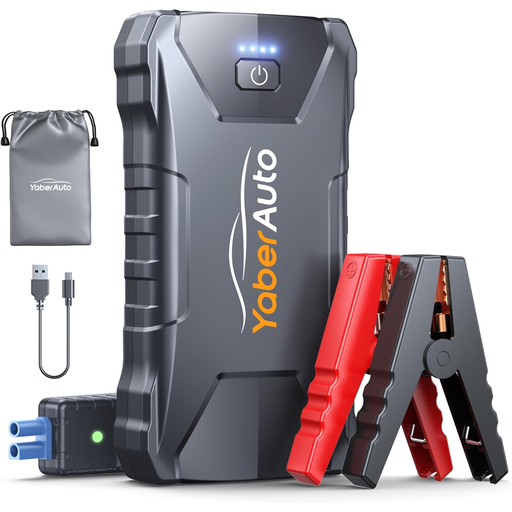
Why we chose it: Perfect for drivers of gasoline-powered city cars and sedans looking for a compact, hassle-free emergency solution. Its feather-light weight (340 g) and mini format allow it to slip discreetly into the glove box.
No inflated numbers. Its 2000A peak power is more than enough for gasoline engines up to 7.0L. There's no need to pay more for power you don't need.
Ultra-compact and lightweight: Fits in the glove box. Maximum safety: 10 built-in protection levels for total peace of mind.
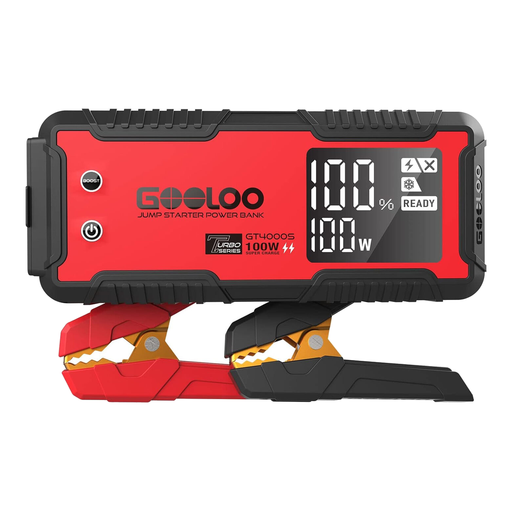
Why we chose it: Built for the large engines (diesel up to 10.0L) found in SUVs, 4x4s, vans, and motorhomes. Its colossal power and fast charging make it the perfect ally for long trips and extreme conditions.
This is much more than a simple power bank. Its 100W two-way charging can recharge the jump starter in 1.2 hours and power a laptop at full speed. This isn't a useless gadget; it's a true performance tool.
100W Express Charge: 5 minutes of charging is enough for one jump start. XXL Power: Starts diesel engines up to 10.0L without breaking a sweat.

Why we chose it: For those who want to handle any roadside emergency with a single device. It combines a super-powerful jump starter with a genuine air compressor, making it the ultimate tool for RV owners, adventurers, and prepared families.
Unlike low-end models, its 160 PSI compressor is genuinely effective (inflates a tyre in about 3 minutes) and includes an automatic shut-off. Its large 3.3-inch screen makes operation clear and intuitive. This is a far cry from a poorly made gadget.
True 160 PSI Compressor: Fast, with preset automatic shut-off. Monster Power (6000 A): Compatible with all gasoline engines and diesel engines up to 12L.
Discover our full selection of jump starters that meet our strictest performance and safety criteria.
A lithium-battery jump starter has a lifespan of several years, or a few hundred charge cycles. To preserve its battery, remember to recharge it at least every 3 to 6 months, even when not in use. Store it in a cool, dry place, away from extreme temperatures.
No, absolutely not. As we've discussed, it's primarily a marketing tactic. For a gasoline-powered city car, a 1500A or 2000A model is more than sufficient. Investing in a 4000A monster would be a waste of money. It's better to choose a power level appropriate for your engine and focus on the quality of the clamps, the built-in safety features, and the brand's reputation.
Most jump starters can withstand a wide temperature range (typically from -20°C to 60°C / -4°F to 140°F). So, in principle, you can leave it in your car. However, extreme cold affects the performance of lithium batteries. During a cold snap, it's wiser to keep it warm to ensure it works effectively when you need it most. Likewise, avoid leaving it in direct sunlight behind the windscreen in summer: overheating is its enemy.