
Livraison le jour même ou le lendemain

Qualité garantie

Débloquez vos offres de bienvenue: Livraison GRATUITE | Jusqu'à -80 % | 30 jours d'essai gratuits à JoyPlus
Téléchargez l'application
A battery can still show the correct voltage while being unable to deliver enough current to start the engine. Conversely, a battery in good condition can go flat if the alternator is not charging the circuit properly. To avoid replacing a part that is not at fault, a 6V 12V 24V car battery tester needs to do more than simply measure voltage.
Before you buy, three common mistakes are worth avoiding.
A well-chosen device should therefore provide easy-to-read results and help distinguish between a worn battery, a charging problem and a starting-system fault.
For a passenger car, a 12 V tester is usually sufficient. Motorbikes and some small items of equipment operate at 6 V, while lorries and certain commercial vehicles use a 24 V system. A versatile device should clearly state which voltages it supports and specify whether the mode changes automatically or via a menu.
According to its product listing, the 6V 12V 24V car battery tester BT500 supports 6 V, 9 V, 12 V and 24 V batteries. For a 6 V or 9 V battery, the mode must be selected from the ‘Motorcycle’ menu. It is therefore best to check this setting before starting the test to avoid an inaccurate diagnosis.
CCA, or cold cranking amps, refers to the current a battery is expected to deliver under standardised conditions. Two CCA values are only comparable when they are based on the same standard.
Before starting the diagnosis, check the standard shown on the battery label:
For a varied vehicle fleet, an analyser covering a wide range is more practical. The BT500 states a range of 5 to 3,000 CCA and supports the CCA, BCI, DIN and SAE standards. However, the value entered must match the figure shown on the battery label exactly.
A basic battery voltage tester shows the voltage measured at a specific moment. To identify the source of a fault, it is better to have several functions available:
A car battery charging tester and an alternator tester do not replace professional diagnostics, but they can often help narrow down the problem. If the voltage drops sharply when starting or charging remains abnormal while the engine is running, check the cables, connections and the entire charging circuit afterwards.
The selection below is based on the features stated in the product listings. The other two items in the catalogue are accessories unrelated to automotive diagnostics: a coffee grinder and a music box. They are therefore not presented as battery-testing solutions.
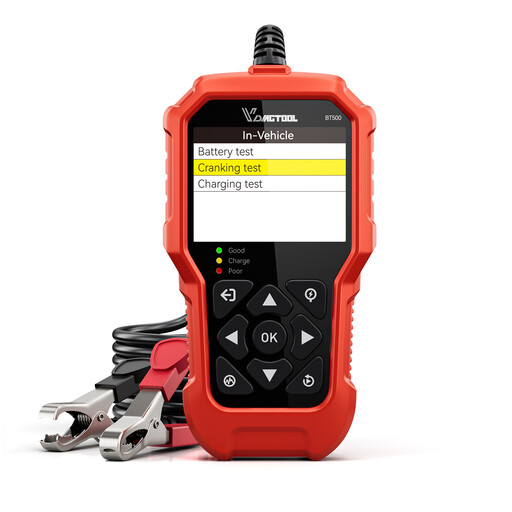
Why this choice suits this profile : its screen and supposedly intuitive menu are suitable for motorists who want to check their car before a long journey without investing in several specialist devices.
It does more than measure voltage: the listing also mentions resistance, SoC, SoH, starting and charging tests.
Stated compatibility with conventional, AGM, GEL and EFB batteries, across a range of 5 to 3 000 CCA.
Why this choice suits this profile : those who want to combine several checks in one unit can examine the battery, starting system and charging circuit.
Support for several standards reduces the risk of selecting an unsuitable CCA value, provided you check the battery label.
Stated protection against reverse polarity and short circuits, with a shock-resistant ABS housing.
Why this choice suits this profile : its 6 V, 12 V and 24 V compatibility may appeal to a garage, fleet manager or owner who uses several types of vehicle.
The listing also states its limitations: the device is not suitable for lithium, deep-cycle or golf-cart batteries.
Twelve languages stated, reinforced clamps and measurements suited to the most common automotive batteries.
We have put together a complete, real-time-updated list of products that fully meet these strict selection criteria and European safety regulations.
Before testing, switch off all electrical equipment and check that the clamps are touching clean terminals. Then select the battery type, standard and CCA value corresponding to the manufacturer’s specifications. A battery that has just been recharged may show a surface charge: wait a few minutes or follow the instructions in the manual.
With a starting-system tester, observe the voltage while operating the starter motor. To use an alternator tester, take the measurement with the engine running and compare the results with the manufacturer’s recommendations. An unusual reading does not necessarily mean that the battery needs replacing: the connections, earth, starter motor and alternator may also be at fault.
Yes, provided its voltage range and supported standards match the vehicles concerned. A motorbike may operate at 6 V or 12 V, while a lorry may be fitted with a 24 V system. Always check the vehicle’s wiring and configuration before connecting the device.
Some models allow this. The BT500 states that it is compatible with conventional, flat-plate AGM, spiral AGM, GEL and EFB batteries. According to its listing, however, this compatibility does not extend to lithium or deep-cycle batteries.
Checking it before winter, before a long journey or after several weeks of short trips can help you monitor the battery’s condition. If starting is slow, the charging warning light comes on or the vehicle repeatedly breaks down, it is best to run a diagnostic without delay. Results should always be interpreted in the context of the vehicle’s overall condition and the manufacturer’s recommendations.