
Livraison le jour même ou le lendemain

Qualité garantie

Débloquez vos offres de bienvenue: Livraison GRATUITE | Jusqu'à -80 % | 30 jours d'essai gratuits à JoyPlus
Téléchargez l'application
A flat battery rarely happens at a convenient time: your car is stranded outside the house, your motorbike refuses to start again after winter, your boat has been taken out of the water or your lawnmower has been forgotten at the back of the garage. On paper, choosing a 12V 24V 20A car battery charger seems straightforward. In practice, there are several features worth checking before you buy.
The first potential pitfall is the advertised current. A device described as “20A 12V / 24V” does not necessarily deliver 20 A at 24 V. You need to examine the technical specifications carefully: the EAFC model featured here delivers 20 A at 12 V and 10 A at 24 V. The second point to check is battery compatibility. A standard car charger is not automatically suitable for AGM, GEL, SLA, EFB, WET or LiFePO4 batteries. As for “repair” and “pulse” functions, they will not work miracles on a battery that is permanently beyond recovery.
Start by identifying the battery’s nominal voltage:
The current affects charging speed, but the highest figure is not always the best choice. A 20 A charger may be suitable for a large car battery, while a 10 A model or below will often be better suited to a small motorbike battery. Follow the manufacturer’s recommendations and do not choose the current solely because it promises faster charging.
To cover several uses, an intelligent 12V 24V charger with automatic or manual mode selection will generally be more practical than a device limited to a single voltage.
Each battery technology has its own charging requirements. Lead-acid, AGM, GEL, SLA, WET and EFB batteries are not all charged in exactly the same way. A lithium iron phosphate battery, or LiFePO4, also requires a dedicated programme.
A reputable AGM GEL SLA battery charger should therefore clearly list the available modes. For a LiFePO4 battery, check that explicit compatibility is mentioned rather than relying on a vague claim such as “all batteries”. If in doubt, consult the battery manual before connecting the charger.
An automatic charger should be able to reduce or cut off the current when the battery reaches the appropriate level, then switch to maintenance mode. This is particularly useful during winter storage, when the device remains connected for several weeks.
The following safety features are worth prioritising:
A display showing the voltage, current, temperature or charge level also helps you keep an eye on the charging process. A sufficiently long cable, well-insulated clamps and built-in storage are useful in a garage as well as in a parking space.
A battery maintainer is primarily designed to keep the charge stable when a vehicle is not being used. It is naturally useful for a second car, a seasonal motorbike, a boat or a lawnmower stored away for several weeks.
Charging generally takes place in stages: diagnosis, gradual current increase, absorption phase and then maintenance. An automatic 9-stage charger can therefore adapt the sequence to the detected condition, depending on the functions provided by the manufacturer.
However, pulse repair should be viewed realistically. It may help deal with certain deposits or slight undercharging on a compatible battery, but it will never replace a worn, swollen, cracked or permanently failed battery. Always inspect the casing before use and stop the process immediately if the battery becomes unusually hot.
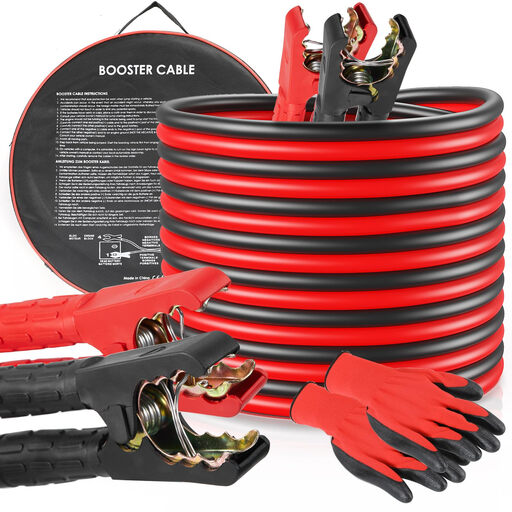
Why this choice suits this profile : For motorists primarily looking for a simple emergency solution, these 4-metre cables can complement the equipment in your boot and make it easier to connect to another vehicle.
This is a jump-start accessory, not a charger misleadingly marketed as universal. It therefore does not replace a device designed for regular battery maintenance.
An advertised length of 4 m, a cross-sectional area of 30 mm² and a stated current of 1 000 A for lead-acid batteries.
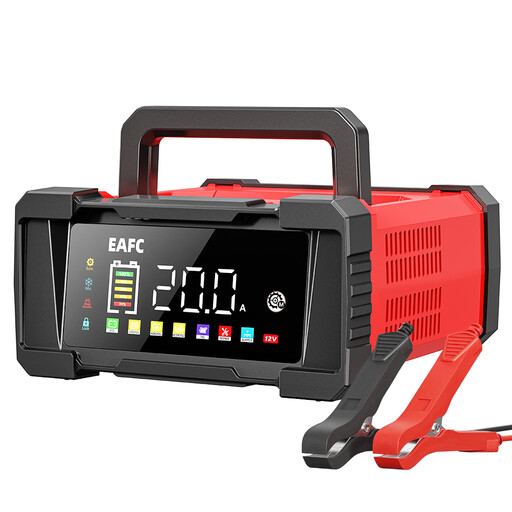
Why this choice suits this profile : This portable model is aimed at those who want charging, maintenance and several programmes in a single device, for cars, motorbikes, lorries, lawnmowers or boats.
The specifications clearly distinguish between 20 A at 12 V and 10 A at 24 V. They also mention protection against reverse polarity, overvoltage and short circuits.
Seven advertised modes, a colour screen, a 2-metre cable, stated compatibility with lead-acid and LiFePO4 batteries, plus nine-stage charging.
Why this choice suits this profile : Those who alternate between 12 V and 24 V vehicles will appreciate the voltage selection and dedicated modes, provided they check each battery before connecting it.
The standard, motorbike, AGM/GEL, lithium, repair and power supply modes are clearly separated. However, the pulse function is still intended only for batteries that can be recovered.
Displays the voltage, current, temperature and charge level, with a cable that can be stored at the back of the casing.
Before connecting a car battery charger, park the vehicle in a well-ventilated area, switch off the ignition and consult the manual. Observe the polarity, select the correct voltage and never cover the device while it is operating. If the battery is installed in a newer vehicle, also check whether the manufacturer requires a specific procedure.
A multifunction device can serve as a motorbike and lorry battery charger, but that does not mean every vehicle can be charged using the same setting. The battery’s capacity, technology and condition remain the determining factors.
A charger with a maintenance mode may be designed to remain connected once charging is complete, but always consult the manual. Check the temperature and condition of the cables regularly, and make sure there are no signs of leakage or swelling on the battery.
Consumption depends on the power actually used, charging time and the device’s efficiency. A 20 A charger does not necessarily draw this current continuously: the current generally decreases during the absorption and maintenance phases.
No. This function does not guarantee that a damaged battery can be restored. It may support an attempt to recover a compatible battery that is simply undercharged, but a cracked, swollen or completely failed battery must be replaced or checked by a professional.