
Livraison le jour même ou le lendemain

Qualité garantie

Débloquez vos offres de bienvenue: Livraison GRATUITE | Jusqu'à -80 % | 30 jours d'essai gratuits à JoyPlus
Téléchargez l'application
A ball used in the garden, on wet grass or near the beach needs to withstand far more than a few occasional kicks. For French families, choosing a waterproof foam football mainly depends on the player’s age, the playing surface and how easy it is to maintain.
However, some marketing claims should be treated with caution. Before placing your order, here are the main pitfalls to avoid and the criteria to consider.
A coating that can withstand a few splashes does not guarantee that the ball will remain stable after prolonged use in the rain. A surface that absorbs water can become heavier, deform or feel less comfortable to control.
For regular outdoor use, choose a construction with no visible stitching and a clear statement that the ball does not absorb water. This does not mean you can skip drying it after each use, especially during the colder months.
A ball that is too large can make control more difficult for a young child. Conversely, a model that is too small may not be suitable for an older player’s exercises.
Age recommendations are only a guide. You should also consider the player’s build, ability level and the guidance provided by their club or coach.
A valve that gradually allows air to escape means frequent reinflation and makes training sessions less enjoyable. If a needle, pump or bag is not included, you may also need to make additional purchases.
A ball with pump and storage bag lets you start playing quickly and makes your equipment easy to carry. However, check the exact contents of the set before ordering.
Here are the size specifications given for this range:
The product listing associates size 4 with young players and size 3 with smaller children. For family activities, size 3 is often easier for young children to handle.
A rubber football or rubberised foam ball can provide a softer feel than a ball with a rigid outer coating. The Longsail construction is described as a seamless composite shell made from rubberised foam, with shock-absorption capabilities claimed by the manufacturer.
This material is designed for different surfaces: grass, artificial turf, outdoor ground and sand. Nevertheless, it is best to avoid highly abrasive surfaces and areas covered with sharp objects: no coating is completely protected against punctures.
The range features a double-layer valve. According to the information provided in the product listing, the stated air loss is less than 1 to 3% over 48 hours. This figure should be viewed as a characteristic communicated by the manufacturer, not as a guarantee that applies in all conditions.
To help maintain the ball’s shape:
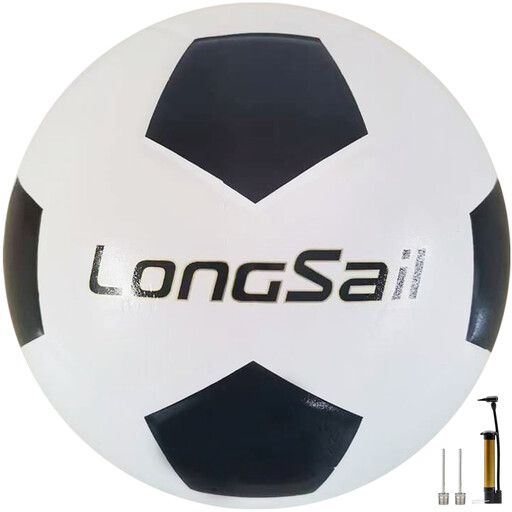
Why this choice suits this profile : Its size 3 design and set with pump, needle and bag are ideal for children who are starting to play at home, in the park or in the garden.
The seamless rubberised foam shell is presented as waterproof, helping to reduce the risk of the ball becoming waterlogged outdoors.
A size suitable for children under 8, a water-resistant surface as stated and included accessories.
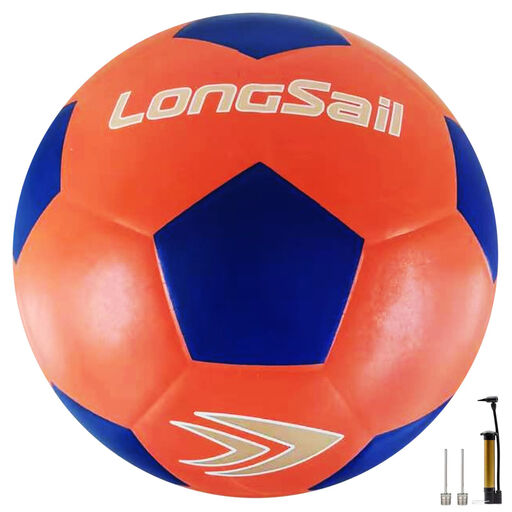
Why this choice suits this profile : Size 4 is suitable for children aged 8 to 12 who want to improve their dribbling, passing and shooting skills.
The listing mentions a double-layer valve and a shell that should not swell when it comes into contact with water: two points to check before buying.
A size 4 for children aged 8–12, a rubberised foam construction and an inflation kit included.
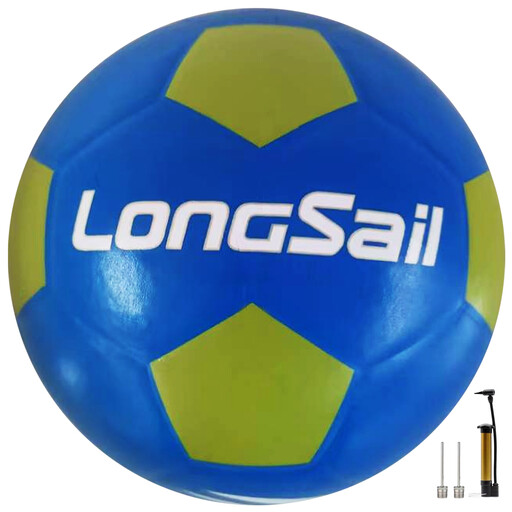
Why this choice suits this profile : Its all-weather design may suit families who alternate between training, outdoor play and outings on different types of pitch.
The manufacturer states that it can withstand repeated impacts and that its surface is suitable for wet conditions. However, these claims should be treated simply as information from the product listing.
A size 3 format, a seamless shell described as waterproof and a mesh bag for storage.
The lifespan of a durable football depends on how often it is used, the type of surface and storage conditions. A ball used on grass or artificial turf will generally retain its appearance for longer than one that is rubbed against concrete every day.
After each session, remove soil and sand with a damp cloth. Do not dry it directly on a radiator: excessive heat can weaken the material and the valve. Also check the pressure before training. An overinflated ball is harder to control, while an underinflated model responds less consistently.
When using it by the seaside, gently rinse away any sand, then leave the ball to air-dry before storing it in its bag.
We have put together a complete, real-time updated list of products that fully meet these strict selection criteria, as well as European safety regulations.
A size 3 football is generally recommended for this age group. Its smaller circumference makes it easier to hold, pass over short distances and use for coordination exercises. If the child is particularly tall or already familiar with football, you should also ask their coach for advice.
Yes, a construction described as waterproof is designed to limit water absorption. However, you should wipe the ball after the session and let it dry before storing it. Rain can also make the pitch slippery and alter the ball’s trajectory, whatever material it is made from.
Yes. The pump lets you adjust the pressure before every session, while the needle means you do not have to buy an accessory separately. A storage bag also protects the ball from rubbing and makes it easier to carry between home, the park and the pitch.