
Livraison le jour même ou le lendemain

Qualité garantie

Débloquez vos offres de bienvenue: Livraison GRATUITE | Jusqu'à -80 % | 30 jours d'essai gratuits à JoyPlus
Téléchargez l'application
A wall-mounted coat rack: just a simple accessory for organising a hallway, bedroom, or bathroom? Not so fast. The wrong choice can turn a good idea into a real headache. Between models that rip out of the wall under the weight of the first winter coat and those with a design that's as pretty as it is impractical, it's easy to make a mistake.
Our editorial mission is to guide you. Let's break down the pitfalls to avoid and the essential criteria for finding the wall-mounted coat rack that combines durability, practicality, and style.
Don't be fooled by a pretty picture. Certain deal-breaking flaws can render a coat rack useless in just a few months.
To avoid making a mistake, focus on these few technical points. They are the guarantee of your future coat rack's quality and longevity.
The wood and metal coat rack combination is often a sign of sturdiness, but be warned: not all woods and metals are created equal.
bathroom hook.The load capacity is the most crucial piece of information. It is indicated in kilograms (kg), either per hook or for the entire unit. A family hallway coat rack should be able to support a minimum of 15 to 20 kg in total. Also, make sure the mounting system is compatible with your wall. Don't hesitate to buy specific wall anchors (like Molly bolts for plasterboard); it's the guarantee of a rock-solid installation.
Good design isn't just about aesthetics. A designer wall hook must be functional. Look at the spacing between the hooks: a minimum of 10 to 15 cm is recommended for comfortable use. The shape of the hooks is just as important. Rounded heads or vintage wall hook models with a ball tip will protect your clothes. The object then becomes a true piece of decorative wall storage.
Here are a few models that check all the boxes, suited for different needs and budgets.
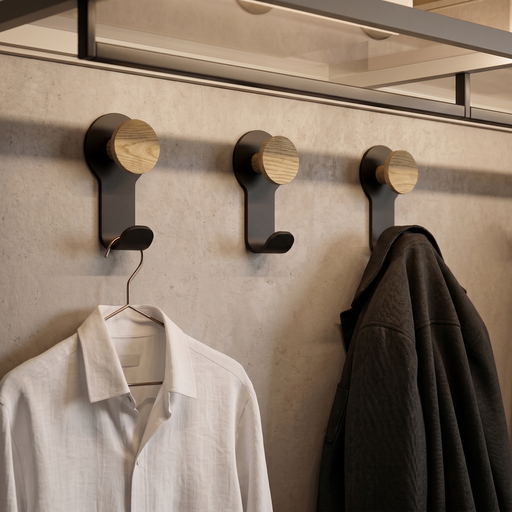
Why it's a great choice: Ideal for creating a custom storage solution. These individual hooks can be arranged freely in a hallway, bedroom, or behind a door to perfectly fit your space and needs.
The design, combining an aluminium alloy and FSC-certified wood, sidesteps the trap of low-grade materials. Individual mounting allows you to use the most suitable fixings for your wall for each hook, ensuring rock-solid durability.
The dual-hook design (one wood, one metal) optimises storage space. The rounded edges protect clothes from snags.
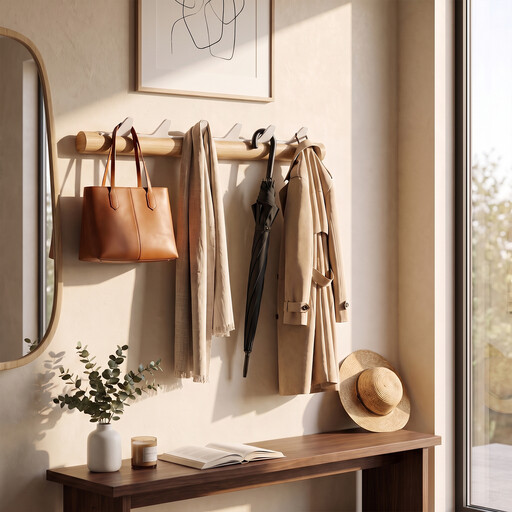
Why it's a great choice: With its high load capacity (up to 30 kg) and 6 sturdy hooks, this model is built for busy entryways. It will handle the coats, backpacks, and school bags of the whole family without breaking a sweat.
Its high load capacity directly addresses the problem of flimsy coat racks. The combination of solid rubberwood (FSC certified) and aluminium alloy guarantees excellent durability, even with intensive use.
The combination of a solid wood bar and metal hooks offers a complete and aesthetic solution. Its protective varnish makes it resistant to water and rust.
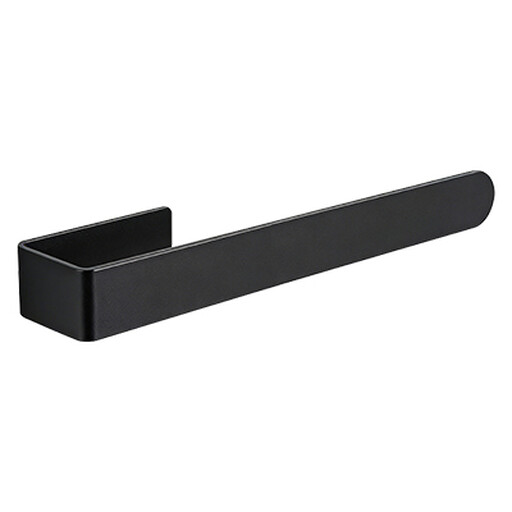
Why it's a great choice: Specifically designed for damp rooms, this versatile model serves as both a towel bar and a coat rack thanks to its integrated hooks. Its understated finish blends easily into most bathrooms.
Stainless steel is the best defence against rust, the number one enemy of metal accessories in the bathroom. It's a durable material that won't degrade with humidity.
Its dual function (bar and hooks) makes it a very clever 2-in-1 storage solution for optimising space in a bathroom or toilet.
Beyond hooks, a well-organised bathroom relies on the right accessories. Discover our selection of towel racks that combine design and practicality.
For adults, the standard height is between 1.70 m and 1.75 m from the floor. If the coat rack will also be used by children, plan for a height that is accessible to them, generally between 1.10 m and 1.30 m.
Forget the standard wall plugs that come with the product. For a plasterboard wall, it is essential to use hollow-wall anchors (like Molly bolts). They anchor themselves behind the board to distribute the load and offer unparalleled strength, eliminating any risk of it pulling out. Just remember to check the maximum load supported by the chosen anchor.
Yes, it's an excellent idea, provided the wood is treated for humidity. Favour naturally resistant woods like bamboo or teak, or a solid wood protected by an effective water-repellent varnish. Good ventilation in the room is, of course, essential to ensure its longevity. Models that combine treated wood and stainless steel are often the best compromise.