
Livraison le jour même ou le lendemain

Qualité garantie

Débloquez vos offres de bienvenue: Livraison GRATUITE | Jusqu'à -80 % | 30 jours d'essai gratuits à JoyPlus
Téléchargez l'application
Hanging a picture frame, mirror, shelf, or television isn't simply about picking a product labeled "ultra-strong." A wall mount must be suited to the object's weight, the wall material, and the intended duration of use. An adhesive designed for lightweight decor won't necessarily work for a mailbox or a TV wall mount.
Both renters and homeowners often fall into the same traps: choosing tape that's too weak, applying the mount to a dusty wall, or confusing a removable solution with a permanent installation. Here are the points to check before ordering, along with a selection of solutions available on Joybuy.
A claim like "up to 120 kg" doesn't mean a 120 kg object can be hung without care. The supported load depends on the length of mounting adhesive used, the flatness of the surface, the temperature, and how the weight is distributed.
A deep shelf that pulls forward exerts more stress than a frame flush against the wall. For heavy loads, plan a safety margin and strictly follow the manufacturer's recommendations.
Painted walls, smooth tiles, glass, or metal generally offer a more uniform surface than wallpaper, textured plaster, or friable board. A drill-free wall mount can lose much of its grip on a textured, dusty, or greasy surface.
Before starting, also check that the paint adheres well to the wall. An adhesive can hold perfectly while peeling off a layer of paint upon removal.
A water-resistant adhesive may be suitable for a bathroom or sheltered outdoor use, without being designed for permanent submersion. Temperature variations, condensation, and direct exposure to the elements can also reduce the holding time of certain products.
Start by weighing the object, then plan a margin suited to its daily use. A shelf that is regularly handled or a mirror placed in a high-traffic area undergoes additional movement. For a frame, picture hanging strips can work for moderate weight, provided the wall is smooth and clean.
For a television, the choice of mount depends on three factors:
A fixed TV wall mount intended for a concrete wall should not be installed on drywall if the instructions forbid it. The models shown here are designed for solid concrete, solid brick, or load-bearing wooden studs. Installing a large screen should be done by two people.
A reliable mount starts with a surface that is:
With a mounting adhesive, apply dots or a bead according to the instructions, press firmly, then let the product set for the recommended time. A final strength claimed after 24 hours does not mean the object can be loaded immediately.
Adhesive hooks and repositionable pads are suitable for lightweight objects and frequent decor changes. A heavy-duty double-sided tape is better suited for long-term mounting, while an adhesive will generally provide a more durable bond.
Also check the removal conditions: "no nails or screws" doesn't necessarily mean "without any trace." If the surface is painted, old, or fragile, always test the solution on an inconspicuous area.
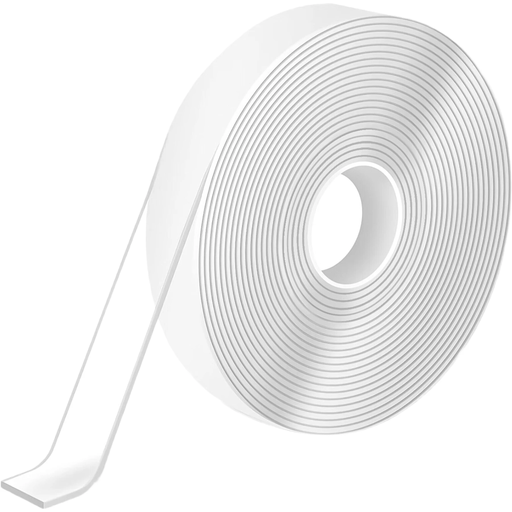
Why this product is relevant: This roll is suitable for small setups around the home, office, or car: decorations, cables, rugs, and light to moderate accessories.
The spec sheet indicates a thickness of 0.2 cm, a width of 1.3 cm, and a length of 300 cm. The surface can be washed with water for reuse, provided the application conditions are met.
Its roll format is versatile, and removal is claimed to be residue-free: practical for testing a wall arrangement without getting out the tools.
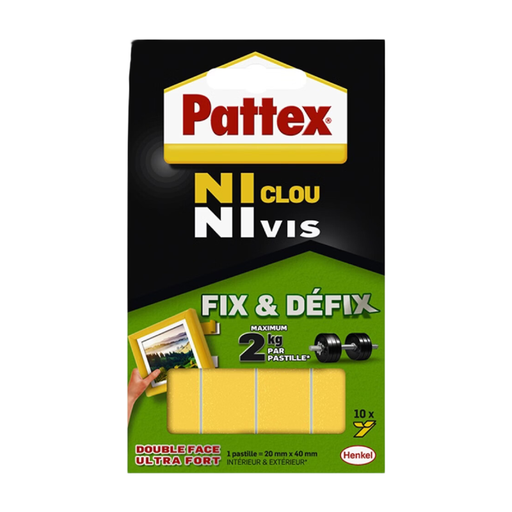
Why this product is relevant: These 10 pads (20 × 40 mm) are designed for frames, hooks, small decorative objects, and cables in a home where the layout changes regularly.
The claimed load is up to 2 kg per pad after 24 hours. This limit prevents accidentally using them for a shelf or heavy mirror.
The repositionable format and removal claimed to be mark-free on smooth, clean, degreased surfaces.
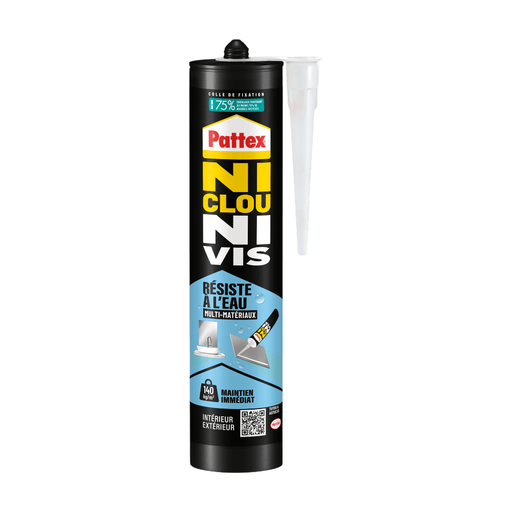
Why this product is relevant: This cartridge mounting adhesive is suitable for baseboards, panels, decorative elements, and accessories exposed to moisture, indoors and outdoors.
The spec sheet mentions resistance to water, moisture, and UV, but excludes permanent immersion. Surfaces must be prepared according to the instructions.
Final strength is claimed after 24 hours, with repositioning possible for approximately 10 minutes.
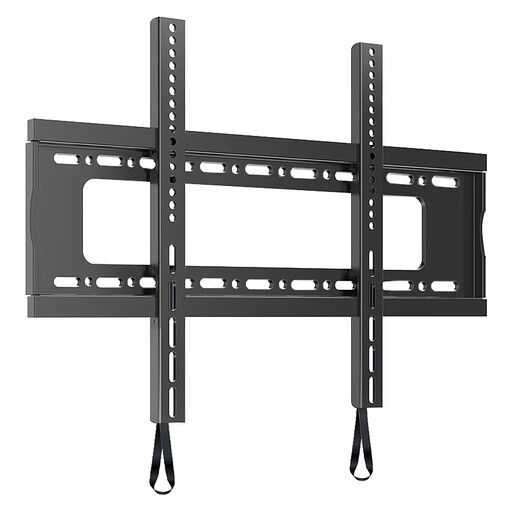
Why this product is relevant: This TV wall mount is designed for large screens and load-bearing walls made of concrete or solid brick, with a screwed, non-removable installation.
The instructions exclude drywall, hollow bricks, and partition walls. The bottom lock must be tightened once installation is complete.
Its compatibility with multiple VESA patterns and its claimed maximum load of 85 kg, according to the product sheet.
Discover an updated selection of solutions suited to different mounting needs, load capacities, and drill-free installation.
For a frame or small accessory, pads, picture hanging strips, and adhesive hooks are generally the easiest solutions to remove. However, check their compatibility with the paint and avoid textured or fragile surfaces.
It can be suitable if the product is compatible with glass and if the mirror's weight remains within the specified limit. Clean the wall and the back of the mirror thoroughly, use sufficient length, and respect the setting time. For a heavy mirror or one installed above a high-traffic area, a suitable mechanical mount is often preferable.
For a large television, the mounts in this selection require screws and anchoring in a load-bearing wall. An adhesive solution should not replace a TV wall mount designed for the screen's weight, dimensions, and VESA pattern.