
Livraison le jour même ou le lendemain

Qualité garantie

Débloquez vos offres de bienvenue: Livraison GRATUITE | Jusqu'à -80 % | 30 jours d'essai gratuits à JoyPlus
Téléchargez l'application
Vacuum storage bags effectively reduce the volume of clothes, duvets and blankets in a wardrobe, under a bed or at the bottom of a suitcase. Choosing the right model is essential, however. A storage bag that is too small for a coat, a seal that lets air back in or a valve that is incompatible with your vacuum cleaner can quickly turn a good idea into a disappointing purchase.
Here are the criteria to review before choosing your vacuum compression bags, along with a selection of models suited to the most common needs in France.
Manufacturers sometimes advertise spectacular volume reductions. In practice, the result varies according to the fabric, its thickness, how much is placed in the bag and the quality of the seal. A down duvet, a padded coat and a stack of T-shirts will not compress in the same way at all.
An overfilled bag also puts considerable pressure on the closure and valve. It is better to leave a little room and choose a size that genuinely suits its contents.
A poorly aligned closure, a basic seal or one that is difficult to operate can allow air to seep back in gradually. For storing seasonal clothing, look for a double zip, a sealing slider or a visual indicator confirming that the bag is properly closed.
Not all valves work in the same way. Some require a vacuum cleaner with a hose, while others are designed for use with a hand pump or simply by pressing the bag. This is an important consideration when travelling, living in a studio apartment or staying in student accommodation without a vacuum cleaner.
Vacuum bags are particularly practical for jumpers, coats, blankets and other household linens. Delicate fabrics, highly structured garments and items that need to retain their shape require greater care, however.
For suits and jackets, vacuum garment bags for wardrobes equipped with hooks help minimise folding. Avoid overfilling them, and always follow the care instructions on the garment label.
The size should suit both the available storage space and the type of textile you want to store:
Large vacuum storage bags are ideal for duvets and blankets, but once filled they also take up more floor or shelf space. Measure the area under your bed, in your boot or inside your wardrobe before ordering.
The models presented here are primarily made from polyamide (PA), polyethylene (PE), nylon or PE/PET. According to the product specifications, these materials are marketed as resistant to tearing, water or air. They should nevertheless be kept away from sharp objects, unprotected metal fasteners and flames.
For regular use, choose reusable vacuum bags with a sturdy closure and a properly protected valve. After opening, wipe the inside if necessary and allow the bag to dry completely before folding it away. Never store damp textiles: the bag limits air exchange but cannot replace proper drying.
Three systems are commonly available:
Also check that the valve is compatible with your appliance. The word “universal” does not always guarantee perfect compatibility: the hose diameter and the shape of the nozzle can make a difference.
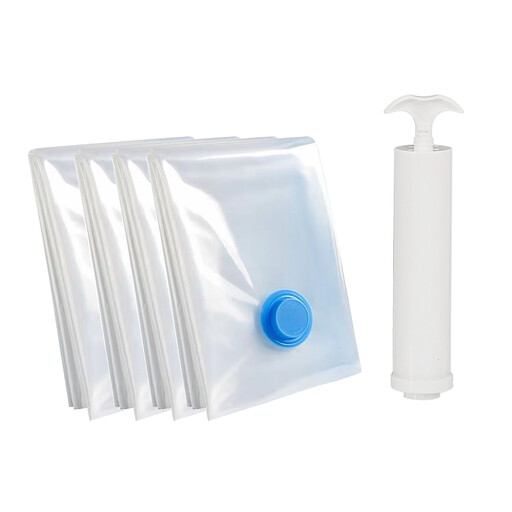
Why this is a good choice: With five medium-sized bags and a hand pump, this kit is suitable for folded clothes, jumpers and household linens in a flat or student room.
The included pump means you do not have to rely on a vacuum cleaner, while the medium size reduces the risk of overloading a bag intended for smaller items.
The product listing specifies a set of 5 medium bags and a hand pump; the design is advertised as helping to limit moisture and dust.
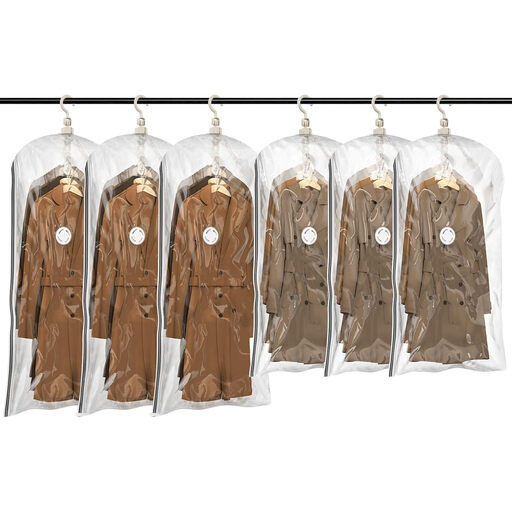
Why this is a good choice: Integrated rings allow jackets, coats, dresses and suits to be hung vertically without folding them.
The two lengths reduce the risk of choosing a garment bag that is too short. The colour-changing zip makes it easier to check that the closure is properly sealed.
Six pieces: 3 long bags measuring 134.9 × 69.9 cm and 3 short bags measuring 104.9 × 69.9 cm; valve compatible with a standard vacuum cleaner.
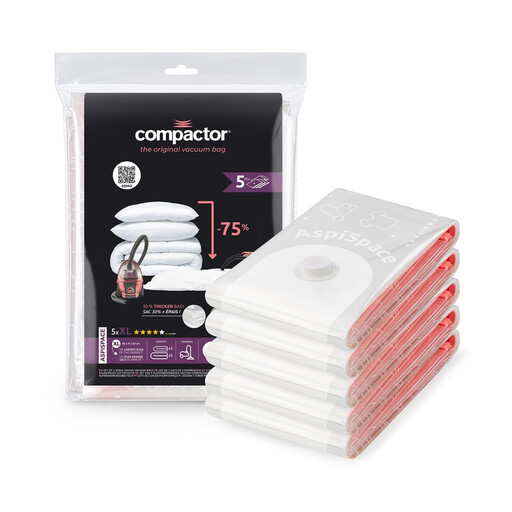
Why this is a good choice: Measuring 80 × 130 cm, this model is designed for duvets, pillows, blankets and particularly bulky winter clothing.
The XL dimensions are clearly stated, avoiding the need to divide a duvet between several small bags or put excessive strain on the closure.
Set of 5 XL bags, advertised recyclable PE/PET material and use with a vacuum cleaner fitted with a hose.
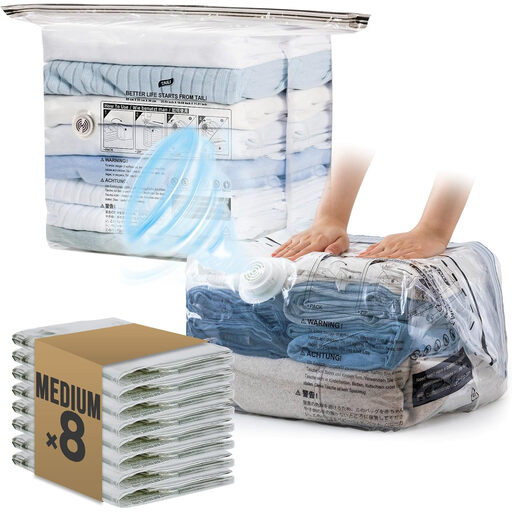
Why this is a good choice: These cube-shaped bags hold clothes, lightweight blankets and accessories in a suitcase, travel bag or compact storage space.
Compression is performed by hand, so there is no need to buy a pump or adapter when preparing your luggage.
Set of 8 bags measuring 63.5 × 48.3 × 27.9 cm, featuring an advertised ESY SHRINK valve for pump-free compression and PA/PE material.
We have put together an up-to-date selection of products that meet these criteria, helping you organise clothing, bedding and compact living spaces.
Yes, several models are designed to work with a vacuum cleaner fitted with a hose. However, check the shape of the nozzle and the valve’s compatibility. Models with a hand pump or manual compression are a practical alternative when you do not have a vacuum cleaner available.
It depends on how frequently it is used, how it is handled and whether it has suffered any punctures. A clean closure, storage away from heat and sensible filling all help extend its reusable life. No manufacturer can guarantee a universal lifespan: inspect the bag and its seal before each period of long-term storage.
Yes, provided you choose a bag that is large enough. Double duvets and thick blankets generally require an L, XL or cube-sized model. However, avoid compressing an item for a prolonged period if the manufacturer recommends storing it unfolded or with a minimum amount of volume.