
Livraison le jour même ou le lendemain

Qualité garantie

Débloquez vos offres de bienvenue: Livraison GRATUITE | Jusqu'à -80 % | 30 jours d'essai gratuits à JoyPlus
Téléchargez l'application
Overflowing closets, winter duvets cannibalising an entire shelf... It's a familiar scenario, especially when living in a small space. The promise of a vacuum storage bag is appealing: reduce the volume of your linens by up to 75% while protecting them from dust, moisture, and moths.
The only catch: the market is flooded with products of wildly inconsistent quality. Before you buy, it's crucial to know the three classic pitfalls that can turn this miracle solution into a real headache:
This guide is here to help you decode the spec sheets, make an informed choice, and find THE space-saving solution for your closet that truly delivers on its promises.
To avoid unpleasant surprises, there are three technical points to scrutinise. These are the true guarantors of your bag's quality and lifespan.
The durability of a garment compression bag depends primarily on its composition. The most reliable models combine two plastics: Polyamide (PA) and Polyethylene (PE).
A 100% PE bag or one made of unidentified plastic will be much more fragile and porous. The key is to check for the mention of this dual composition (PA+PE) on the product page.
A bag's entire seal relies on this critical duo: the zipper and the valve.
The choice of format is far from a minor detail for optimised closet organisation.
Rather than an endless list, we've selected products that check all the boxes for specific needs.
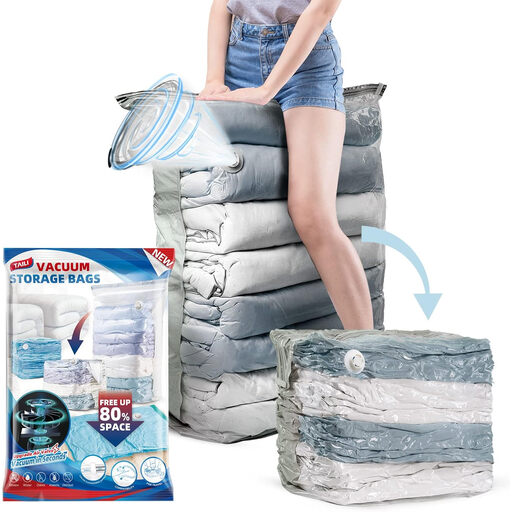
Why we chose it: Ideal for families who need to store the bulkiest items: winter duvets, pillows, coats... The cube format is designed to optimise vertical space on shelves.
Its self-supporting structure makes filling much easier (no more need for a second person!), and its robust PA+PE composition, coupled with the double zip, minimises the risk of reinflation.
The cube format ensures stable, stackable storage. Say goodbye to the shapeless pile of linens and hello to a perfectly neat stack.
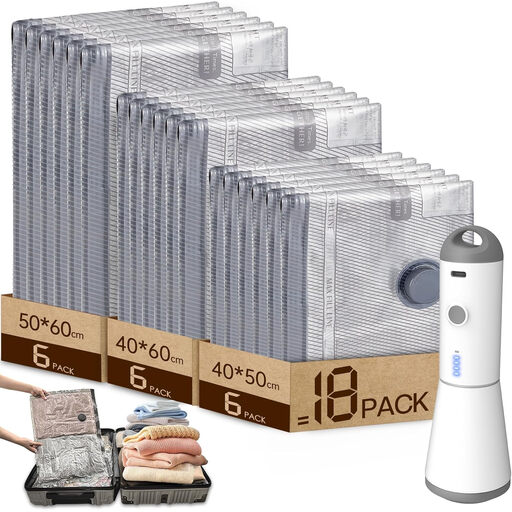
Why we chose it: The all-in-one solution for a travel vacuum storage bag or for those without a canister vacuum. The mini cordless electric pump is ultra-compact and lets you create a vacuum anywhere.
This kit solves the compatibility problem between the valve and the vacuum. The pump is custom-designed for the bags in the set, ensuring fast compression and a flawless seal.
The rechargeable cordless pump offers complete freedom, whether at home, in the middle of a move, or for reorganising your suitcase before the flight home.
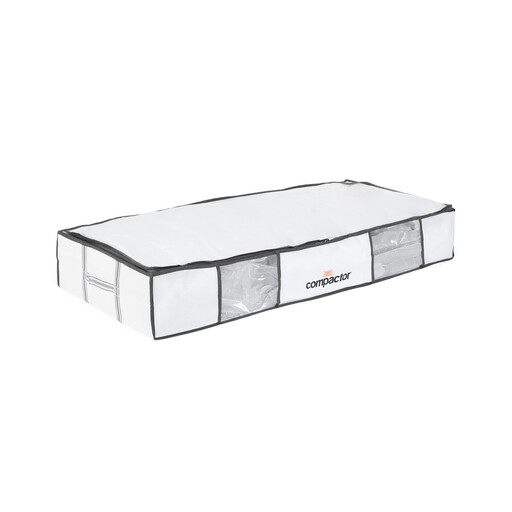
Why we chose it: For organisation perfectionists. The semi-rigid external structure acts like an exoskeleton: the bag maintains a perfect box shape even after compression, for a visually flawless closet.
Its patented semi-rigid design eliminates the "shapeless sack" effect of flexible models. It offers dual protection (internal compression, external barrier against bumps) and guarantees Tetris-like stacking.
It combines the best of both worlds: the space-saving benefits of vacuum sealing and the impeccable aesthetic of a classic storage box.
Discover our full selection of products that meet our demanding specifications for quality and safety.
Reinflation is almost always a sign of a micro-leak. The usual culprits are:
Most bags are compatible with the round nozzles of classic canister vacuums. However, stick vacuums (like Dyson) or robot vacuums generally do not work. If you only have a stick vacuum, you have two options: look for a compatible adapter or opt for a kit that includes a pump.
It's a perfect solution for seasonal storage (3 to 6 months). For periods longer than a year, it's recommended to open the bag and let the linens air out for 24 hours before recompressing them. This "reset" allows natural fibres (feathers, down) to breathe and maintain their loft over the very long term.