
Livraison le jour même ou le lendemain

Qualité garantie

Débloquez vos offres de bienvenue: Livraison GRATUITE | Jusqu'à -80 % | 30 jours d'essai gratuits à JoyPlus
Téléchargez l'application
Vacuum storage bags can significantly reduce the volume of clothes, duvets and household linen in a wardrobe, under a bed or in a suitcase. However, not all models are equally suitable for every use. Choosing the wrong size, an unreliable seal or an incompatible pump can quickly turn a bargain into an unusable accessory.
Before comparing offers, here are the most common pitfalls and the criteria to consider when choosing vacuum compression bags suited to your home and habits.
A very large bag is not necessarily the most practical option. Once filled with several duvets, it can become difficult to move or slide under a bed. Conversely, a smaller model may be better suited to clothes, but you will need several bags to store a complete bedding set.
The dimensions should therefore match the space available to you: the width of a shelf, the clearance under the bed, the depth of a storage chest or the size of your suitcase.
Compression performance depends on several components: double zip seal, slider, valve and any cap. If the zip is not closed properly or the bag is overfilled, air may gradually get back in.
Models with a visual sealing indicator, clip or cap-free valve may be easier to use. However, you should check the seal along its entire length before removing the air.
Vacuum bags for clothes are suitable for coats, jumpers, bed linen and seasonal textiles. However, sharp objects, unprotected shoes and items with rigid parts can puncture the plastic.
Clothes should be clean and completely dry before being stored. Compression is no substitute for proper preparation, and these bags are not designed for storing food.
Bags made from polyamide (PA) and polyethylene (PE) are generally described as tear-resistant and suitable for repeated use. Some models use recyclable PE/PET, with a stated thickness of 0.085 mm. This information indicates how the bag is made, but its lifespan also depends on how it is handled and whether it is kept away from sharp objects.
For vacuum wardrobe storage, a transparent material makes it possible to identify the contents without opening every bag. Opaque models can, however, create a more uniform appearance in a wardrobe or storage room.
Three configurations are particularly common:
Vacuum bags with a pump can be useful for storing textiles in a cellar, garage or holiday home. For use on the go, check the pump’s weight and how it is recharged.
A flat bag slides easily under a bed. A cubic or semi-rigid model stands more securely and can be stacked. Hanging bags make use of the height of your wardrobe for suits, jackets and coats.
For vacuum bags for duvets and blankets, choose a base that is sufficiently wide and a capacity suitable for the recommended weight. Avoid overfilling them to protect the seal and reduce strain on the welded seams.
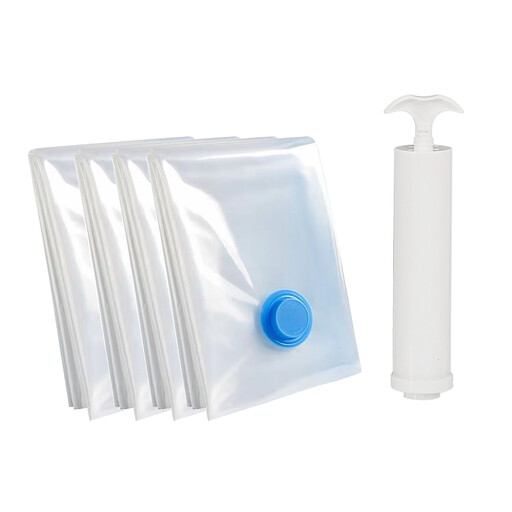
Why this choice suits this type of user: The medium size is ideal for seasonal clothes, jumpers and lightweight bed linen. The included manual pump means you can get started without buying any additional equipment.
The five-bag set means you do not have to choose unnecessarily large sizes, while the pump means you do not need a vacuum cleaner.
Five bags, a manual pump and a medium size that is well suited to organising a wardrobe.
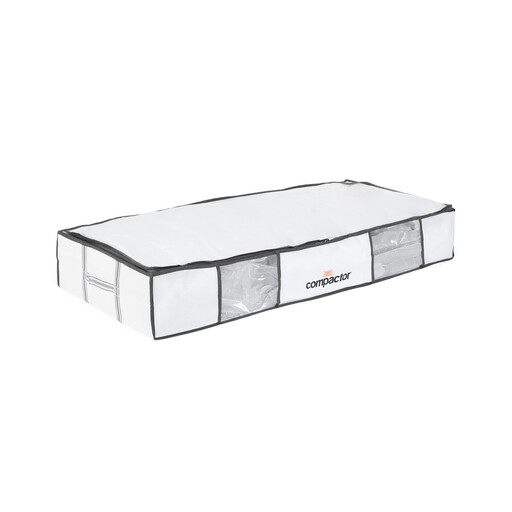
Why this choice suits this type of user: Its semi-rigid 3D structure and dimensions of 105 × 45 × 15.5 cm are designed for bulky textiles and stacked storage.
The semi-rigid shape helps prevent a partly filled bag from sagging, unlike a soft model that quickly becomes difficult to stack.
XL size, stackable design, stated recyclable PE/PET material and protection against dust and moisture.
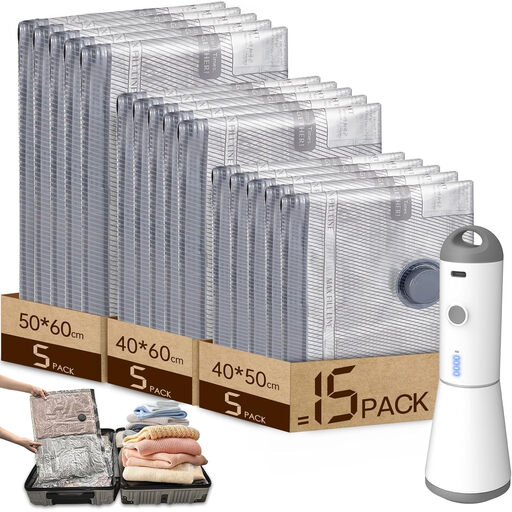
Why this choice suits this type of user: The three sizes and cordless pump are suitable for families, house moves and travellers switching between clothes, bed linen and under-bed storage.
The different sizes mean you do not have to compress a small item in an oversized bag, while the integrated pump reduces the number of accessories you need to carry.
Fifteen bags in three sizes, a cordless pump and a double-zip closure described as reusable.
Waterproof storage bags can help limit exposure to dust and moisture, but they are no substitute for a dry, properly ventilated storage area. Inspect bags used for long-term storage regularly.
No. Many models are designed to work with a standard vacuum cleaner, but some are used with a manual pump, an electric pump or by simply rolling them to expel the air. Check the type of valve and the accessories supplied before buying.
This depends on the type of textile, its condition and the manufacturer’s recommendations. For seasonal storage, make sure clothes are clean and dry, then air them when you take them out of the bag. Avoid compressing delicate items for long periods without checking their care label.
They can reduce the volume of clothes in a suitcase, but not their weight. Compact sizes, particularly those around 40 × 60 cm, fit more easily into luggage. A lightweight pump or manual compression system can be useful when no vacuum cleaner is available.