
Same-day & Next-day Delivery

Quality Guaranteed

Unlock Your Welcome Offers: FREE Delivery | Up to 80% OFF | Free 30-day JoyPlus trial
Download the APP
An overflowing suitcase, an impossible-to-organise wardrobe or duvets taking over the entire cupboard: vacuum storage bags for clothes help reduce the space occupied by textiles and free up room. Provided, however, that you choose the right model.
Before buying compression bags for clothes, take the time to check the air-removal system, the available sizes and the quality of the seal. Here are the criteria to consider when looking for a solution suited to travel, moving house or storing household linen.
Some bags are simply compressed by rolling them, without a vacuum cleaner or pump. Others work with an electric pump, a manual pump or a household vacuum cleaner. A product description that only mentions ‘vacuum’ technology may therefore lack precision.
For travelling, a roll-up model is often the most practical option: it does not require any device or power socket. For storing seasonal clothing, duvets or blankets, a pump can remove the air more quickly and evenly.
A small bag filled with thick jumpers can be difficult to close. Conversely, a large model containing only a few T-shirts will take up an awkward amount of space in a suitcase.
Travel vacuum bags and compression bags designed for luggage should be chosen according to the clothes being carried: small sizes for shirts and underwear, medium sizes for T-shirts and sportswear, and large sizes for jumpers, towels and bulky items.
A poorly aligned closure or an overfilled bag can cause compression to gradually decrease. Double zips reduce this risk, provided they are closed fully and along their entire length.
Zips, buckles, shoes and other rigid objects can also puncture the plastic. Protect angular items and never exceed the recommended capacity.
Three configurations are particularly common:
Models that combine roll-up compression and suction offer greater versatility. Simply check the type of valve and compatibility with the supplied pump.
Vacuum storage bags for clothes are generally made from PE, PET, PA or a combination of several materials. Thickness, expressed in microns, provides a useful technical reference. The COMPACTOR bags featured here, for example, use PE/PET material measuring 55 microns or 85 µm, depending on the model.
For under-bed storage, a dry cellar or a regularly used cupboard, choose plastic that is resistant to tearing and punctures. This does not remove the need to keep the bags away from excessive moisture, flames and sharp objects.
For a cabin suitcase, small and medium sizes are generally easier to fit in. A 40 × 60 cm bag can hold T-shirts, shirts and lightweight clothing. A 55 × 70 cm model is more suitable for jumpers, towels and thicker items.
For storing household linen, a set offering several sizes makes it possible to separate smaller items from duvets and blankets. If you plan to travel with the pump and bags, also remember to check their total weight.
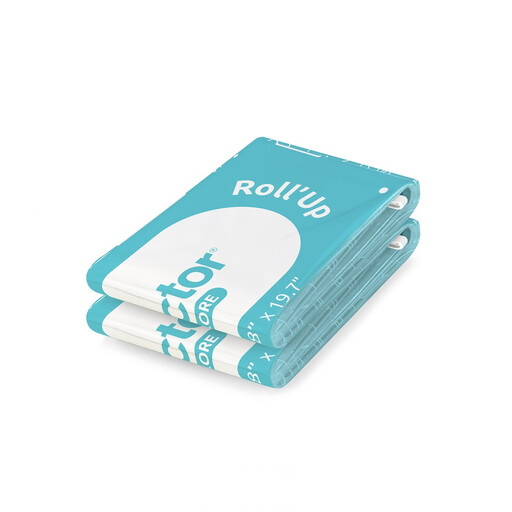
Why this choice suits this profile : This set of two 35 × 50 cm bags is ideal for getting started with travelling. It helps you organise T-shirts, shirts and sportswear without the need for a pump.
The roll-up system is clearly indicated: it requires neither a vacuum cleaner nor a pump. This reduces the risk of having to buy an additional accessory.
A compact size, reusable bags and manual compression of up to 50% claimed by the manufacturer.
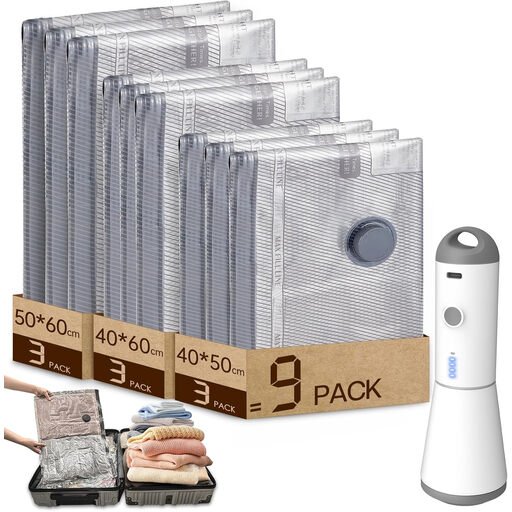
Why this choice suits this profile : This kit includes three sizes, a cordless pump and nine bags. It is suitable for regularly organising clothes, bed linen or the family wardrobe.
The available sizes are 40 × 50, 40 × 60 and 50 × 60 cm. This variety prevents you from cramming items into a bag that is too small or wasting space in an oversized model.
A cordless pump included, a double closure and polyamide and polyethylene materials described as reusable.
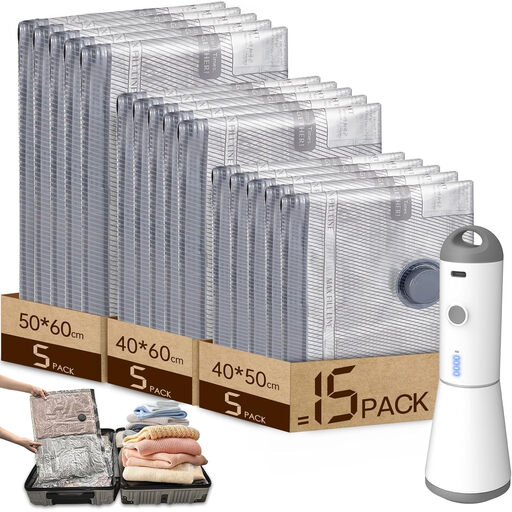
Why this choice suits this profile : With fifteen bags in three sizes, this kit meets the needs of moving house, seasonal storage or intensive family use, particularly for duvets and bulky clothing.
The number of bags lets you separate different categories and avoid overloading a single model. The product description also specifies that the recommended capacity must not be exceeded.
Five bags in each size, a cordless pump included and sizes suitable for clothes, duvets and bed linen.
We have put together a complete, real-time-updated list of products that meet these demanding selection criteria and European safety standards.
For even compression, fold your clothes before placing them in the bag and leave a little space near the closure. Close the zip along its entire length, then use the appropriate system: roll-up compression, a manual pump or an electric pump.
Never store clothes while they are still damp. The bags limit exposure to dust and ambient moisture, but they do not replace thorough drying or a clean, dry storage space. When storing textiles for several months, air them regularly and check the condition of the seams and the valve.
These bags are not designed for food. Also keep them out of the reach of children due to the risk of suffocation. For models equipped with a battery, keep the pump away from water and follow the battery disposal instructions.
They can remove the air between the fibres and around the items. However, the result depends on the type of textile, the amount placed in the bag and the compression system used. COMPACTOR roll-up models claim a reduction of up to 50%, according to the product description. This is a manufacturer’s indication, not a guaranteed result for every item of clothing.
Yes, if the bag has a roll-up system or a valve designed for manual compression. A vacuum bag with a pump is necessary when the model is primarily intended for mechanical suction. Always consult the instructions and check which accessories are supplied.
It depends on the quality of the closure, the condition of the bag and its storage conditions. Before storing clothes for several months, make sure they are clean and completely dry. Then regularly inspect the zip, valve and bag for any signs of punctures. For bulky items, choose bags for duvets and clothes that are sufficiently large rather than forcing the closure.