
Livraison le jour même ou le lendemain

Qualité garantie

Débloquez vos offres de bienvenue: Livraison GRATUITE | Jusqu'à -80 % | 30 jours d'essai gratuits à JoyPlus
Téléchargez l'application
Vacuum storage bags significantly reduce the space taken up by clothes, duvets and blankets in a wardrobe, under a bed or in a suitcase. But not all models are equal, and they do not meet the same needs. A bag that is too small for a duvet, a seal that gradually lets air back in or an incompatible pump can quickly turn a good idea into a disappointing purchase.
Before choosing vacuum bags for clothes or a vacuum storage bag for a duvet, it is worth checking a few practical features. Here are the main pitfalls to avoid, the criteria to compare and a selection suited to different uses.
A product description may promise a dramatic reduction in volume. That does not necessarily mean the bag can hold any type of textile. A double duvet, several coats or a pile of jumpers require a sufficiently large format.
To avoid disappointment, compare the dimensions of the open bag with those of the textiles you want to store. A 40 × 60 cm model is more suitable for shirts, T-shirts and small items of clothing. For a duvet or thick blanket, a large format or more spacious storage bag is generally the better choice.
The space-saving benefit mainly depends on the bag’s ability to retain the air that has been removed. A poorly aligned seal, a fragile slider or a leaking valve can allow the contents to regain volume within a few hours or days.
Look for a secure zip seal, a valve with a cap and, where specified, an anti-leak system. These details matter more than the compression claim alone.
Some vacuum bags come with a manual or electric pump. Others connect to a vacuum cleaner fitted with a hose. If you choose a model without a pump, check that your vacuum cleaner has the correct attachment.
For travel, a cordless pump is often more convenient. At home, a bag compatible with your vacuum cleaner may be all you need, avoiding the need to store an extra accessory.
When storing seasonal clothes, several medium-sized bags can sometimes be easier to stack than one very large model. They also make it simple to separate different categories: winter clothes, bed linen or children’s clothes.
The bags are generally made from polyethylene, polyamide, nylon or PEVA. A thicker material will withstand handling better, but no bag should come into contact with sharp objects, unprotected metal fasteners or a source of heat.
Transparent models make it easier to identify the contents. PEVA bags or those with a textile outer cover may blend more neatly into a wardrobe, but they do not necessarily guarantee vacuum compression.
A properly sealed bag limits contact with dust and ambient moisture, depending on the quality of its seal. However, it does not replace storage in a dry, well-ventilated place. Textiles should be clean and completely dry before packing to help prevent odours and condensation.
Avoid filling the bag to the brim: the seal should slide closed without excessive tension. After use, clean the inside if necessary, allow it to dry fully, then store it away from sharp objects.
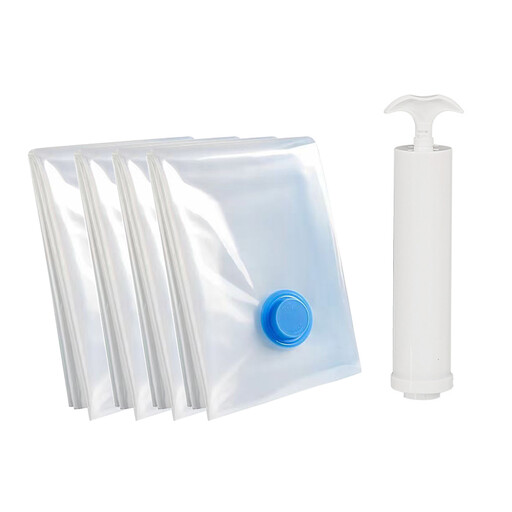
Why this choice suits this profile: This set of five large bags with a hand pump is ideal for anyone getting started with vacuum storage for seasonal clothes and bedding.
The pump is included, so there is no need to check compatibility with a household vacuum cleaner.
A set of five large-format bags, suitable for clothes and bulky laundry.
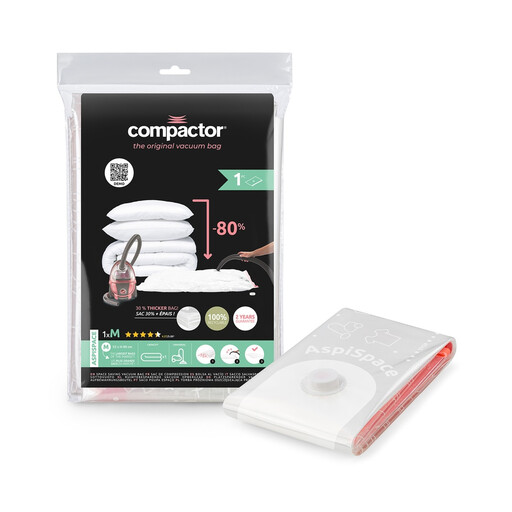
Why this choice suits this profile: The combination of two M-sized bags and one L-sized bag makes it easy to adapt storage to jumpers, coats, pillows and duvets.
The M and L dimensions are clearly stated, while the valve is designed for a vacuum cleaner with a compatible hose.
A transparent design, a zip closure and advertised protection against dust, moisture and certain pests.
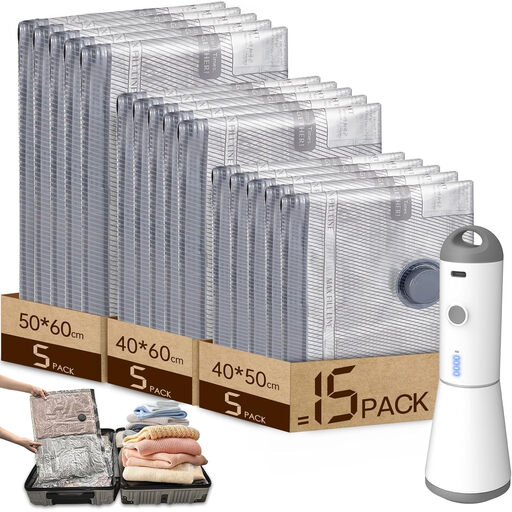
Why this choice suits this profile: This multi-size set is aimed at families, people moving house and anyone who regularly switches between different types of textiles.
The cordless pump means you do not have to rely on a vacuum cleaner, while the three sizes reduce the risk of overfilling the bags.
Fifteen reusable bags, a double-zip closure and a rechargeable pump included.
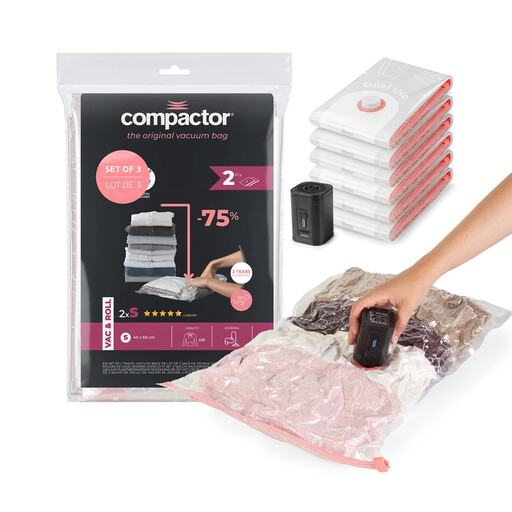
Why this choice suits this profile: The six 40 × 60 cm bags fit easily into a cabin suitcase, backpack or small storage space.
The bag can be compressed with the electric pump or rolled to remove the air, depending on the equipment available.
Six S bags and an electric pump; recyclable PE/PET material advertised as 85 µm.
We have put together a complete, up-to-date selection of products that meet these demanding criteria while complying with European safety regulations.
Compression is suitable for clothes, blankets and duvets. For items that need to retain their loft, such as certain padded jackets, follow the care recommendations on the label.
It depends on the condition of the bag, the quality of its seal and the storage conditions. Check the valve and zip regularly. For long-term storage, air the textiles when you open the bag and check that there is no moisture before packing them again.
No. Some models require a dedicated pump, while others have a valve compatible with a vacuum cleaner fitted with a hose. Always check the system supplied and the connection diameter specified by the manufacturer.
They provide a practical barrier against dust and limit exposure to ambient moisture when the seal is airtight. However, they do not replace a dry storage area. Never place damp or still-warm textiles in a sealed bag.