
Livraison le jour même ou le lendemain

Qualité garantie

Débloquez vos offres de bienvenue: Livraison GRATUITE | Jusqu'à -80 % | 30 jours d'essai gratuits à JoyPlus
Téléchargez l'application
Any long journey in a motorhome, caravan or with a trailer should always begin with a thorough tyre check. However, a simple pre-departure inspection may not detect a slow leak, overheating or a drop in pressure while driving. A TPMS tyre pressure monitoring system for motorhomes and trailers lets you track these readings throughout your journey and alerts you as soon as a value falls outside the defined thresholds.
The challenge is choosing a model suited to long vehicles. The number of sensors, maximum supported pressure, radio range and valve type are all essential criteria to check before placing your order.
A 4-sensor TPMS kit is generally suitable for a car or a setup with four tyres to monitor. For a caravan, a motorhome with twin wheels or a multi-axle trailer, you may need to move up to a 6-sensor TPMS, 8-sensor TPMS or 10-sensor TPMS.
Some systems support additional sensors, but these are not always included in the box. Check the exact contents of the kit, as well as whether additional units can be added later.
The bodywork, chassis and distance between the trailer and the display can weaken the signal. On a long vehicle, a wireless TPMS without a long-range repeater may therefore display readings intermittently.
The 433.92 MHz frequency is common for this type of product, but it does not by itself guarantee stable communication. The repeater’s position—usually between the rear sensors and the display—also plays an important role.
Motorhome, semi-trailer and heavy-duty truck tyres may require considerably higher pressure than passenger-car tyres. A device limited to 8 bar, or approximately 116 PSI, will therefore not be suitable for every configuration.
Before buying, compare the recommended pressure shown on the tyre, the manufacturer’s specifications and the monitor’s measurement range. The stated maximum should cover your intended use with a reasonable margin.
To monitor a trailer’s tyre pressure effectively, count every wheel in use, including twin wheels and, where necessary, the spare wheel. External sensors screw directly onto the valves and are easy to install, but they must be assigned to the correct position on the display.
Metal valves are generally preferable for this type of sensor. If your vehicle has rubber valves, check their condition, ensure there are no cracks and confirm that they can support the sensor’s additional weight.
A tyre pressure and temperature monitor should, at a minimum, display the pressure of each wheel together with its measured temperature. Ranges vary between devices: some models designed for cars and smaller vehicles cover 0 to 8 bar, while GUTA models intended for motorhomes and trailers advertise measurements of up to 14 bar.
Also check the available units, particularly bar and degrees Celsius, which are more convenient in France. A tyre pressure alert is only genuinely useful when the thresholds are correctly configured based on the recommended cold-tyre pressure.
Typical functions include alerts for rapid leaks, excessively low or high pressure, excessive temperature and low battery levels. Some devices also warn you when the display battery reaches a critical level.
Automatic standby after a few minutes of inactivity can help reduce power consumption. Check the display and sensor battery life separately: the models featured here use CR2032 or CR1632 batteries, whose service life varies according to usage and driving conditions.
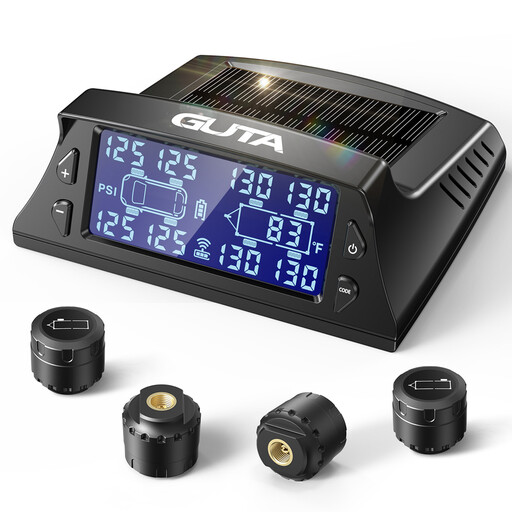
Why this option suits this profile: a straightforward solution for monitoring the four tyres of a small motorhome or compact trailer.
Its advertised range of 0 to 14 bar covers more tyres than systems limited to 8 bar. Nevertheless, check your vehicle’s length and whether a repeater may be required.
A colour LCD screen, alerts for leaks or overheating, external sensors powered by CR2032 batteries and an advertised two-year warranty.
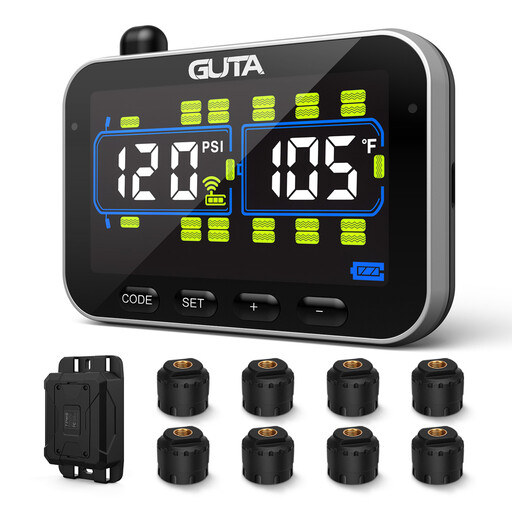
Why this option suits this profile: its eight sensors and repeater are suitable for setups with multiple wheels and an overall length of up to approximately 15 metres.
The repeater reduces the risk of signal loss on a long vehicle. The sensors are advertised as pre-paired and identified according to their position.
Pressure and temperature monitoring, six advertised alert types, a 78 × 44.5 mm screen and an advertised display battery life of approximately 15 hours.
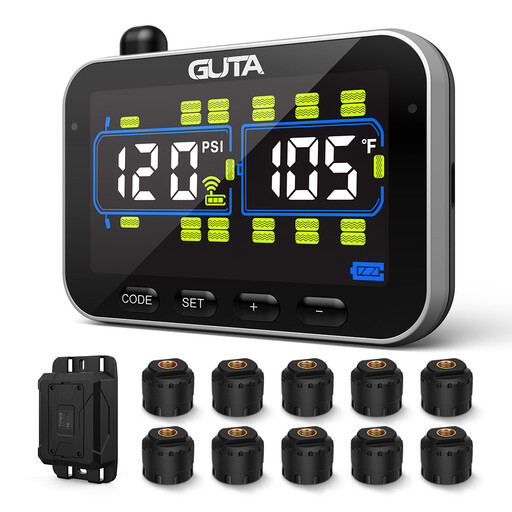
Why this option suits this profile: a kit designed for semi-trailers, lorries, motorhomes with twin wheels and configurations with numerous tyres.
The ten included sensors eliminate the need to purchase additional units immediately. The repeater is designed for long vehicles.
An advertised range of up to 14 bar, a colour screen, CR2032 sensors and advertised support for 24 tyres with expansion.
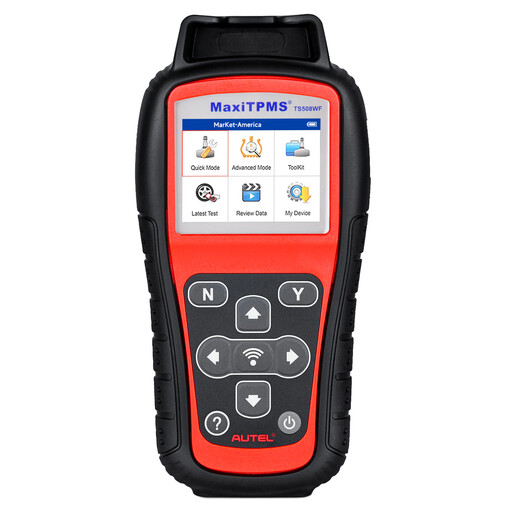
Why this option suits this profile: a diagnostic tool for workshops, fleet managers and users who regularly replace or reprogram sensors.
It does not replace an onboard monitor. Instead, it is used to diagnose and activate sensors, and to carry out the relearning procedure after servicing.
Wi-Fi connectivity for updates, access to sensor IDs and data, OBD diagnostics and a multilingual interface including French.
We have put together an up-to-date selection of products suited to different tyre pressure monitoring needs, along with the technical specifications to check in France.
External sensors are directly exposed to road spray, winter road salt and impacts. Clean them with a mild product and replace the battery as soon as the low-voltage alert appears. A TPMS is a preventive monitoring tool, but it does not replace a visual inspection, checking tread depth or the maintenance recommended by the manufacturer.
Yes. It lets you monitor the caravan’s tyre pressure and temperature throughout your journey. Choose the number of sensors according to the wheels you need to monitor, and check the radio range, especially if the rear axle is a considerable distance from the display.
It depends on the model, temperature and frequency of use. The product specifications for the models featured state approximately two years for some CR1632 batteries and up to four years for certain CR2032 batteries. These figures are manufacturer estimates and do not represent a guaranteed service life under all conditions.
Not necessarily. On a short vehicle, the display may receive sensor data directly. For a motorhome, semi-trailer or multi-metre setup, however, a kit with a repeater can reduce communication losses. Always check the maximum length specified in the product details and the recommended placement in the manual.