
Livraison le jour même ou le lendemain

Qualité garantie

Débloquez vos offres de bienvenue: Livraison GRATUITE | Jusqu'à -80 % | 30 jours d'essai gratuits à JoyPlus
Téléchargez l'application
A long journey in a motorhome, caravan or with a trailer requires closer tyre monitoring than driving a conventional car. The loaded weight, distance between the axles and overall length make stationary checks less convenient. A TPMS for motorhomes and trailers displays pressure and temperature in real time, while also alerting you to abnormal changes.
However, not all models meet the same needs. Here are the pitfalls to avoid and the criteria to consider before making a purchase.
A kit equipped with four sensors is suitable for a vehicle where all four tyres are monitored. However, it may prove insufficient for a motorhome with twin wheels, a caravan or a combination made up of a towing vehicle and trailer.
Before ordering, count the tyres you need to monitor precisely and check whether the system accepts additional sensors. Some TPMS systems for motorhomes support six, eight, ten or even more sensors.
On a long trailer or semi-trailer, the tyre pressure monitor may be a considerable distance from the rear sensors. A wireless connection that is perfectly stable in a compact car will not necessarily perform as well on a vehicle combination.
The presence of a TPMS signal repeater is therefore an important point to check for long vehicles. It should generally be positioned between the sensors and the display, often underneath the chassis or close to the rear axle.
Motorhome, caravan, lorry and trailer tyres may require considerably higher pressure than passenger car tyres. A device limited to 8 bar or 116 PSI may not be suitable for heavily loaded tyres.
Always compare the system’s measurement range with the pressure recommended by the tyre or vehicle manufacturer. A TPMS does not remove the need to inflate your tyres in line with the manufacturer’s recommendations.
To monitor tyre pressure and temperature correctly, choose the number of sensors according to your actual configuration:
Some GUTA kits are advertised as compatible with up to 24 tyres by adding extra sensors. However, check the list of compatible sensors and the expansion conditions with the manufacturer.
A suitable model should cover your tyres’ pressure range and display measurements in a clear unit, such as PSI or bar. The GUTA models featured here indicate a range of up to 0–14 bar, or approximately 0–203 PSI, while several Tymate models are advertised as supporting up to 8 bar, or 116 PSI.
Alerts can indicate a rapid leak, pressure that is too low or too high, excessive temperature or a low sensor battery. For the models featured, thresholds are calculated from a reference pressure, with an alert at around –15% and +25%. This is useful for avoiding fiddly adjustments, but it does not remove the need to calibrate the system when the tyres are correctly inflated.
External sensors screw directly onto the valves. Installation is quick, but mechanical compatibility is therefore even more important. Metal valves are generally recommended to ensure greater stability. With rubber valves, inspect their condition and make sure that installation does not place excessive strain on them.
Also check the vehicle’s electrical voltage. Several products operate on a 12 V system and are not designed for a 24 V power supply without a suitable converter. If your vehicle uses internal sensors, an external kit will not meet the same requirements.
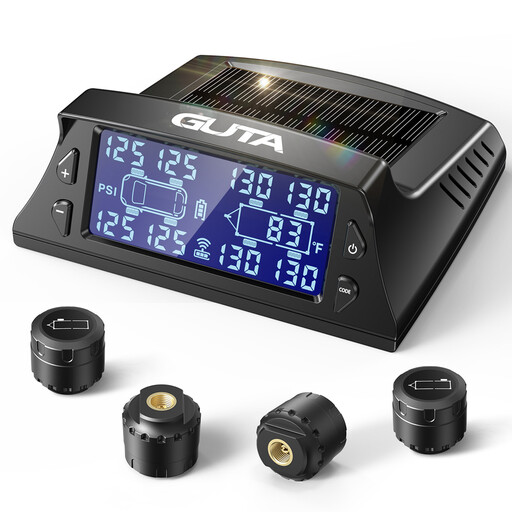
Why this choice suits this profile : Its four sensors are suitable for a straightforward configuration. The colour display, measurement range of up to 14 bar and screw-on installation complete the package.
Its high pressure range prevents you from ending up with a monitor designed solely for passenger cars. The external sensors come with an installation tool.
Pressure and temperature monitoring, six advertised alert types and a replaceable CR2032 battery.
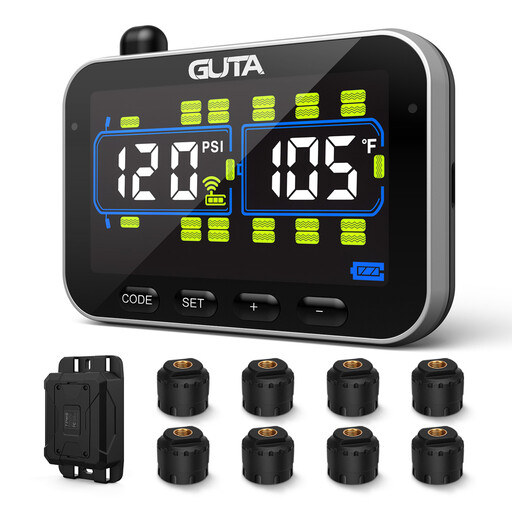
Why this choice suits this profile : This kit is designed for motorhomes, caravans and long vehicles that require several measurement points and relayed transmission.
The included repeater meets the requirements of combinations measuring up to around 15 metres, while the pre-paired sensors avoid configuration hassle.
Advertised range of 0 to 14 bar, 78 × 44.5 mm LCD screen, six alerts and advertised screen battery life of around 15 hours.
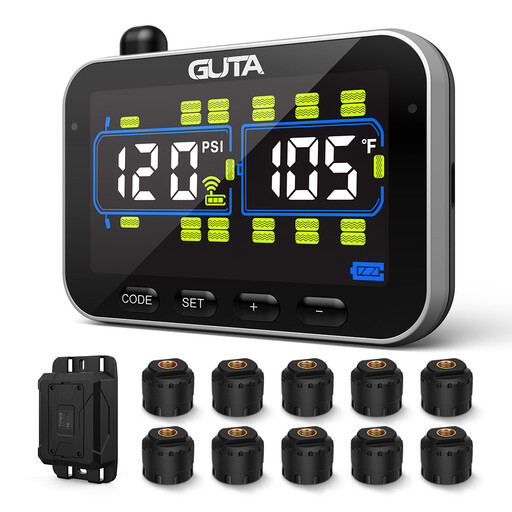
Why this choice suits this profile : It is suitable for configurations with several axles, drivers who cover long distances and certain fleet applications.
With ten sensors, the risk of leaving some tyres in a complex combination unmonitored is significantly reduced. The repeater is also supplied for long vehicles.
Measurement up to 14 bar, advertised temperature range of –40 to 105 °C, colour display and pre-paired CR2032 sensors.
We have put together a complete, real-time-updated selection of products that meet these demanding selection criteria and European safety requirements.
External sensors are exposed to water, mud and spray. Their advertised battery life varies between models, generally ranging from two to four years. However, actual service life depends on usage and operating conditions.
Yes. It lets you monitor the caravan’s tyres from inside the towing vehicle. If the wheels are a long way from the display, choose a kit equipped with a signal repeater and check the advertised maximum transmission distance.
Routine maintenance mainly involves replacing the sensor batteries, checking that they are securely attached and recharging the display. Models using CR2032 or CR1632 batteries are easy to maintain. However, keep compatible batteries available and check the casing’s watertightness after each intervention.
No. It complements tyre pressure checks but does not replace checking with a suitable pressure gauge. Before setting off, measure the pressure when the tyres are cold and visually inspect the tyres, valves and sidewalls.