
Livraison le jour même ou le lendemain

Qualité garantie

Débloquez vos offres de bienvenue: Livraison GRATUITE | Jusqu'à -80 % | 30 jours d'essai gratuits à JoyPlus
Téléchargez l'application
Whether you're heading out on a long RV road trip, towing a trailer, or driving a heavy-duty vehicle, your tire safety is non-negotiable. A good tire pressure monitoring system (TPMS) is your best ally. The only problem? The market is flooded with options, and it's easy to fall for the common pitfalls that make a purchase useless at best, and dangerous at worst.
As the Head of Product Recommendations at Joybuy, my mission is to help you see things more clearly. Let's review the mistakes to avoid and the criteria that truly matter when choosing an RV TPMS that's perfectly suited to your needs.
Before we even get into the technical details, it's crucial to be aware of the hidden flaws in many entry-level models. These shortcomings can cost you dearly, both literally and figuratively.
To be sure of the reliability of your future tire pressure monitoring system, here are the three technical points you should never overlook.
This is the absolute starting point. Check the recommended pressure from your vehicle and tire manufacturer (often found on a sticker in the driver's doorjamb). For an RV, caravan, or heavy-duty truck, aim for a system capable of measuring high pressures, ideally up to 13 bar (approx. 188 PSI). This will give you a comfortable safety margin and ensure compatibility with most heavy vehicles.
Next, take stock of how many RV tire pressure sensors you need. Consider all the axles on your main vehicle, those on your trailer (trailer TPMS), and don't forget the spare tire(s)! Good to know: some modular systems allow you to add more sensors later.
The most common wireless transmission technology uses the 433.92 MHz frequency. While effective for a car, it quickly shows its limitations on vehicles longer than 7-8 meters (about 25 feet). For an RV, a car-and-caravan setup, or a heavy-duty truck, a signal repeater is therefore essential. This small box, often placed at the rear of the towing vehicle, relays and amplifies the signal from the farthest sensors. It ensures stable communication with the monitor and puts an end to random data loss.
A good TPMS does more than just display numbers; it must actively alert you to problems. Verify that the system offers at least these 6 essential alerts:
Finally, a color LCD screen with auto-adjusting backlight ensures optimal readability day or night.
To put theory into practice, here is our selection of systems that meet different needs while adhering to the reliability criteria we've just discussed.
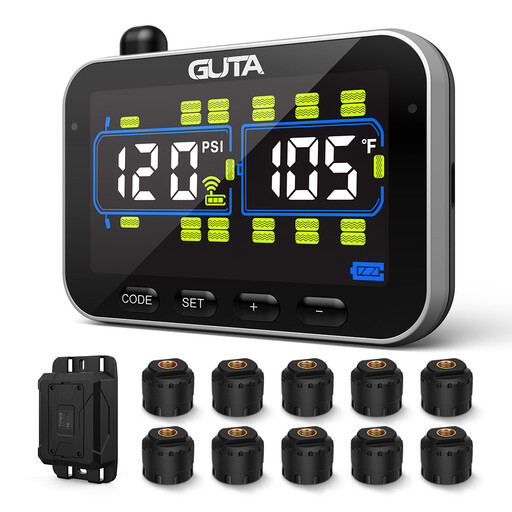
Why it stands out: Built for the largest rigs, this kit is the solution for Class A motorhomes, heavy-duty trucks, or complex setups (e.g., vehicle + dual-axle trailer). It's perfect for those who clock up serious mileage and demand flawless monitoring.
With its high pressure range (up to 13 bar / 188 PSI) and included signal repeater, it checks the two essential boxes for long vehicles where budget models consistently fail.
Shipped with 10 pre-paired sensors, it's expandable up to 24 tires. This makes it a scalable solution, ideal for fleet tracking or truck tire pressure monitoring. Its large color screen is a model of clarity.
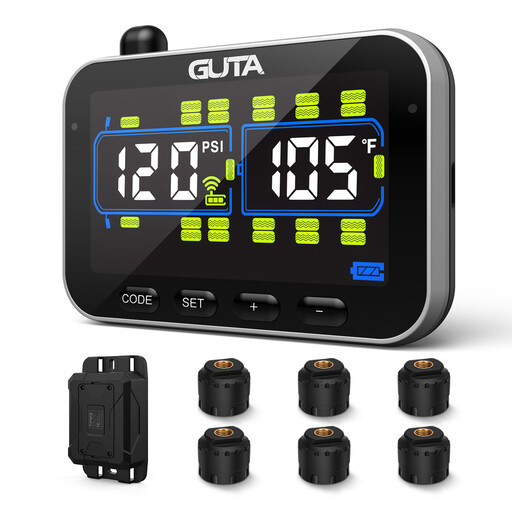
Why it stands out: This is the perfect choice for Class C or semi-integrated motorhomes and for setups with a single-axle caravan. It offers the same security as the premium model but with a sensor count tailored to the most common configurations.
It features the same professional pressure range (0-188 PSI) and signal repeater, ensuring reliable monitoring without the blind spots of entry-level systems.
The perfect balance of professional features and a more accessible price point for 6-wheel setups. Installation remains a breeze thanks to the pre-paired sensors.
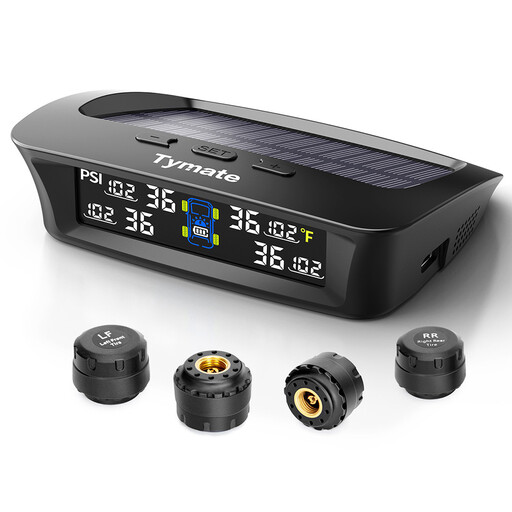
Why it stands out: The ideal solution for outfitting a car, sedan, or SUV with an aftermarket monitoring system. It's simple, effective, and perfectly sized for the needs of a passenger vehicle.
With a pressure range calibrated for light vehicles (up to 8 bar / 116 PSI), it saves you from paying for unnecessary heavy-duty features while still providing precise and reliable monitoring.
Its installation is incredibly simple: just screw on the external sensors. The compact display and 5 alarm modes make it a practical safety ally for both daily driving and long holiday trips.
We have curated a complete selection of systems that meet our strict selection criteria and current safety standards.
What is the lifespan of TPMS sensors? The lifespan of an external sensor is directly tied to its battery life. For most models, which use standard batteries like CR2032 or CR1632, you can expect 2 to 4 years of use. The major advantage of external sensors is that these batteries are very easy to replace yourself. This extends the life of your equipment without needing to buy new sensors.
Is installing a wireless TPMS complicated? No, for the vast majority of systems with external sensors, installation is a breeze. You simply screw each sensor onto the corresponding tire's valve stem, replacing the original cap. Good systems come with factory-paired sensors. All you have to do is install them and turn on the monitor, and the data will appear instantly. The whole process only takes a few minutes.
Is a signal repeater really necessary for my RV? Yes, and in some cases, it's absolutely essential. If your vehicle (RV, large converted van) is longer than 8 meters (about 25 feet), or if you are towing a caravan or trailer, a repeater is non-negotiable. It ensures that the signal from the farthest tires reaches the monitor without interference. It's the only way to get consistently reliable data and say goodbye to false disconnection alerts.