
Same-day & Next-day Delivery

Quality Guaranteed

Unlock Your Welcome Offers: FREE Delivery | Up to 80% OFF | Free 30-day JoyPlus trial
Download the APP
For a motorhome, caravan, trailer or commercial vehicle, a slow leak can go unnoticed until a warning light comes on, the tyre deforms or you lose stability. A TPMS tyre pressure monitoring system typically displays pressure and temperature in real time, while alerting you to certain faults.
But not every model suits every vehicle. Number of sensors, radio range, maximum pressure and valve type are among the criteria you need to check before buying. Here are the points to examine to avoid nasty surprises.
A kit supplied with four sensors only monitors four wheels. On a motorhome with twin rear wheels, a multi-axle caravan or a professional trailer, this may not be enough.
Some TPMS systems claim compatibility with 24 tyres, yet the supplied kit only contains four, six, eight or ten sensors. You therefore need to distinguish between:
A wireless transmission at 433.92 MHz can work for many uses, but the actual range depends on the vehicle length, the chassis, the display position and any metal obstacles.
For a TPMS intended for a caravan, trailer or truck, the signal repeater deserves special attention. It is usually placed between the furthest sensors and the monitor installed in the cab.
A model designed for a car or SUV will not necessarily suit the tyres of a motorhome or heavy goods vehicle. A range stated as up to 116 PSI may not meet the needs of a vehicle whose recommended pressure is higher.
External TPMS sensors screw onto the valves. For heavy-duty use, product listings often recommend metal valves. With rubber valves, check their condition, compatibility and the extra weight of the sensor.
The sensor's measurement range must cover the manufacturer's recommended pressure, with sufficient margin. Technical specifications may use PSI or bar: 1 bar is approximately equal to 14.5 PSI.
Watch out for inconsistencies between the commercial title and the technical data. Some GUTA models, for example, state "0–188 PSI" in their description, while another line mentions "0–14 bar, i.e. about 203 PSI". This difference should be confirmed with the seller before any use on heavily inflated tyres.
A good tyre pressure and temperature monitoring system does more than just display pressure. Temperature can rise during a long journey, especially in hot weather, with a heavy load or during repeated braking.
The stated thresholds correspond to the product's own alert parameters and do not guarantee detection of every situation. Several kits offer automatic calibration of the reference pressure, with an alert around −15% for under-inflation and +25% for over-inflation. It remains essential to check the pressure when cold using a suitable device.
A solar TPMS can reduce the need to recharge the display, but check that the panel will receive enough light behind a tinted windscreen or in overcast weather. Models equipped with a USB-C rechargeable battery offer a more predictable solution.
External sensors typically use button cell batteries, such as CR1632 or CR2032. Their stated battery life can reach two to four years depending on the model and usage. However, the battery must be checked regularly, along with the tightness of the sensor and the absence of any leak at the valve.
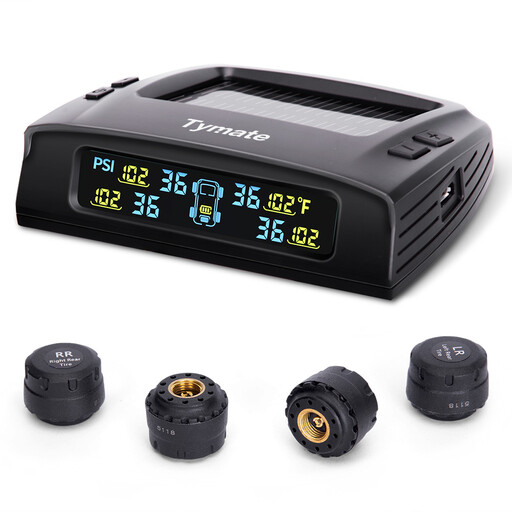
Why this choice suits this profile: This kit is suitable for a car, SUV or vehicle with a stated maximum length of 20 feet, with four wheels to monitor and a screw-on installation.
The number of sensors and the 0 to 116 PSI range are clearly stated. This makes it easier to check compatibility with a light vehicle before ordering.
Colour LCD display, alerts for rapid air loss, pressure, temperature and low battery; stated battery life of around two years for the sensors' CR1632 battery.
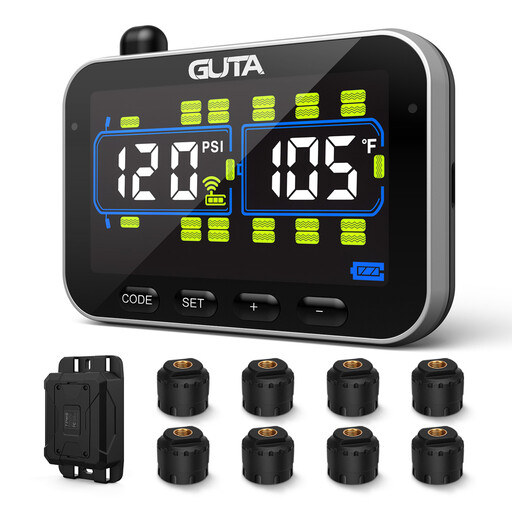
Why this choice suits this profile: Its configuration targets motorhomes, caravans, semi-trailers and trucks under 50 feet, with a 78 × 44.5 mm colour display.
The repeater partly solves the range issue on long vehicles. The sensors are pre-paired and identified according to their position.
Stated range of 0 to 188 PSI, monitoring from −40 to 105 °C according to the data sheet, six alerts and stated battery life of around four years for the sensors' CR2032 battery.
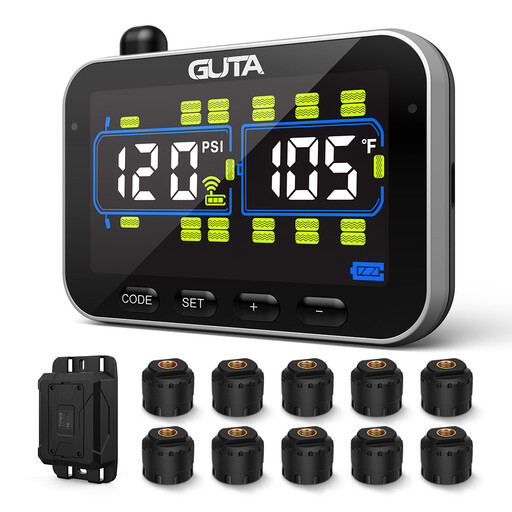
Why this choice suits this profile: This configuration is aimed at fleets, semi-trailers and vehicles with many tyres, where four or six sensors are no longer enough.
The ten included sensors avoid an immediate separate purchase, while the repeater improves transmission on long vehicles.
Colour LCD display, six types of alarm, pre-paired sensors and stated support for up to 24 tyres with additional sensors.
We have put together a comprehensive, real-time updated selection of products that meet these demanding criteria, as well as European safety regulations.
A wireless monitor is used to display data while you are driving. A TPMS programming tool serves a different purpose: activating a sensor, reading its ID, clearing a fault code or initiating a relearn procedure after a replacement.
The XTOOL TP150 supports 315 and 433 MHz sensors, diagnostic functions and XTOOL TS100 sensors. The Autel MaxiTPMS TS508WF can, among other things, activate sensors, perform diagnostics and run several relearn procedures. Before buying, check its compatibility with the vehicle make, model and year, as well as with the type of sensor you are using.
Remove the valve cap, screw on the sensor corresponding to the relevant wheel, then install the display in the cabin. Avoid over-tightening. Then check that each wheel appears in the correct position and calibrate the reference pressure following the instructions in the manual.
It depends on the battery, temperature, transmission frequency and storage conditions. The data sheets for the models shown state around two years for some sensors equipped with a CR1632 battery and up to four years for certain models with a CR2032. These figures are indicative: replace the battery as soon as a low battery alert appears.
In addition to the price of the kit, you may need to factor in sensor batteries, any additional sensors and, for long vehicles, a repeater and its power supply. Rechargeable models reduce the need to change the display battery, but the sensors fitted to the wheels are still typically powered by button cell batteries.