
Same-day & Next-day Delivery

Quality Guaranteed

Unlock Your Welcome Offers: FREE Delivery | Up to 80% OFF | Free 30-day JoyPlus trial
Download the APP
A good stainless steel kitchen utensil set is a long-term investment. Sturdy, hygienic, and high-performing, it's an essential partner in any serious kitchen. The problem? The market is flooded with options of wildly varying quality. Between steel that rusts after the first wash and poorly designed handles, it's easy to make a purchasing mistake. This guide breaks down the essential criteria for choosing equipment that is reliable, durable, and truly practical for everyday use.
Before we even talk about technical specs, let's review the hidden flaws that can render a set useless in just a few months.
To make the right choice, focus on these few objective points. They are your guarantee of the quality and longevity of your future stainless steel kitchen utensil set.
This is the number one criterion. 304 stainless steel, also known as 18/8 or 18/10, is the absolute benchmark for kitchen accessories, whether for professional or home use. Its composition (18% chromium and 8-10% nickel) gives it exceptional resistance to rust and food acids. It's the best guarantee of durability and food safety.
A utensil forged from a single piece of metal (one-piece or "monobloc") will always be more robust and hygienic. The absence of welds, rivets, or joints eliminates weak points where the utensil could bend or break. Most importantly, this design prevents any water or food from seeping in. Cleaning is simplified and hygiene is impeccable—a decisive advantage for worry-free dishwasher use.
A good set should, above all, meet your daily needs. Before you check out, make sure it includes:
Rather than an endless list, we've selected a few products that meet specific needs while scrupulously adhering to the quality criteria defined above.
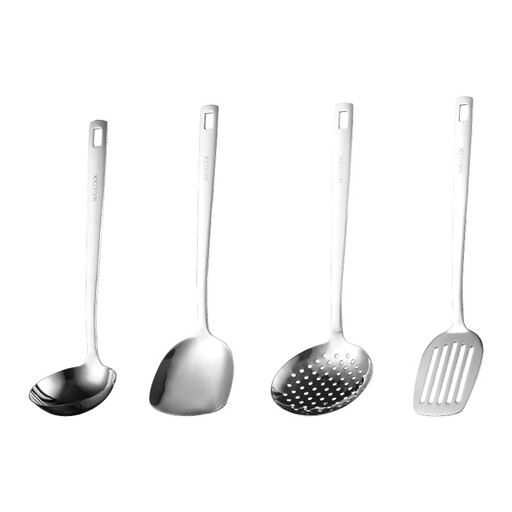
Why we chose it: This set gets straight to the point with the four core pieces for daily cooking. It's the perfect choice for a simple and effective setup, for replacing old, tired utensils, or for intensive everyday use.
Its sturdy one-piece construction eliminates any risk of water infiltration and internal rust. The set includes a wok spatula, a ladle, and a skimmer, covering all the essentials.
The one-piece design and long, anti-scald handle are guarantees of safety and durability. Fully dishwasher-safe, its maintenance is a breeze.
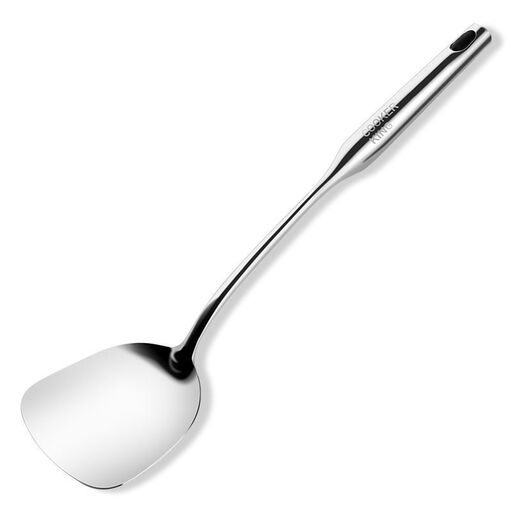
Why we chose it: For wok or plancha cooking, a standard spatula quickly shows its limits. This model is built for high temperatures and rapid movements, which demand a rigid tool capable of handling food with force and precision.
Forged from food-grade 304 steel, it offers superior resistance to heat and corrosion. Its thickened one-piece design protects it from any deformation, even under heavy use.
Its thickened structure gives it heavy-duty rigidity and durability, perfect for stir-frying. Its ergonomics are specifically designed for the movements of wok cooking.
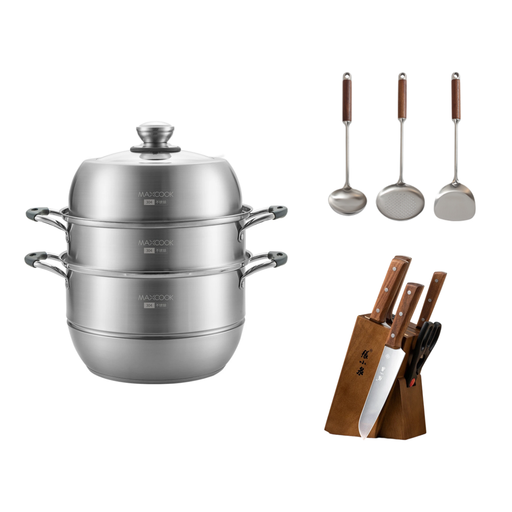
Why we chose it: For those moving into a new place or wanting to start from scratch, this bundle is the turnkey solution. Much more than just a utensil set, it includes a steamer pot, knives, and a knife block.
The core pieces (steamer, spatula, ladle) are made of 304 stainless steel, ensuring quality where it matters most. The bundle is designed to be immediately functional and versatile.
An all-in-one solution with unbeatable value for getting fully equipped. The combination of utensils, knives, and a steamer pot covers a very wide range of recipes.
Explore our full selection of products that meet our quality criteria and food safety standards.
To avoid water spots or limescale, the secret is to wipe them with a soft cloth right after washing, even when they come out of the dishwasher. For stubborn stains, a little diluted white vinegar or baking soda on a non-abrasive sponge will restore their shine.
No, that's a very bad idea. Metal utensils, including stainless steel, will permanently scratch and damage the coating of your non-stick pots and pans. On these surfaces, you must use utensils made of silicone, nylon, or wood. Reserve your stainless steel set for your stainless steel, cast iron, or carbon steel pans.
Simply put: there is none. The terms "304 stainless steel," "18/8 stainless," and "18/10 stainless" all refer to the same family of food-grade steel. The first number (18) corresponds to the percentage of chromium, and the second (8 or 10) to the percentage of nickel. These two elements are what guarantee its famous resistance to corrosion.