
Livraison le jour même ou le lendemain

Qualité garantie

Débloquez vos offres de bienvenue: Livraison GRATUITE | Jusqu'à -80 % | 30 jours d'essai gratuits à JoyPlus
Téléchargez l'application
Buying stainless steel kitchen utensils seems simple… until you have to compare thickness, coatings, handles and induction compatibility. A shiny frying pan is not necessarily suitable for your hob, while a wok marketed as non-stick may require particularly careful maintenance.
To avoid choosing cookware that is not right for your needs, look closely at the product’s composition, the type of base it has and the recommended usage conditions. Here are the main criteria to consider before choosing a stainless steel frying pan, wok or stainless steel cookware set.
The term ‘stainless steel’ may refer only to the outside of the vessel. Some models feature an aluminium core, a ceramic coating or a textured cooking surface. This is not necessarily a drawback, but it does affect how the cookware should be maintained and how resistant it is to scratches.
When a product is described as a 304 stainless steel model, check its technical specifications carefully. Find out whether 304 steel makes up the entire body, only the food-contact surface or just certain components, such as the lid.
To work on an induction hob, cookware must have a magnetic base. However, the shape of the base matters just as much. A small base on a large wok may heat less evenly. On a standard hob, therefore, look at the actual base diameter rather than just the advertised top diameter.
Compatibility with gas, electric, ceramic and induction hobs should be specified separately. An induction-compatible wok may work on several types of hob, but you still need to check its dimensions and stability on yours.
A non-stick stainless steel frying pan or non-stick stainless steel wok will generally make cleaning easier, but its coating requires moderate heat and suitable utensils. Abrasive sponges, prolonged heating when empty and repeated thermal shocks can shorten its lifespan.
By contrast, an uncoated stainless steel frying pan is more suitable for use with metal utensils. However, it requires the right cooking technique to prevent food from sticking.
304 is a common designation for stainless steel used in many food-related applications. However, the finished quality also depends on the thickness, construction and finish. A three-layer structure, often referred to as ‘tri-ply’, generally combines several metals to distribute heat more evenly.
For a stainless steel cookware set, pay particular attention to:
This information is far more useful than a simple promise of durability.
For one or two people, a 24 cm frying pan or a 26 cm wok may be perfectly suitable. For a family, a diameter of 28 to 32 cm provides more cooking space, but requires a sufficiently large hob and suitable storage space.
A wok with a glass lid lets you monitor cooking without lifting the lid. A frying pan with a lid is useful for slow-cooked dishes, vegetables and recipes that need to retain their moisture. However, check whether the lid is oven-safe and whether its handle could become hot.
A ceramic non-stick saucepan or a hybrid frying pan can be very practical for cooking eggs, fish or food with little added fat. Choose low or medium heat and use wooden, silicone or nylon utensils unless the manufacturer states otherwise.
For an uncoated model, the ‘hot pan, cold oil’ method can help reduce sticking, provided you maintain a medium temperature. Also allow the cookware to cool before washing it to prevent thermal shock.

Why this product suits this profile : Its 30 cm diameter, glass lid and advertised compatibility with induction, gas, electric and ceramic hobs make it a versatile choice for everyday family cooking.
The product details specify the three-layer construction, ceramic non-stick surface and recommended hand washing. You cannot mistake it for a basic stainless steel wok that needs no special care.
Tri-ply 304 stainless steel body, flat magnetic base, tempered glass lid and insulated handle.
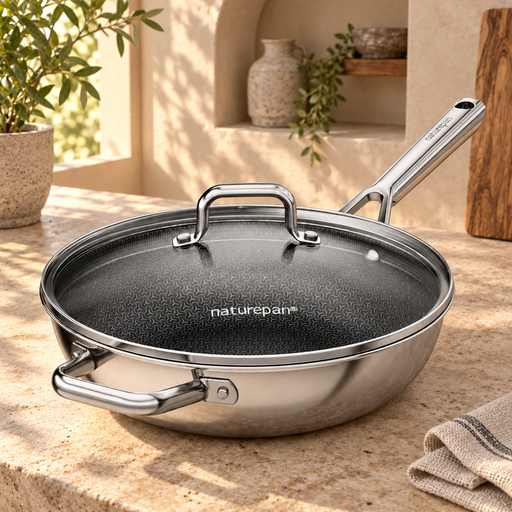
Why this product suits this profile : This versatile format is ideal for anyone who alternates between searing, cooking vegetables and preparing saucy dishes in a single pan.
The product details distinguish the multi-layer stainless steel body from the ceramic coating and specify a maximum oven temperature of 230 °C, with the lid removed.
Hybrid hexagonal surface, aluminium heat-conducting core, lid included and advertised compatibility with several types of hob.
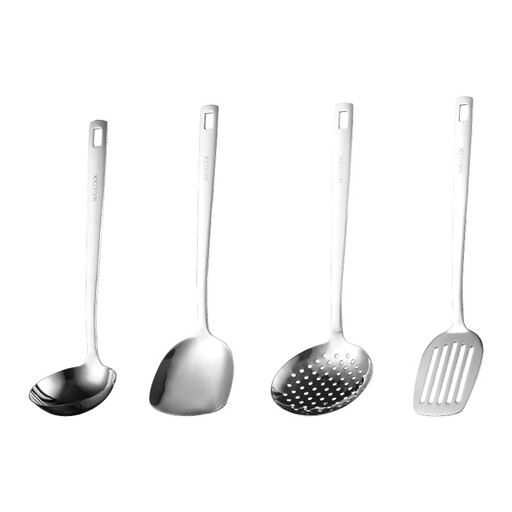
Why this product suits this profile : This set is designed for households that regularly use a wok, frying pan or saucepan and want to bring together several essential accessories.
The one-piece construction and long handles reduce the number of parts that could come loose. However, the manufacturer recommends gentle cleaning and drying immediately after washing.
Four accessories, long handles, ladle and skimmer heads designed for everyday tasks, with hanging holes.
We have put together a complete, real-time updated list of products that meet these strict selection criteria, as well as European regulatory requirements for safety.
To keep your stainless steel kitchen utensils in good condition:
The ‘304 stainless steel’ label does not mean that the utensil will be impossible to stain. Iridescent marks, mineral deposits or cooking residue may appear after intense heating. They often disappear with suitable cleaning, but a scratched surface or damaged coating should be monitored.
Yes, provided that their base contains a magnetic section and the manufacturer states that they are compatible. You can optionally test the base with a magnet and check the diameter of the area that is actually in contact with the hob.
No, but it requires careful temperature control. Preheat it gradually, add the fat at the right moment and avoid turning the food too soon. If you are looking for easier cooking, a non-stick or hybrid stainless steel frying pan can be a good alternative, provided you follow the instructions for its coating.
A cookware set is a convenient way to equip a kitchen quickly and have matching sizes. Buying individual pieces is more sensible if you mainly cook with a wok, have limited storage space or prefer to choose a frying pan, saucepan and lid that are precisely suited to your hobs.