
Livraison le jour même ou le lendemain

Qualité garantie

Débloquez vos offres de bienvenue: Livraison GRATUITE | Jusqu'à -80 % | 30 jours d'essai gratuits à JoyPlus
Téléchargez l'application
A stainless steel non-stick wok compatible with induction can replace several utensils for stir-frying, cooking vegetables, frying, simmering or preparing family meals. However, some claims highlighted in product descriptions deserve closer examination. A ‘honeycomb’ surface, large diameter or ‘all hobs’ label does not necessarily guarantee enjoyable everyday use.
Here are the criteria to review when choosing a wok suited to your kitchen, whether you use an induction hob, gas, an electric hob or a ceramic hob.
A 30 or 32 cm wok naturally appears spacious. On an induction hob, however, only the magnetic base beneath the utensil is heated directly. If it is too narrow, the wok may heat up more slowly and cooking may be less even around the sides.
So check the base diameter, not just the opening. For a family, a 28 to 32 cm wok generally offers comfortable capacity, provided its base is sufficiently wide and stable.
A ceramic or PTFE coating makes cooking and cleaning easier, but it remains sensitive to prolonged overheating, sudden temperature changes and certain utensils. Manufacturers often recommend using low to medium heat and wooden, silicone or nylon utensils.
The honeycomb texture can reduce direct contact between the utensil and the coated surface, but it does not remove the need to follow care instructions. To preserve the coating’s performance, hand washing is frequently recommended.
A large multi-layer stainless steel wok can become heavy once filled with several portions. A poorly designed handle or a lid that is difficult to store can also turn a promising utensil into an awkward item.
Before ordering, check whether it comes with a glass lid, the handle length, the space available in your cupboards and whether the lid is oven-safe. Removable handles make storage easier, but they must be locked securely before each time you move the wok.
A stainless steel wok offers good resistance to corrosion and is suitable for everyday cooking. Tri-ply models generally combine several layers of metal, with an aluminium core designed to distribute heat more effectively. However, you should still use moderate heat, as stainless steel can cause food to stick if the wok has not been preheated properly.
A carbon steel wok, also known as a carbon steel wok, generally has no coating. It requires initial seasoning, hand washing and the application of a thin layer of oil after drying. In return, its surface improves over time and can withstand high-temperature cooking. This type of wok is best suited to users who are prepared to maintain it regularly.
A ceramic non-stick wok lets you cook with little added fat and is easy to clean. Hybrid models combine an etched surface, exposed stainless steel areas and coated sections. The aim is to combine effective searing with food that is easier to release. However, the recommendations regarding temperature and utensils remain essential.
If you want to use metal spatulas, check the manufacturer’s instructions carefully. A claim of scratch resistance does not mean that sharp objects or repeated impacts are risk-free.
The all-hob wok label should be confirmed in the technical specifications. Look for explicit information about:
For a French kitchen fitted with an induction hob, a flat base is particularly practical. It removes the need for a wok ring and provides greater stability.
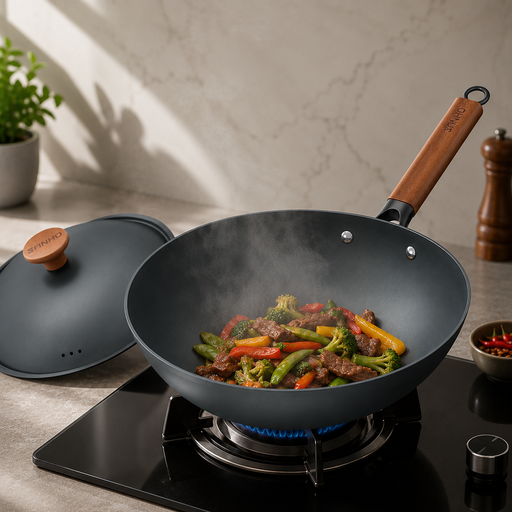
Why this choice suits this profile : This five-piece set provides a useful foundation for a first kitchen setup. It works on induction, gas, electric and ceramic hobs. The pieces stack together thanks to the removable handle, while the 20 cm saucepan has a stated capacity of 3 litres.
Rather than relying on one large piece that is difficult to store, this set combines a removable handle with several sizes to make storage and everyday use easier.
Ceramic interior coating, aluminium heat-conducting core, compatibility with several heat sources and oven use up to 230 °C without the handle or lid.
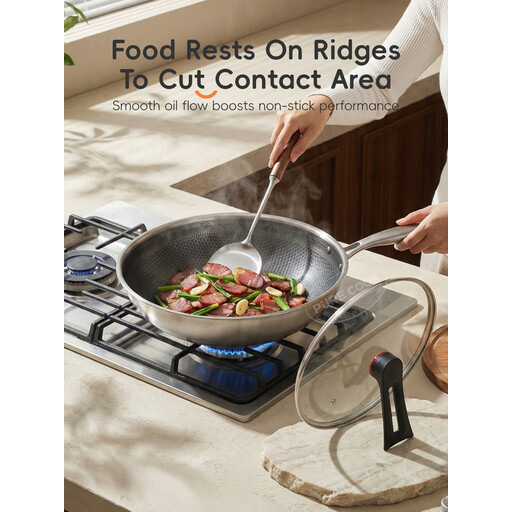
Why this choice suits this profile : With its 32 cm diameter, this model is designed for households that cook several portions at once. Its three-layer 304 stainless steel construction and glass lid are equally useful for cooking and keeping an eye on your food.
Its large diameter is paired with a base stated to be compatible with induction, gas and electric or ceramic hobs. It is therefore more than just a wide opening.
Tri-ply construction, textured honeycomb interior, glass lid and pouring rim. Hand washing is still recommended.
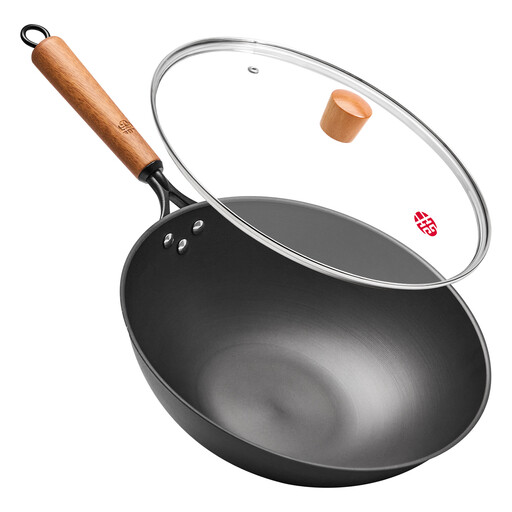
Why this choice suits this profile : With no coating, this wok is aimed at cooks who enjoy searing at high temperatures and preparing dishes inspired by Chinese cuisine. Its flat base is stated to be compatible with induction, gas, electric and ceramic hobs.
The absence of a coating removes concerns about coating wear, but it requires seasoning and care after every use.
1.5 mm carbon steel, glass lid, flat base and stated capacity for 3 to 5 portions. Hand washing is required.
We have brought together a complete, real-time updated selection of products that meet these demanding criteria and European safety standards.
To minimise food sticking, preheat the utensil gradually and adjust the hob’s power. With a non-stick model, use low to medium heat and do not leave it empty on a switched-on hob. With a carbon steel or uncoated wok, use the ‘hot pan, cold oil’ method, then dry it carefully after washing.
Also make sure you have a secure grip before lifting a full wok. The lid, handle or removable handle may remain hot, even when its material is described as heat-insulating.
A 30 cm wok is generally suitable for several portions without taking up as much space as a 32 cm model. For one or two people, a diameter of 24 to 28 cm is often easier to handle. Always check the base diameter to ensure suitable contact with your induction hob.
Some manufacturers state that their cooking bodies are dishwasher-safe. However, they often recommend hand washing to preserve the coating and the appearance of the stainless steel. Removable handles, lids and accessories may also need to be cleaned separately by hand.
It depends on the thickness of the metal, how often it is used and how well it is maintained. A carbon steel wok should be dried immediately, then lightly oiled to reduce the risk of rust. Its seasoning can become more durable with continued cooking, but it is best to avoid abrasive products and the dishwasher.