
Livraison le jour même ou le lendemain

Qualité garantie

Débloquez vos offres de bienvenue: Livraison GRATUITE | Jusqu'à -80 % | 30 jours d'essai gratuits à JoyPlus
Téléchargez l'application
A well-organised hallway often starts with a shoe storage unit suited to the available space and the number of pairs you need to store. However, some models win you over with their appearance or promises before revealing their everyday drawbacks: excessive depth, compartments that are too low, laborious assembly or a stated capacity that is difficult to verify.
Here are the main criteria to consider before buying a shoe cabinet, shelving unit or stackable boxes for your home.
A capacity of 18, 22 or 25 pairs does not necessarily mean that all your shoes will fit comfortably. Bulky trainers, ankle boots and heels take up more room than flat shoes. The internal width and height of the compartments therefore matter just as much as the number of tiers.
For an 18-pair shoe storage unit, check in particular whether this capacity applies to slim shoes or bulkier styles. The external dimensions do not always show how much usable space is actually available.
A unit that is too deep can obstruct a door, narrow the passageway or create a hazardous corner in a small hallway. Before ordering, measure the available area, including skirting boards, then allow a few extra centimetres for opening doors or drawers.
A slim shoe rack can be perfectly suitable for a hallway, provided you check its stability and how the shoes are arranged. A shallow solution is only useful if it remains suitable for the pairs you actually wear.
Units made from wood-based panels often provide a practical surface and a coordinated style, while a metal shoe rack is generally lighter and easier to dismantle. Transparent plastic boxes make it easier to identify each pair, but their additional height needs to be taken into account.
A closed unit protects shoes from dust, but it is best to let them dry before putting them away. Ventilation, ease of cleaning and access to the compartments should be just as important as appearance.
Measure:
In a cramped room, a shallow unit, a vertical structure or storage installed inside a cupboard can help preserve clear passageways. In a bedroom or living room, visual integration and noise when opening the unit also become important.
Adjustable shelves allow you to alternate between low-profile shoes, trainers and boots. This is particularly useful for families where sizes and types of footwear vary. Fixed compartments are simpler, but may leave unused space.
For larger collections, stackable shoe storage boxes provide a modular solution. Compare the dimensions of each box with your shoes, taking size, shape and sole thickness into account. A transparent front lets you identify each pair quickly, while a front-opening door means you do not have to move the entire stack.
A tall or heavily loaded unit must remain completely stable. Check whether a wall-fixing device is included when the manufacturer specifies one, particularly in a family home. For a metal structure, check the maximum load shown for each tier and distribute the pairs evenly.
Details such as a stated load capacity of 150 kg or 10 kg per tier reflect the manufacturer's data. They must be observed under the specified usage and assembly conditions. Clear instructions, numbered parts and the tools provided can also help reduce assembly errors.
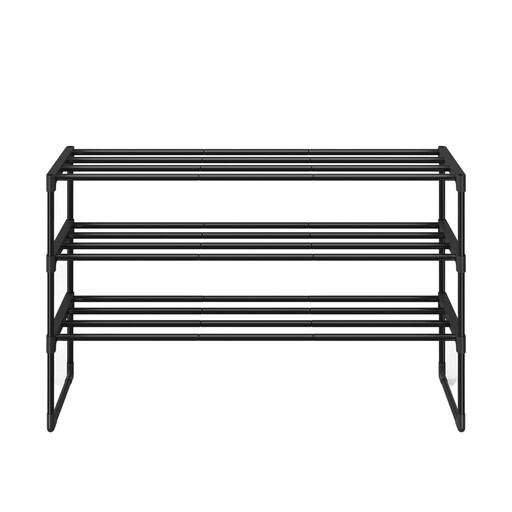
Why this choice suits this profile : Measuring 30 × 92 × 55 cm, this structure is suitable for a hallway, cupboard or living room where you want direct access to your shoes and hassle-free installation.
Its dimensions are clearly specified, and tool-free assembly makes installation simple. However, you must observe the stated load capacity of 10 kg per tier and 30 kg in total.
Three metal tiers, stackable or reversible structure, stated weight of 1.3 kg and open access to your pairs.
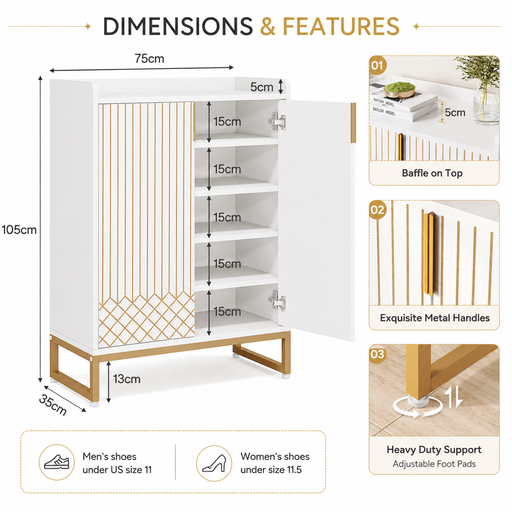
Why this choice suits this profile : If you want your storage to complement your décor, this white, closed unit offers five tiers and a top surface for displaying a few items.
The doors conceal the shoes and limit their exposure to dust. Before buying, check the space required to open them and plan for two-person assembly, following the instructions.
Stated capacity of 22 to 25 pairs, five tiers, an open lower shelf and a structure mounted on metal feet.
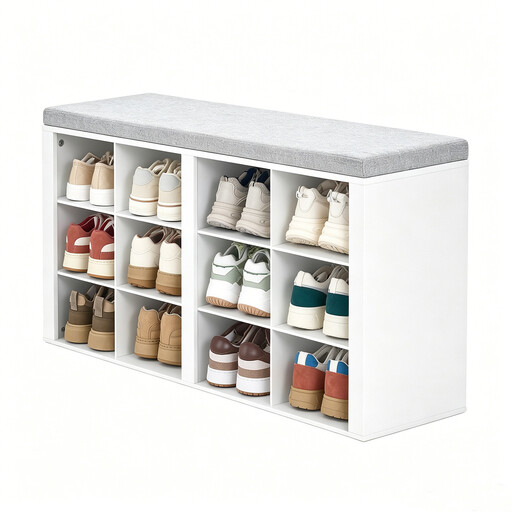
Why this choice suits this profile : This hallway shoe storage unit combines seating and storage. It is suitable for families and anyone who wants to make putting shoes on easier in the hallway.
Its adjustable shelves let you adapt the space for trainers, heels or boots. The cushion cover is removable, making it easier to clean.
Twelve compartments, dimensions of 30.5 × 104.5 × 49.5 cm and a stated load capacity of 150 kg.
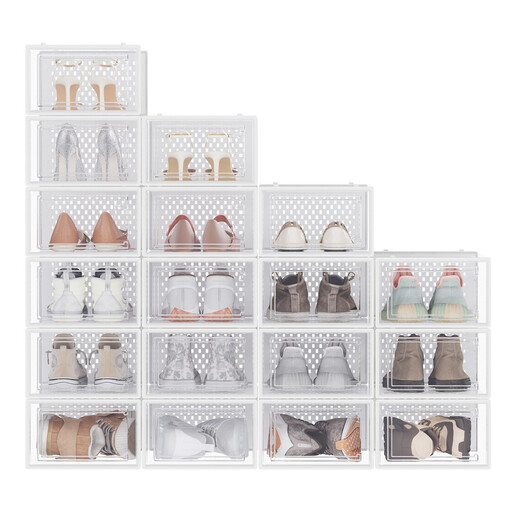
Why this choice suits this profile : These boxes are suitable for a dressing room or cupboard where seeing each pair is more important than having one single storage unit.
The transparent front means you do not need to open every box. However, the dimensions of 33.3 × 23.1 × 14.3 cm per box should be compared with your shoes before ordering.
Pack of 18 boxes, front-opening doors, integrated ventilation and an assembly design intended for stacked organisation.
We have compiled a complete, real-time updated list of products that fully meet these strict selection criteria and European safety regulations.
In a hallway, allow enough room to sit down and open the doors without blocking the passageway. A shoe storage bench can replace a separate seat, but its height and depth must remain compatible with your household's habits.
For a closed model, avoid putting damp shoes straight inside. In a dressing room, doors protect them from dust. In a narrow hallway, however, a front-opening door may require more clearance than a unit with drop-down fronts.
Capacity varies according to the width of the compartments and the type of shoes. A compact model may be suitable for a few everyday pairs, while a five-tier unit is stated here to hold 22 to 25 pairs. For boots and bulky footwear, expect the actual capacity to be lower than the theoretical figure.
Let your shoes dry before placing them in the unit, clean the surfaces regularly and avoid overfilling the compartments. Boxes with ventilation openings can encourage air circulation, but they do not replace proper drying.
Start by measuring the available depth. A metal shelving unit approximately 30 cm deep, a slim shoe rack or stacked boxes can help minimise the floor space used. If you choose a tall unit, check its stability and use the fixing devices supplied by the manufacturer.