
Livraison le jour même ou le lendemain

Qualité garantie

Débloquez vos offres de bienvenue: Livraison GRATUITE | Jusqu'à -80 % | 30 jours d'essai gratuits à JoyPlus
Téléchargez l'application
Shoes piling up in the entryway, clutter taking over the hallway, a chronic lack of space... Does this scenario sound familiar? Finding a suitable shoe storage solution isn't just about aesthetics: it's a matter of daily organisation and peace of mind.
Yet, the market is flooded with solutions that look promising but prove disappointing in practice. As a Product Expert at Joybuy, my role is to help you navigate the options. Let's analyse the common pitfalls and essential criteria together to make an informed choice.
An impulse buy can quickly turn into regret. Many products suffer from design flaws that aren't visible at first glance. Here are the three most common issues.
To avoid these pitfalls, it's crucial to focus on a few key features. They are the guarantee of a worthwhile long-term investment.
Rather than trusting the advertised number of pairs, check the internal dimensions of the compartments. A depth of at least 30 cm is recommended to comfortably fit most adult shoe sizes. For entryway shoe storage in a narrow hallway, a slim shoe cabinet with a depth of 24-25 cm can be an excellent option, provided the shoes are stored tilted or vertically. Measure your available space and compare it to the cabinet's total footprint to avoid any unpleasant surprises.
The ideal solution adapts to your needs. Look for features like:
The choice of material has a direct impact on your furniture's durability and maintenance.
Every home has its own constraints and needs. Here is a selection of products designed for different profiles, keeping in mind the quality criteria we've just discussed.
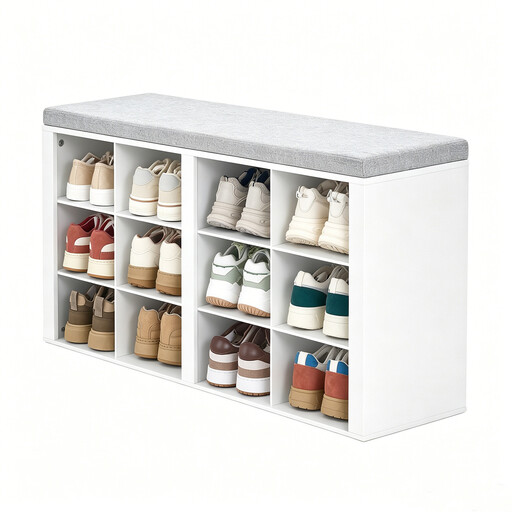
Why we chose it: Ideal for a busy family entryway. This shoe bench combines a comfortable seat for putting on shoes with generous storage. It centralises everything in one place, simplifying the morning routine.
It avoids the misleading capacity pitfall with its height-adjustable shelves, which can accommodate everything from ankle boots to kids' trainers. Its sturdy frame supports up to 150 kg, thus overcoming the issue of flimsy construction.
The dual-function seating/storage and the removable cushion cover for easy cleaning make it an extremely practical solution for daily use.
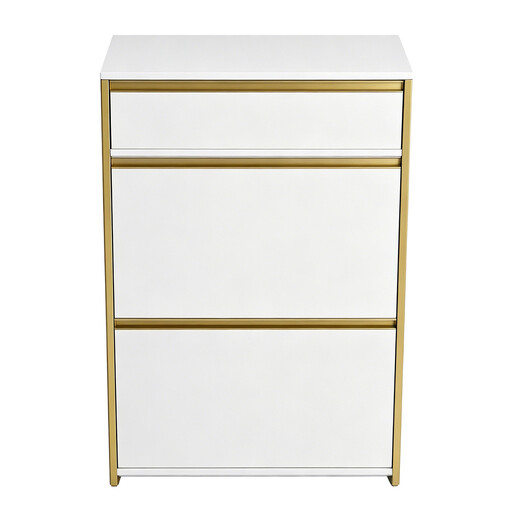
Why we chose it: Designed for entryways or hallways where every centimetre counts. Its shallow depth (24 cm) allows it to be installed without obstructing the walkway, while still offering considerable storage capacity.
It overcomes the lack of versatility pitfall: its internal shelves are adjustable and removable, and it includes a drawer and a top shelf. This isn't just a shoe cabinet; it's a complete entryway organiser.
Its white and gold design adds a decorative touch, transforming a purely functional item into a stylish element for your home.
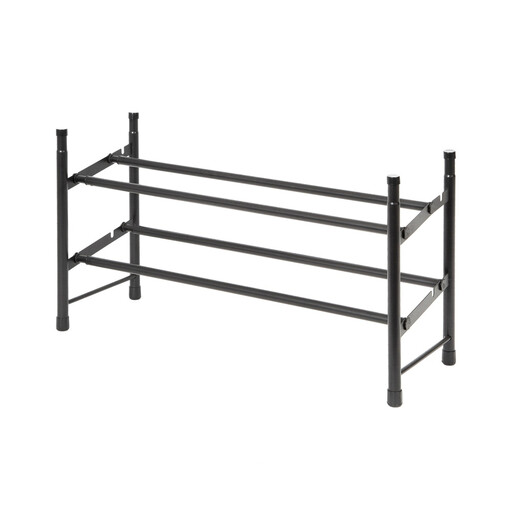
Why we chose it: Perfect for those whose storage needs are always changing. Whether you live in a studio or a house, this rack adjusts in width (from 62 to 117 cm) to fit your space and your collection perfectly.
It's the antithesis of a rigid, inflexible unit. Its extendable design and the ability to stack it with other units (sold separately) offer maximum modularity. Its coated metal frame is both sturdy and durable.
No assembly required. It's ready to use out of the box and adapts instantly, making it a simple, scalable solution for wardrobes, entryways, or utility rooms.
We have selected a full range of products that meet our quality criteria and current safety standards.
For a closed cabinet or wardrobe, ventilation is key. Make sure the model has openings at the back. Always let your shoes air-dry completely before putting them away. You can also place bamboo charcoal or lavender sachets inside to absorb moisture and neutralise odours.
In a tight space, every centimetre is precious. A cabinet with a depth of 24 to 25 cm is often sufficient. These models, known as "tilt-out" cabinets, store shoes at an angle, optimising space. Always check that the compartment height is compatible with your ankle boots or high-top shoes.
Yes, as long as you choose a quality model. Check the maximum weight capacity of the seat, which should be clearly stated by the manufacturer. A capacity of 120 to 150 kg is a good indicator of sturdiness, ensuring it can be safely used by adults on a daily basis. Models made from high-density particleboard or solid wood are generally very reliable.