
Livraison le jour même ou le lendemain

Qualité garantie

Débloquez vos offres de bienvenue: Livraison GRATUITE | Jusqu'à -80 % | 30 jours d'essai gratuits à JoyPlus
Téléchargez l'application
A cluttered hallway quickly looks untidy, especially when shoes pile up in a household that owns between 12 and 25 pairs. A white shoe cabinet can make the space feel larger while hiding your shoes away – provided you choose a model that fits the available space, the volume you need to store and your daily habits.
Before you order, three common mistakes keep cropping up:
Measure the width, height and depth you have available, allowing enough room to open the doors or drawers. In a hallway or corridor, a depth of around 24 to 25 cm can keep the walkway clear, but always check the internal dimensions.
A cabinet that is 105 cm wide will suit a clear wall, while a 60 cm model will fit more easily into a small hallway. Don't forget about skirting boards – they can stop the cabinet from sitting flush against the wall.
To store around twenty pairs, go for a cabinet with several tiers and well-spaced compartments. Doors protect your shoes from dust and instantly give the hallway a tidier look. Adjustable or removable shelves let you alternate between trainers, low shoes and ankle boots without being stuck with a fixed layout.
A 5-tier shoe cabinet generally offers a more generous capacity. A model with a drawer also gives you a dedicated space for laces, insoles, keys or other small hallway accessories. Just check that the drawer doesn't take up too much of the shoe storage volume.
MDF and particle board are very common in this category. Where the information is available, compare the thickness of the panels and check for metal hinges, stable feet and an anti-tip device.
For a shoe cabinet destined for the hallway, wall fixing is especially recommended if it is tall or installed in a walkway. Follow the assembly instructions carefully and use wall plugs suitable for your wall type. Any mention of compliance with a standard or safety requirement should be verifiable in the product listing or the supplied documentation.
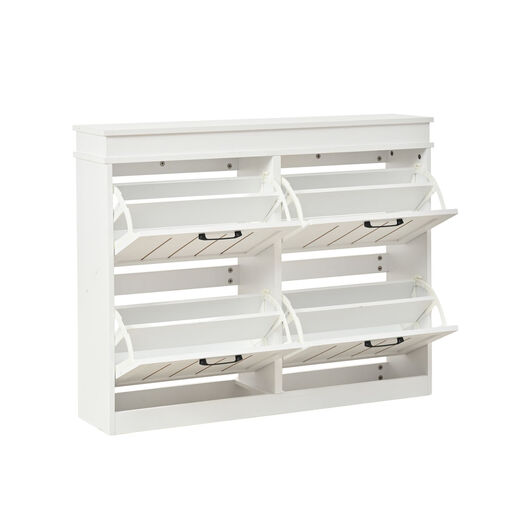
Why this choice suits this profile: Its 4 hinged doors and 8 compartments are ideal for a first hallway set-up or for a household looking for closed storage without a deep cabinet.
At just 24 cm deep, it takes up minimal floor space. The removable dividers let you adapt the compartments to what you're storing, rather than being stuck with a fixed layout.
MDF construction, 8 compartments, flat top surface and contrasting black handles.
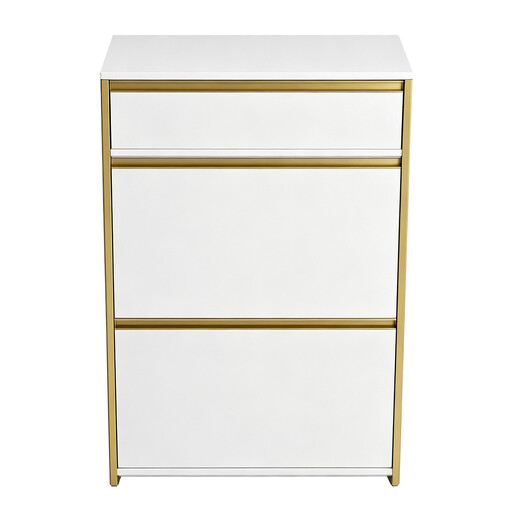
Why this choice suits this profile: Its white and gold finish complements modern, Scandinavian or minimalist décor. The drawer and top surface offer practical space for storing or displaying small items.
The internal shelves are adjustable and removable. The supplied anti-tip device adds stability to a tall cabinet installed in the hallway.
Dimensions 60.5 x 24.5 x 105 cm, stated capacity up to 12 pairs, drawer and adjustable shelves.
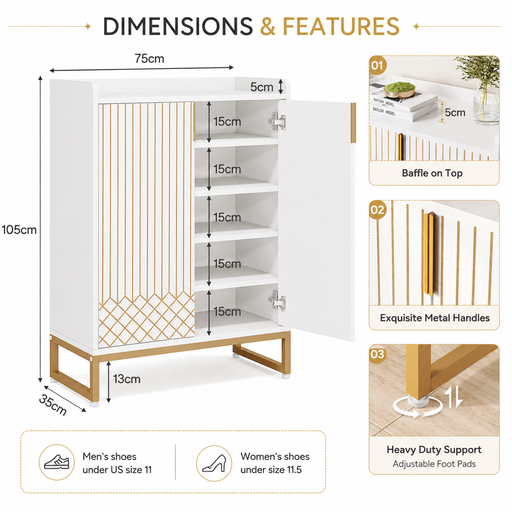
Why this choice suits this profile: This model is aimed at households with a large collection, with a stated capacity of 22 to 25 pairs and closed storage for the hallway, dressing room or bedroom.
The doors hide your shoes away and the metal hinges are designed to withstand regular use. However, the stated capacity should be weighed against your shoe sizes and any bulky footwear.
5 tiers, closed storage, open bottom shelf and top surface for placing a few decorative items.
Before you start assembling, sort your shoes by how often you wear them. Keep the pairs you wear every day at hand height and reserve the upper tiers for shoes you wear less often. In a multi-functional storage cabinet, make sure the drawer and top surface stay accessible so they don't become dumping grounds for clutter.
Install the cabinet on a level floor, check the door alignment and tighten the screws after a few days of use. Avoid filling the compartments to the brim – overloading can make the doors difficult to close and put extra strain on the hinges. Clean the surfaces with a soft, slightly damp cloth and dry them quickly. Wood-based panels must be kept away from prolonged moisture.
We've put together a comprehensive, real-time updated list of products that fully meet these strict selection criteria and European safety regulations.
A depth of 24 to 25 cm can work in a narrow passage, but always check the usable depth inside. High-top shoes, thick soles and larger sizes may need more room. Also measure the distance between the cabinet, any doors and the walkway areas.
The capacity depends on the number of tiers, the width of the compartments and the type of shoes. Some models claim 12 pairs, while others promise 22 to 25. These figures are only a guide – compare them with your own collection and leave a little extra room so you can store your shoes without forcing them in.
No. Regular dusting and gentle cleaning are usually enough. Wipe off marks quickly and avoid letting water sit on the panels. To keep the cabinet in good condition, let your shoes air out before storing them and don't put wet shoes directly into the compartments.